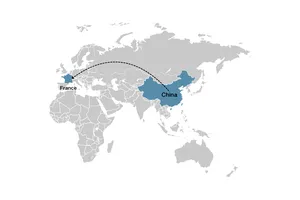
Are you wondering how much it costs to ship a 20ft or 40ft container from China to France? Understanding the real expenses and potential fees is crucial for any business or importer. In this comprehensive guide, we’ll break down the key factors influencing container shipping costs, discuss important ports, import taxes, and share actionable tips to help you save money when shipping from China to France.
Key Ports for China to France Container Shipping
When shipping containers from China to France, choosing the right ports is crucial for optimizing transit time, cost, and logistics efficiency. Both countries feature several prominent seaports that handle high volumes of international freight. Understanding these ports helps importers, exporters, and supply chain managers plan their shipments effectively.
Main Chinese Ports for Exports to France
-
Shanghai Port
The largest and busiest container port in the world, Shanghai Port is a key hub for exports to Europe, including France. Its advanced facilities and frequent vessel departures make it ideal for both 20ft and 40ft container shipments. -
Shenzhen Port
Located in southern China, Shenzhen Port is renowned for efficient customs clearance and strong connectivity to manufacturing centers in Guangdong province. It is a preferred choice for electronics, textiles, and consumer goods headed to France. -
Ningbo-Zhoushan Port
With high cargo throughput and cutting-edge logistics infrastructure, Ningbo-Zhoushan Port is well-equipped for large-scale shipments, offering competitive freight rates to European destinations. -
Qingdao Port
This northern Chinese port is strategic for shipments originating from Shandong and surrounding regions, with regular sailings to French ports. -
Guangzhou Port
A major gateway for southern China’s manufacturing exports, Guangzhou Port serves as a viable option for both FCL (Full Container Load) and LCL (Less than Container Load) shipping.
Major French Ports for Receiving Containers from China
-
Port of Le Havre
The largest container port in France, Le Havre serves as the primary entry point for Asian imports. Its proximity to Paris and extensive inland connections make it highly efficient for distribution across France and neighboring countries. -
Port of Fos-sur-Mer
Situated near Marseille in southern France, Fos-sur-Mer handles a significant share of imports, especially for companies based in southern and eastern France. -
Port of Dunkirk
Well-connected to the Benelux region and northern France, Dunkirk is an alternative gateway for container shipments, particularly for industrial and bulk goods.
Typical Shipping Routes and Transit Time
Most containerized cargo from China to France follows this maritime route:
Chinese Port → South China Sea → Indian Ocean → Suez Canal → Mediterranean Sea → French Port
Average transit time: 25–35 days, depending on the specific ports, vessel schedule, and shipping line.
Comparative Table: Key Ports and Transit Times
| Chinese Port | French Port | Average Transit Time (Days) | Remarks |
|---|---|---|---|
| Shanghai | Le Havre | 28–33 | Most popular route, frequent sailings |
| Shenzhen | Fos-sur-Mer | 25–30 | Good for southern France distribution |
| Ningbo-Zhoushan | Le Havre | 27–32 | Reliable for high-volume shipments |
| Qingdao | Le Havre/Dunkirk | 30–35 | Preferred for northern France deliveries |
| Guangzhou | Fos-sur-Mer | 28–33 | Convenient for multi-modal connections |
Note: Actual transit times may vary due to port congestion, vessel availability, and weather conditions.
As a highly professional freight forwarder, DTFU International Logistics Co.,Ltd leverages strong partnerships with leading shipping lines and port operators to offer tailored solutions for container shipping between China and France, ensuring timely and cost-effective deliveries.
20 ft container shipping cost from China to France
The cost of shipping a 20ft container from China to France is influenced by multiple factors, including port pair, shipping line, market demand, fuel surcharges, and seasonal fluctuations. Below, I provide a detailed analysis based on industry data and recent market developments.
Related reading: If you are interested in similar cost structures for other European markets, see the comprehensive overview of 20ft & 40ft Container Cost from China to Kosovo.
Factors Affecting 20ft Container Shipping Cost
-
Origin and Destination Ports
Major port pairs with higher vessel frequency (e.g., Shanghai–Le Havre) tend to offer more competitive rates. -
Shipping Season
Peak seasons (pre-Chinese New Year, summer, and pre-Christmas) often see higher rates due to increased demand. -
Container Type
Standard 20ft containers (20'GP) are suitable for cargo up to 28CBM, offering an economical choice for moderate-volume shipments. -
Service Type
Options range from basic port-to-port to comprehensive door-to-door, with additional costs for customs clearance, warehousing, and insurance. -
Market Conditions
Global events, such as the Red Sea crisis in Q4 2025 and ongoing logistics disruptions, have caused spot rate volatility.
Typical 20ft Container Freight Rates (2025 Q4)
| Origin Port (China) | Destination Port (France) | Port-to-Port Base Rate (USD) | Average All-in Cost (USD) | Transit Time (Days) |
|---|---|---|---|---|
| Shanghai | Le Havre | $2,200–$2,800 | $2,800–$3,500 | 28–33 |
| Shenzhen | Fos-sur-Mer | $2,100–$2,600 | $2,700–$3,300 | 25–30 |
| Ningbo-Zhoushan | Le Havre | $2,300–$2,900 | $2,900–$3,600 | 27–32 |
| Guangzhou | Fos-sur-Mer | $2,200–$2,700 | $2,800–$3,400 | 28–33 |
All-in cost includes basic ocean freight, BAF (Bunker Adjustment Factor), documentation fee, security charges, and local handling, but excludes customs duties, inland transportation, and insurance.
Additional Cost Considerations
- Inland Haulage (if door-to-door is required): $300–$800 depending on final destination in France.
- Customs Clearance: Typically $100–$300 per shipment.
- Insurance: Highly recommended, ranging from 0.1% to 0.3% of cargo value.
How to Get the Best Rates
- Book early and avoid peak season congestion.
- Consolidate shipments where possible to maximize container utilization.
- Work with a trusted freight forwarder like DTFU International Logistics Co.,Ltd for access to competitive contracts and personalized service.
At DTFU International Logistics Co.,Ltd, we offer end-to-end international shipping solutions, including sea freight, customs clearance, warehouse, cargo insurance, and door-to-door delivery. Our extensive experience with China–France trade lanes ensures timely, secure, and cost-effective container shipping for both SMEs and large enterprises.
40 ft container shipping cost from China to France
When considering international freight, the cost of shipping a 40 ft container from China to France is influenced by multiple factors, including port pair, shipping mode (FCL vs LCL), seasonal demand, fuel surcharges, and global logistics trends. Recent market changes—such as disruptions in the Red Sea or port congestion at major European gateways—can also affect rates. As a Senior Logistics Analyst, I recommend regularly checking for updated rates to ensure budgeting accuracy.
See also: For comparison with another major European route, check the latest Shipping Cost from China to Germany to understand trends and rate benchmarks in neighboring markets.
Key Factors Affecting 40ft Container Costs
- Origin and Destination Ports: Costs differ between routes (e.g., Shanghai to Le Havre vs Shenzhen to Marseille).
- Container Type: Standard 40ft (capacity: 56 CBM) vs high cube 40HQ (capacity: 68 CBM).
- Shipping Line and Service Level: Faster transit, premium services, or guaranteed space can increase rates.
- Seasonality: Peak periods (pre-Christmas, Chinese New Year) often see price surges.
- Surcharges: BAF (Bunker Adjustment Factor), GRI (General Rate Increase), and congestion fees may apply.
Estimated 40ft Container Rates (2025)
Below is a reference table of estimated ocean freight rates for a standard 40ft container from major Chinese ports to key French ports (as of Q4 2025). These rates exclude local charges, customs fees, and additional surcharges:
| Origin Port | Destination Port | 40ft FCL Base Ocean Freight (USD) | Transit Time (Days) |
|---|---|---|---|
| Shanghai | Le Havre | $3,200 – $3,800 | 28–35 |
| Shenzhen | Marseille | $3,400 – $4,000 | 30–36 |
| Ningbo | Dunkirk | $3,350 – $3,900 | 29–37 |
| Qingdao | Fos-sur-Mer | $3,450 – $4,200 | 32–38 |
Note: These rates are for FCL (Full Container Load). They are indicative and fluctuate based on real-time market conditions, fuel price adjustments, and global shipping events.
Additional Considerations
- Inland Haulage: Transportation from origin factory to port and from destination port to warehouse is billed separately.
- Customs Clearance: Fees for customs clearance at both ends are not included in base freight.
- Insurance: Cargo insurance is highly recommended; DTFU International Logistics can provide comprehensive insurance solutions.
Import Tax and Duty about Goods Exported from China to France
When importing goods from China to France, understanding the regulatory and tax framework is crucial for cost control and compliance. France is part of the European Union (EU), and its import regulations strictly follow the EU Customs Union rules.
For deeper insight on customs costs and procedures across the EU, refer to our analysis of Shipping Cost from China to Belgium, a neighboring country sharing similar EU import requirements.
Main Types of Import Charges
-
Customs Duties
- Calculated based on the HS Code (Harmonized System Code), product description, and declared value (CIF: Cost, Insurance, and Freight).
- The EU Common External Tariff applies. For most industrial goods, duty rates range from 0% to 12%. Some products (e.g., textiles, electronics) have specific rates.
-
Value Added Tax (VAT)
- France charges VAT on all imported goods.
- Standard VAT rate: 20% (as of 2025). Reduced rates (5.5%, 10%) may apply for specific products.
- VAT is calculated on the sum of CIF value + duty + any other applicable taxes.
-
Additional Taxes or Levies
- Anti-dumping duties or excise taxes may apply to specific goods (steel, chemical products, certain electronics, etc.).
- Environmental taxes or product-specific compliance fees may be levied.
Calculation Example
Suppose you import goods with a CIF value of $10,000 and a customs duty rate of 6%. Here’s a simplified calculation:
| Item | Calculation | Amount (USD) |
|---|---|---|
| CIF Value | $10,000 | |
| Customs Duty | $10,000 x 6% | $600 |
| Subtotal | $10,000 + $600 | $10,600 |
| VAT (20%) | $10,600 x 20% | $2,120 |
| Total Payable | $12,720 |
Tip: Always confirm the latest duty rates using the EU TARIC database or consult with your customs broker. DTFU International Logistics provides one-stop customs clearance in both China and France to ensure accurate compliance.
Key Compliance Requirements
- Ensure correct HS Code classification to avoid penalties.
- Prepare the required documentation: Commercial Invoice, Packing List, Bill of Lading, Certificate of Origin, and any product licenses.
- For certain goods (food, cosmetics, electronics), additional certifications or standards may be required for clearance in France.
Recent Policy Updates
- CBAM (Carbon Border Adjustment Mechanism): Starting from 2023, the EU is phasing in a carbon tax on imported products with high carbon footprints (steel, cement, aluminum, etc.). Importers should assess if their goods are subject to CBAM reporting or charges.
- EORI Number: Importers must have a valid EORI (Economic Operators Registration and Identification) number for customs processes within the EU.
How DTFU International Logistics Can Help
Our expert team is well-versed in the intricacies of EU and French customs regulations. We offer:
- Accurate duty and tax calculation support.
- Comprehensive customs documentation preparation.
- One-stop customs clearance for seamless delivery.
- Real-time regulatory updates to help you avoid compliance pitfalls.
By partnering with DTFU International Logistics Co.,Ltd, you’ll minimize import risks and control your landed costs effectively.
Other Additional Charges
When shipping a 20ft or 40ft container from China to France, the base freight rate is just part of the total cost. There are several other additional charges and surcharges that can significantly affect your overall shipping budget. Understanding these fees is vital for accurate cost calculation and avoiding unexpected expenses.
Common Additional Charges in China-France Container Shipping
| Charge Type | Description | Typical Range (USD) | Who Pays |
|---|---|---|---|
| Bill of Lading (B/L) Fee | Administrative fee for issuing shipping documents | $30–$80 per B/L | Shipper/Consignee |
| Terminal Handling Charge (THC) | Covers loading/unloading at ports in China and France | $150–$300 per container | Shipper (origin), Consignee (destination) |
| Port Security Charge | Covers port security measures and administration | $10–$30 per container | Shipper/Consignee |
| Customs Clearance Fee | Charged by agents for handling customs formalities | $50–$150 per shipment | Shipper/Consignee |
| Import VAT & Duties | Taxes levied by French Customs based on cargo value and classification | Varies (see Import Tax section) | Consignee |
| ISPS Surcharge | International Ship and Port Facility Security fee | $10–$15 per container | Shipper/Consignee |
| Documentation Fee | Handling documents for customs, compliance, and transportation | $30–$60 per container | Shipper/Consignee |
| Demurrage & Detention Charges | Penalties for exceeding free container usage time at port or outside the terminal | $50–$150 per day (variable) | Shipper/Consignee |
| Cargo Insurance | Optional, but highly recommended to protect goods in transit | 0.15%–0.5% of cargo value | Shipper/Consignee |
| Delivery Order Fee | Charged at the destination for releasing goods | $50–$100 per shipment | Consignee |
| Pre-carriage/On-carriage | Inland trucking/rail between factory and port, or port and final destination | $100–$1000+ depending distance | Shipper (origin), Consignee (destination) |
| Fuel Surcharge (BAF) | Adjustment for fuel price fluctuations | Varies – check latest rates | Shipper/Consignee |
| Peak Season Surcharge (PSS) | Temporary increase during high-demand periods (e.g., August–October) | $100–$500 per container | Shipper/Consignee |
| Congestion Surcharge | Applied during port congestion or strikes at major French Ports (e.g., Le Havre, Marseille) | $50–$150 per container | Shipper/Consignee |
Notes:
- Actual costs vary by shipping line, route, season, and cargo type.
- Always ask for a comprehensive quotation from your freight forwarder.
- Some charges are negotiable depending on shipping volume and contract terms.
DTFU International Logistics Co.,Ltd provides clear, all-inclusive quotations to ensure our clients have full visibility over shipping costs. We recommend working with experienced freight forwarders to minimize unnecessary charges and optimize your logistics budget.
Step-by-Step Container Shipping Process
Shipping a 20ft or 40ft container from China to France involves multiple stages, each critical for a smooth and compliant transportation process. Below is a detailed, step-by-step breakdown to help importers, exporters, and supply chain professionals understand what to expect.
1. Cargo Preparation & Packing
- Select container type: Choose between 20ft, 40ft, 40HQ, or 45HQ containers based on cargo volume (see capacity info).
- Pack goods securely: Ensure compliance with international shipping standards and French import regulations.
- Label and document: Prepare commercial invoices, packing lists, and all required export documents.
2. Inland Transportation to Port of Loading (China)
- Arrange domestic trucking or rail: Move cargo from the factory or warehouse to a key Chinese port (e.g., Shanghai, Shenzhen, Ningbo).
- Pre-carriage coordination: Schedule timely pickup to meet vessel cutoff times.
3. Customs Clearance (China)
- Submit export declaration: File paperwork with Chinese Customs.
- Inspection: Some goods may be subject to inspection; delays can occur if documentation is incomplete.
4. Container Stuffing & Sealing
- Load cargo: Either at shipper’s premises (FCL) or at port’s container freight station (CFS for LCL).
- Seal container: Apply customs-approved seals to prevent tampering.
5. Port Handling & Loading on Vessel
- Terminal Handling Charges (THC): Pay applicable fees.
- Load onto vessel: Container is transferred onto the ocean carrier.
6. Ocean Freight Transportation
- Sailing from China to France: Typical transit time ranges from 25 to 35 days depending on port of origin/destination and shipping line.
- Tracking: Monitor shipment status via online tracking systems.
7. Arrival at French Port (e.g., Le Havre, Marseille)
- Discharge container: Offload from vessel at destination port.
- Port Handling: Pay necessary arrival port fees.
8. Customs Clearance (France)
- Submit import documentation: Provide bill of lading, commercial invoice, packing list, and other required documents to French Customs.
- Pay import taxes and duties: As per French and EU regulations.
9. Inland Transportation to Final Destination
- Arrange domestic transport: Truck or rail delivery from port to consignee’s warehouse, retailer, or Amazon FBA location (DTFU offers such services).
- Unloading and return of empty container: Return empty containers within the allowed free time to avoid detention fees.
Tips for a Smooth Shipping Experience
- Work with a reliable freight forwarder such as DTFU International Logistics Co.,Ltd who offers end-to-end support, from cargo preparation to final delivery.
- Prepare documents in advance and double-check for accuracy to avoid customs delays.
- Consider cargo insurance to protect against loss or damage in transit.
- Monitor key deadlines for stuffing, port entry, and pickup to avoid extra charges.
By following these steps, businesses can ensure a transparent, efficient, and cost-effective shipping process for 20ft & 40ft containers from China to France. For tailored logistics solutions and up-to-date shipping rates, contact DTFU International Logistics Co.,Ltd—your trusted partner for international freight forwarding.
How to Reduce Container Shipping Costs from China to France
As an experienced logistics analyst, I understand that controlling container shipping costs is crucial for businesses aiming to maximize profits and remain competitive in global trade. When shipping a 20ft or 40ft container from China to France, several practical strategies can help you reduce overall freight expenses without compromising on reliability or transit time. Below, I detail proven methods and actionable tips, underpinned by the latest industry insights.
You might also be interested in: Shipping Cost from China to France, which covers further analysis on price trends and logistics best practices for the China–France trade lane.
1. Choose the Optimal Shipping Route and Port Pair
Selecting the right combination of origin and destination ports can lead to significant cost differences due to variable port charges, congestion surcharges, and local handling fees. For example, shipping to Le Havre (the largest container port in France) might be more cost-effective compared to Marseille for certain cargo flows.
| Origin Port (China) | Destination Port (France) | Typical Transit Time (Days) | Cost Differential* |
|---|---|---|---|
| Shanghai | Le Havre | 27-32 | Standard |
| Shenzhen | Marseille | 28-34 | +3-8% |
| Ningbo | Le Havre | 27-31 | Standard |
*Cost differential is based on current 2025 rate benchmarks from major carriers. Actual rates may fluctuate due to market conditions.
2. Plan Ahead and Book Early
Ocean freight rates are highly dynamic. Booking your 20ft or 40ft container well in advance helps lock in lower rates, especially during peak seasons (e.g., pre-Christmas, Chinese New Year). Advance planning also allows for more favorable vessel schedules and reduces the risk of premium surcharges.
3. Consolidate Shipments
If your cargo volume does not fill a full container, consider LCL (Less than Container Load) or group shipments with reliable partners to fill a 20ft or 40ft container. This reduces per-unit shipping costs and minimizes underutilized space.
4. Optimize Packaging and Container Utilization
Maximize the use of container capacity (20ft = 28CBM, 40ft = 56CBM, 40HQ = 68CBM) by optimizing packaging dimensions and using space-saving materials. Efficient container stuffing minimizes the cost per cubic meter and avoids unnecessary shipments.
5. Negotiate with Multiple Freight Forwarders
Always request quotes from several freight forwarders and compare the full breakdown of charges—including base freight, bunker adjustment factors, security fees, and destination charges. Consider working with a reputable, integrated logistics provider like DTFU International Logistics Co.,Ltd, which offers competitive rates and a transparent cost structure.
6. Select the Appropriate Service Level
For non-urgent shipments, choosing standard FCL (Full Container Load) sea freight over express services significantly cuts costs. If time is sensitive, but budget is limited, explore multimodal options (e.g., sea-rail or sea-road combinations).
7. Take Advantage of Freight Market Trends
Monitor freight indexes and shipping news for seasonal trends, policy shifts (such as IMO 2020 fuel surcharges), and capacity changes. In 2025, for example, fluctuating demand and geopolitical events (like the Red Sea crisis) have a direct impact on shipping rates and routing.
8. Utilize a One-Stop Logistics Provider
Working with a one-stop service provider like DTFU International Logistics Co.,Ltd ensures integrated solutions: sea, air, and road freight, warehousing, customs brokerage, insurance, and door-to-door delivery. Bundling services often leads to volume discounts and streamlined coordination, reducing administrative overhead and the risk of hidden costs.
9. Take Full Advantage of Cargo Insurance and Value-Added Services
While insurance is an additional cost, it protects you from losses that could far exceed the premium—especially for long-haul, high-value shipments. Providers like DTFU International Logistics Co.,Ltd offer tailored cargo insurance and value-added services designed to mitigate unforeseen risks and ultimately reduce your total landed cost.
FAQs
Q1: What is the current cost to ship a 20ft or 40ft container from China to France in 2025?
A: As of Q4 2025, the average market rate for ocean freight (excluding local charges and surcharges) is approximately USD 2,200–3,200 for a 20ft container and USD 3,800–5,200 for a 40ft container from major Chinese ports (e.g., Shanghai, Shenzhen) to major French ports (Le Havre, Marseille). Please note that rates are subject to change due to market demand, fuel costs, and global events.
Q2: Which are the main ports in China and France for container shipping?
A: In China, the main ports are Shanghai, Shenzhen, Ningbo, and Qingdao. In France, the leading ports are Le Havre (the primary gateway for container freight) and Marseille (serving southern France and the Mediterranean).
Q3: How long does it take to ship a container from China to France?
A: Typical ocean transit times range from 27 to 34 days, depending on the specific ports, carrier schedules, and whether the sailing is direct or involves transshipment.
Q4: What is the difference between 40ft and 40HQ containers?
A: A 40ft standard container has a capacity of 56CBM, while a 40HQ (High Cube) provides increased capacity at 68CBM, offering better efficiency for larger or lighter cargo.