If you're importing goods from China to Angola, you've probably already discovered that the cost of shipping a container from China to Angola isn't a single number — it's a stack of charges spread across two countries, three currencies, and at least four different service providers. In 2026, you'll pay roughly $2,500–$3,500 for a 20ft container and $3,500–$5,500 for a 40ft container in base ocean freight alone. But the total landed cost — the number that actually matters to your business — typically runs 50–80% higher once you add origin charges, surcharges, CNCA certification, Angolan customs duties, IVA, and last-mile delivery.
This guide breaks down every fee you'll face when shipping a container from China to Angola. No ranges pulled from a generic freight calculator — just line-by-line numbers based on real shipments we've handled on this route. We'll walk through current 2026 rates by port, a four-phase cost breakdown no compe***** publishes, and two detailed landed-cost scenarios you can benchmark your own shipment against.
2026 Container Shipping Rates: Current Prices by Port & Container Size
Rates on the China–Angola route have been volatile through 2025 and into 2026, driven by carrier surcharge rounds and persistent congestion at Luanda. Here are the current ranges as of mid-2026.
FCL Rates by Port Pair (USD)
| Origin Port | Destination | 20ft | 40ft / HQ |
|---|---|---|---|
| Shanghai | Luanda | $2,550 – $3,450 | $3,650 – $5,350 |
| Shanghai | Lobito | $2,550 – $3,350 | $3,800 – $5,500 |
| Shenzhen (Yantian / Shekou) | Luanda | $2,550 – $3,450 | $3,800 – $5,500 |
| Shenzhen | Lobito | $2,600 – $3,500 | $3,750 – $5,450 |
| Ningbo-Zhoushan | Luanda | $2,550 – $3,500 | $3,850 – $5,550 |
| Ningbo | Lobito | $2,500 – $3,400 | $3,850 – $5,650 |
| Qingdao | Luanda | $2,600 – $3,500 | $3,700 – $5,500 |
| Qingdao | Lobito | $2,550 – $3,450 | $3,950 – $5,250 |
| Guangzhou (Nansha) | Luanda | $2,600 – $3,450 | $3,750 – $5,350 |
LCL (Less than Container Load): $95–$250 per CBM, depending on whether your cargo is charged by volume (light goods) or weight (dense goods). For shipments above roughly 15 CBM, FCL is almost always cheaper than LCL on a per-unit basis.
Carrier Surcharges (2025–2026)
These are applied on top of base freight and change frequently:
| Carrier | Surcharge Type | Amount | Effective |
|---|---|---|---|
| Maersk | Peak Season Surcharge (PSS) | $1,000 / 20ft, $2,000 / 40ft | June 2025 |
| CMA CGM | PSS (multiple rounds) | $75 – $150 / TEU | Apr–Nov 2025 |
| Hapag-Lloyd | PSS | $800 / TEU | June 2025 |
| Hapag-Lloyd | GRI | $300 / container | March 2025 |
| Maersk | Operational Cost Import (OCI) | $70 / 20ft, $90 / 40ft | April 2025 |
These surcharges shift constantly — CMA CGM Raises PSS on Far East–West Africa Lane is just one example of the carrier adjustments we track for clients on this route. For the most current Sea Shipping cost from China to Angola, always request a live breakdown from your forwarder rather than relying on static rate sheets.
Why do rates vary so much? Five factors determine your actual freight cost: the specific carrier and service (direct vs. transshipment), the season (rates spike 10–15% during August–October and pre-Chinese New Year), your container type, cargo classification, and whether you're booking spot or under contract. The low end of each range reflects off-peak contract rates; the high end reflects peak-season spot bookings.
Transit Times
| Service Type | Transit Time |
|---|---|
| Direct (Maersk, MSC) | 28 – 35 days |
| Transshipment (COSCO, etc.) | 40 – 55 days |
| LCL consolidation | 43 – 50 days |
Every Fee Explained: The Complete 4-Phase Cost Breakdown
This is the section no compe***** publishes. Here's every line item you'll encounter when shipping a container from China to Angola, organized from the factory floor to your warehouse.
Phase 1: Origin Charges (China Side)
| Fee | Typical Cost (USD) | Notes |
|---|---|---|
| Inland trucking (factory → port) | $150 – $400 | Depends on distance; Foshan → Nansha runs ~$220, while inland from Chengdu can hit $600+ |
| Terminal Handling Charge (THC) | $80 – $125 / container | Paid to the terminal operator at origin |
| Export customs declaration | $50 – $80 | Your freight forwarder handles this |
| Documentation fee | $30 – $60 | Bill of Lading issuance |
| VGM (Verified Gross Mass) filing | $15 – $30 | Mandatory SOLAS requirement |
| ENS (Entry Summary Declaration) | $25 – $35 | Security filing |
Phase 2: Ocean Freight & Surcharges
| Fee | Typical Cost (USD) | Notes |
|---|---|---|
| Base ocean freight | See rate table above | The largest single line item |
| Bunker Adjustment Factor (BAF) | Varies quarterly | Fuel cost pass-through |
| Peak Season Surcharge (PSS) | See carrier table | Multiple rounds possible per year |
| General Rate Increase (GRI) | $300 – $500 / container | Carrier-initiated rate adjustments |
| Low sulphur surcharge | ~$20 – $40 | IMO 2020 compliance |
Phase 3: Destination Charges (Angola Side)
This is where most first-time importers get surprised. Angola's destination charges are higher than many other African ports due to congestion and procedural complexity.
| Fee | Typical Cost (USD) | Notes |
|---|---|---|
| Destination THC | $150 – $250 | Port of Luanda terminal handling |
| Bill of Lading release fee | $50 – $100 | Required to take possession of cargo |
| Customs brokerage | $200 – $500 | Your local clearing agent's fee |
| CNCA certificate | $150 – $300 | Mandatory — see Section 5 for details |
| Import duty (Direitos Aduaneiros) | 2% – 50% of CIF value | Varies by HS Code and product category |
| IVA (VAT) | 14% | Applied on CIF value + import duty |
| Customs service fee + statistical tax | ~2.5% combined | Standard across all imports |
| Customs inspection (if selected) | $150 – $400 | Random or targeted inspections |
| Demurrage & Detention | $50 – $150 / day | After free period (7–14 days at Luanda) |
Phase 4: Last-Mile Delivery
| Fee | Typical Cost (USD) | Notes |
|---|---|---|
| Trucking (port → warehouse) | $300 – $800 | Depends on distance and container size |
| Unloading labor | $100 – $200 | Warehouse receiving |
Total landed cost benchmark: For a standard 20ft container of general cargo, expect to pay roughly 1.5× to 2× the base ocean freight rate in total logistics costs. If your ocean freight quote is $2,800, budget $4,500–$5,500 for the full door-to-port landed cost.
Choosing the Right Container: 20ft vs 40ft vs 40ft High Cube
20ft Container — Best for Dense Cargo
Internal dimensions: 5.9m × 2.35m × 2.39m (~33 CBM). Maximum payload: ~28 tons. This is your container if you're shipping ceramic tiles, stone, hardware, Shipping Heavy Machinery from China, auto parts, or bagged cement — anything where weight fills the container before volume does. In our experience, roughly 60% of construction-material shipments from China to Angola move in 20-footers for exactly this reason.
40ft Standard Container — The Volume Workhorse
Internal dimensions: 12.03m × 2.35m × 2.39m (~67 CBM). Maximum payload: ~26 tons. Best for furniture, textiles, plastic goods, and general merchandise — cargo that's light relative to its volume. A 40ft container's freight is typically only 1.4–1.6× the 20ft rate, meaning your per-CBM cost drops significantly.
40ft High Cube (HQ) — Maximum Volume
Internal dimensions: 12.03m × 2.35m × 2.69m (~76 CBM). The extra 30cm of height makes a real difference for bulky items like mattresses, large furniture, and solar panels. The rate premium over a standard 40ft is modest — usually $150–$300.
The LCL → FCL tipping point: Once your shipment exceeds ~15 CBM, FCL becomes cheaper per unit than LCL. Below that, LCL avoids paying for empty container space you don't need.
Which Chinese Port Should You Use?
If your supplier is in Guangdong or Fujian, ship from Shenzhen or Guangzhou (Nansha) — you'll save $100–$300 on inland trucking compared to routing through Shanghai. Suppliers in Zhejiang or Jiangsu should use Ningbo, which often has slightly better rates to West Africa than Shanghai. Northern suppliers (Shandong, Hebei) should use Qingdao. The inland trucking differential alone can swing your total cost by $200–$600.
Angola Destination Guide: Luanda vs Lobito, CNCA, and Customs Duties
Luanda vs Lobito: Which Port?
Luanda handles over 90% of Angola's containerized imports. It has the most frequent sailings from China and the largest pool of customs brokers. The trade-off: terminal utilization runs above 85% during peak periods (November–April, Angola's rainy season), which means berthing delays and a higher risk of demurrage. Free storage is typically 7–14 days, after which the meter runs at $50–$150 per day.
Lobito, Angola's second port, serves the central corridor (Benguela, Huambo, Bié). It's less congested and freight rates are typically $100–$300 cheaper than Luanda. If your end customer is in central or eastern Angola, Lobito saves you an additional $200–$400 on inland transport. The downside: fewer direct sailings and a smaller broker network, so clearance can take 1–2 days longer.
CNCA Certificate: Don't Ship Without It
The CNCA (Conselho Nacional de Carregadores de Angola) is Angola's mandatory cargo tracking note. Every shipment — FCL and LCL — requires one.
- Who handles it: Your freight forwarder applies on your behalf before the vessel departs China.
- Processing time: 2–4 working days (assuming your documents are consistent).
- Cost: $150–$300 per shipment.
- Documents required: Draft Bill of Lading, commercial invoice, packing list.
Here's what we've seen happen when importers skip this step: cargo arrives at Luanda, customs refuses clearance, and the container sits accruing demurrage at $100/day while you scramble to retroactively file. The CNCA penalty alone exceeds $5,000, before counting storage fees. We had a client last year who learned this the hard way on a 40ft shipment — one missed certificate cost him nearly $8,000 in combined fines and detention charges. His goods sat at the port for 19 days.
Angola Import Duties at a Glance
| Product Category | Estimated Duty Rate | IVA (VAT) |
|---|---|---|
| Construction materials (tiles, cement, steel) | 10% – 20% | 14% |
| Furniture | 20% – 30% | 14% |
| Electronics & appliances | 10% – 20% | 14% |
| Textiles & clothing | 20% – 35% | 14% |
| Machinery & equipment | 5% – 15% | 14% |
| General merchandise | 15% – 30% | 14% |
Duties are calculated on the CIF value (goods cost + freight + insurance). IVA is then applied on top of CIF + duty. On a shipment with CIF value of $15,000 and 20% duty, your tax bill alone would be $3,000 (duty) + $2,520 (IVA) = $5,520 — often the single largest cost after the goods themselves.
Required Documents for Angola Customs Clearance
- Original Bill of Lading or Telex Release
- Commercial Invoice
- Packing List
- Certificate of Origin
- CNCA Certificate
- Import License (required for specific regulated goods)
FCL vs LCL vs Door-to-Door: Which Service Gives You the Best Value?
| Service | Best For | Typical Volume | What's Included | What's NOT Included |
|---|---|---|---|---|
| FCL (Full Container Load) | Single supplier, large volume | >15 CBM | Container + ocean freight to destination port | Destination charges, duties, delivery |
| LCL (Less than Container Load) | Trial orders, small batches | <15 CBM | Shared container space to CFS at destination | CFS deconsolidation fee, longer transit |
| Door-to-Door DDP | First-time importers, hassle-free | Any | Pickup + freight + customs + duties + delivery | Nothing — it's all-in |
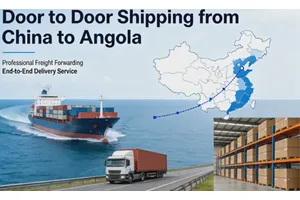
The FOB vs CIF vs DDP trade-off: When a Chinese supplier quotes CIF Luanda, they've bundled the ocean freight into the price — but expect them to add a 10–20% margin on the freight component. You'll also still need to handle everything at the Angolan side yourself. With FOB, you control the freight forwarder and the rate. For a deeper comparison, see our guide on DDP vs FOB: Which Option Saves Time and Reduces Hassle. With Door to Door Shipping from China to Angola, your forwarder handles everything door-to-door, including Angolan customs clearance and duty payment. For a 20ft container from China to Luanda, the DDP premium over CIF typically runs $1,500–$2,500 (covering destination charges, duties, and delivery), but it eliminates the risk of surprise costs at the port.
Two Real Shipments: What the Numbers Actually Look Like
These aren't hypothetical exercises. They're based on actual shipments we've handled, with client details anonymized.
Scenario 1: Ceramic Tiles — 20ft FCL, Foshan to Luanda
One of our regular clients — a construction materials distributor based in Luanda's Maianga district — ships ceramic floor tiles from a factory in Foshan's Chancheng district every 6–8 weeks. Chancheng is China's tile manufacturing hub, and many Angolan importers source from the same cluster of factories within a 10km radius. For a complete guide on handling construction cargo, see our article on Shipping Building Materials from China.
Shipment details: - Cargo: Glazed ceramic floor tiles (HS 6907.21), 28 tons, ~1,200 sqm - Container: 1 × 20ft GP - Origin: Factory near Foshan Chancheng → Guangzhou Nansha port (about 90 km) - Service: MSC direct, Nansha → Luanda - FOB Foshan value: $12,000
| Cost Item | Amount (USD) |
|---|---|
| Inland trucking (Foshan → Nansha) | $220 |
| Origin THC + customs declaration + docs | $190 |
| Base ocean freight (20ft) | $2,800 |
| BAF + PSS (Q3 2026 estimate) | $600 |
| Marine cargo insurance (0.3% — see shipping container insurance cost guide) | $36 |
| CNCA certificate | $200 |
| Destination THC + B/L release | $250 |
| Customs brokerage (Luanda) | $300 |
| Import duty (15% on CIF value of $14,856) | $2,228 |
| IVA — 14% on (CIF + duty) | $2,392 |
| Customs service fee + statistical tax | $371 |
| Trucking (port → Maianda warehouse) | $300 |
| Total Logistics & Duties | $9,887 |
| Total Landed Cost (FOB + logistics) | $21,887 |
A few things worth noting about this shipment. The container loading alone took a full day — when you're hand-stacking 28 tons of tile boxes, you don't rush it. One broken pallet at the bottom of the stack and you'll have crushed tiles throughout the column. The CNCA came back with a query because the commercial invoice listed "glazed porcelain floor tiles" while the packing list said "ceramic floor tiles." Angolan customs is particular about HS code consistency across documents. We caught the discrepancy before the vessel sailed and corrected it same-day — but that's exactly the kind of detail that causes a 5-day delay if you only discover it at the Luanda end.
Notice that duties and taxes alone ($4,991) accounted for roughly half of the total logistics cost. That's typical for Angola, and it's why underestimating the tax burden is the single most expensive mistake importers make on this route.
Scenario 2: General Merchandise — 5 CBM LCL, Guangzhou to Luanda
A small retail trader operating out of Luanda's Sambizanga market makes two or three buying trips to Guangzhou each year, usually right after the Canton Fair. On her most recent trip, she sourced a mixed load of plastic kitchenware, budget phone accessories, and household decorations — about 5 CBM and 3.5 tons total.
Shipment details: - Cargo: Mixed general merchandise (various HS codes), 5 CBM, 3.5 tons - Service: LCL consolidation, Guangzhou → Luanda (via Singapore transshipment) - CIF value: $5,500
| Cost Item | Amount (USD) |
|---|---|
| Pickup + delivery to CFS warehouse (Guangzhou) | $120 |
| Export customs + documentation | $100 |
| LCL sea freight (5 CBM × $140/CBM) | $700 |
| CNCA certificate | $200 |
| Destination CFS deconsolidation fee | $150 |
| Customs brokerage (Luanda) | $250 |
| Import duty (average ~20% on CIF of $5,500) | $1,100 |
| IVA — 14% on (CIF + duty) | $924 |
| Last-mile delivery (Sambizanga) | $130 |
| Total Logistics & Duties | $3,674 |
| Total Landed Cost (CIF + logistics) | $9,174 |
The CFS deconsolidation charge at Luanda caught her by surprise — it's the single most common unexpected cost we see with first-time LCL shippers to Angola. Because her cargo type was low-value and high-variety, the average duty rate ended up around 20%, but it took her broker several hours to correctly classify 14 different HS codes. With mixed LCL shipments, brokerage fees tend to run toward the higher end of the range for exactly this reason.
Would this have been cheaper as a 20ft FCL? No — at 5 CBM, she'd be paying for 28 CBM of empty space. Once her volume reaches about 12–15 CBM consistently, we'd recommend switching to FCL for a lower per-unit cost.
7 Ways to Reduce Your Container Shipping Costs to Angola
1. Book in the off-peak window (February–March). Rates on the China–Angola route dip 8–12% during this period. Avoid August–October and the weeks immediately before Chinese New Year, when space tightens and carriers apply peak surcharges.
2. Maximize container space utilization. Mixed loading — placing heavy goods at the bottom and lighter cargo on top — can increase effective payload by 10–15%. If you're sourcing from multiple suppliers in the same region, have them all deliver to your forwarder's consolidation warehouse and load into a single container there.
3. Match container type to cargo density. We see importers ship heavy tiles in 40-footers and lightweight furniture in 20-footers surprisingly often. Heavy + small = 20ft. Light + bulky = 40ft HQ. Get this wrong and you're paying for either wasted space or wasted payload capacity — either way, 15–30% more than you need to.
4. Consider transshipment if speed isn't critical. Transshipment via Singapore or Port Klang adds 10–15 days versus direct service but saves $300–$500 per container. For non-seasonal goods with predictable demand, this trade-off usually works in your favor.
5. Buy FOB and choose your own forwarder. When a Chinese factory quotes you CIF, they typically mark up the freight component by 15–25%. By negotiating FOB and engaging a freight forwarder directly, you control the rate and the service level.
6. File your CNCA before the vessel sails. This sounds obvious, but we still see containers arrive at Luanda without a valid CNCA at least once a month. The minimum penalty is $5,000, and your goods won't clear until it's resolved. The document costs $200 and takes three days. There's no excuse.
7. Work with a forwarder that has real Angola desk experience. A forwarder with an established Luanda agent relationship gets faster customs clearance, better demurrage terms, and advance notice of port congestion. Generalist forwarders selling Angola as "just another West Africa destination" don't have the local relationships to pull strings when a shipment goes sideways.
Frequently Asked Questions
How long does it take to ship a container from China to Angola? Direct sailings (Maersk, MSC) take 28–35 days port-to-port. Transshipment routes take 40–55 days. LCL consolidation adds roughly 5–7 days on both ends for cargo consolidation and deconsolidation.
What is the cheapest way to ship a container from China to Angola? Transshipment service + off-peak booking (February–March) + FOB terms with your own forwarder. This combination typically saves 15–25% versus peak-season direct service booked under supplier-arranged CIF terms.
Do I need a CNCA certificate for every shipment? Yes. Every FCL and LCL shipment to Angola requires a valid CNCA loading certificate filed before vessel departure. No exceptions.
Which Chinese port is cheapest for shipping to Angola? Ningbo and Guangzhou (Nansha) typically offer rates $100–$300 lower than Shanghai or Shenzhen. But your inland trucking cost from the factory matters more — always choose the nearest port to your supplier.
Can I track my container from China to Angola? Yes. Most major carriers provide online container tracking by B/L or container number. A good freight forwarder also provides milestone updates — vessel departure, transshipment arrival, ETA at Luanda/Lobito, customs clearance status, and delivery confirmation.
Is air freight an option for Angola? Yes — Air Shipping from China to Angola takes 3–10 days and works well for urgent or high-value shipments, though it costs 5–10× more than sea freight.
Do you handle shipments to other African countries? Yes. Beyond Angola, we provide full-service freight forwarding across the continent, including Shipping From China To Nigeria, Shipping From China To South Africa, and most other African destinations.
What happens if my container gets delayed at Luanda port? Luanda offers 7–14 free storage days depending on the carrier and your forwarder's agreement. After that, demurrage (terminal storage) and detention (container usage) run $50–$150 per day combined. During the November–April rainy season, berthing delays of 3–5 days are common, so factor this into your timeline.
Get a Transparent Quote for Your Angola Shipment
The cost of shipping a container from China to Angola is entirely knowable — you just need someone who will show you every line. For reliable, transparent Shipping From China to Angola, partner with a forwarder that knows this route inside and out. At DTFU Logistics, we're a FIATA and IATA-certified freight forwarder with over a decade of hands-on experience on the China–Angola route. We operate through both Luanda and Lobito, handle CNCA certification in-house, and provide every client with a transparent, line-by-line cost breakdown before you commit to anything.
Our Angola desk team works with Maersk, MSC, and CMA CGM under direct contracts — which means competitive rates and guaranteed space even during peak season. We also assign a dedicated account manager to every shipment, so when your container is three days from Luanda and you need to confirm the delivery address, you're messaging one person who already knows your file — not a generic support inbox.
If you're planning a shipment from China to Angola, get a free consultation and detailed quote from our Angola desk. We'll show you exactly where every dollar goes.