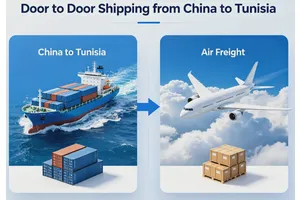
Planning 20ft and 40ft shipping from China to Tunisia for 2026? You're asking the right question — and it's the one most first-time importers get wrong, because the choice between the two boxes decides more than your freight bill. It decides your customs valuation, your demurrage risk, your payment terms, and sometimes whether the whole shipment makes money.
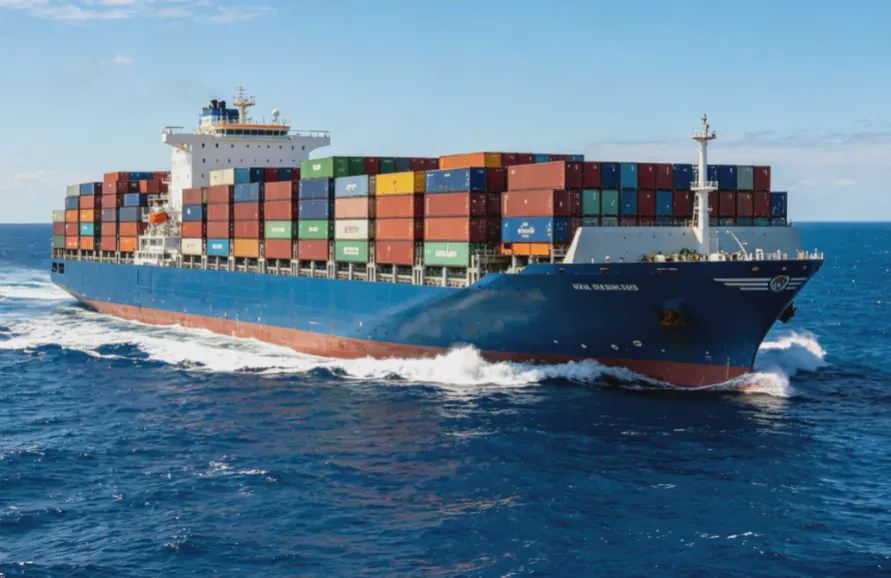
The first time you watch a container ship ease into the Gulf of Tunis, past the white harbor walls of La Goulette and toward the Radès terminals across the bay, you understand why this lane runs on decisions, not just bookings. In this 2026 guide, built on our May 2026 lane data, we break down the port-by-port cost of 20ft and 40ft containers, the transit reality through Mediterranean transshipment hubs, the SINDA customs system you will meet at the border, and the Tunisian Dinar payment rules that catch importers off guard. If you already know you need a container, this is the decision sheet you came for.
| Container | Capacity | Best For | 2026 All-in Rate (China → Radès) | Transit (Port-to-Port) |
|---|---|---|---|---|
| 20ft GP | 28 CBM / ~24 t | Heavy, dense cargo | $2,750 – $3,600 | 27 – 38 days |
| 40ft GP | 56 CBM / ~30 t | Volume cargo, light-medium density | $2,700 – $3,300 | 27 – 38 days |
| 40ft HC (40HQ) | 68 CBM / ~30 t | Bulky, carton-heavy cargo | $2,800 – $3,400 | 27 – 38 days |
Rates are all-in port-to-port snapshots for the China–Radès lane (May 2026), subject to season, fuel, and equipment availability. For the full service picture from pickup to delivery, start with our Shipping from China to Tunisia page.
20ft vs 40ft Shipping from China to Tunisia: Which Container Size Should You Book?
Forget the marketing tables for a minute. The rule we apply to every shipment into Tunisia is about density: how many kilograms your cargo packs into each cubic meter. A 20ft container gives you 28 CBM and roughly 24,000 kg of payload. A 40ft gives you 56 CBM and roughly 30,000 kg. The 40ft box carries twice the volume but only 25% more weight — so heavy goods punish a 40ft booking, and light goods punish a 20ft one.
| Your Cargo Profile | Example | Recommended Box | Why |
|---|---|---|---|
| Heavy and dense (over ~330 kg/CBM) | Auto parts, steel products, tiles, machinery spares | 20ft | You hit the weight limit long before the volume limit; a 40ft would sail half empty |
| Light and bulky (under ~330 kg/CBM) | Textiles, garments, cartons of consumer goods | 40ft or 40HQ | You pay per container, so more CBM per dollar wins |
| Mixed, mid-density | Furniture + fittings, hardware | 20ft or 40ft by total CBM | Work the math at 15–16 CBM: below that, LCL usually beats FCL |
| Cartons that breathe (high CBM, low kg) | Polyester fiber, mattresses, packaging | 40HQ | The extra 12 CBM of height is nearly free |
A Tunisian auto-parts importer moving brake calipers and suspension arms — heavy, compact, steel — is almost always better in a 20ft, because a 40ft would carry the same weight at double the container cost. A garment importer in Sfax, bringing in cartons of ready-made clothing, is better in a 40HQ, because the weight is low and every extra CBM is profit margin. The threshold we use in the office: if your cargo exceeds roughly 330 kg/CBM, start with the 20ft; if it stays under that, price the 40ft first.
One more habit we see in Tunisian importing specifically: first-time buyers overbook. They picture a "big shipment," request a 40ft, then discover their 22 CBM is paying for 34 empty cubic meters. Measure first, book second — and if you are between 15 and 20 CBM, read the LCL section below before committing to any full container.
2026 20ft Container Shipping Cost from China to Tunisia (Port by Port)
The 20ft box is the workhorse of the Tunisia lane: machinery parts, building materials, auto components, and the dense industrial goods that Tunisian manufacturers cannot source locally. Here is where 20ft pricing stood from the main Chinese export ports in our May 2026 lane snapshot:
| Chinese Port of Loading | 20ft FCL All-in (USD) | Transit to Radès | Sailing Frequency |
|---|---|---|---|
| Shanghai | $2,800 – $3,500 | 28 – 33 days | Weekly |
| Ningbo | $2,750 – $3,400 | 28 – 34 days | Weekly |
| Shenzhen (Yantian/Shekou) | $2,900 – $3,600 | 27 – 32 days | Weekly–biweekly |
All-in means ocean freight, origin THC, documentation, and basic destination charges — confirm the exact scope with your forwarder because quotes labeled "all-in" are not all equal. Qingdao and Guangzhou sail on the same loops and typically track within the Shanghai band, with Qingdao running 3–5 days longer due to the positioning leg. Full breakdowns of every cost layer are in our Sea Shipping cost from China to Tunisia guide.
What the headline rate hides — and this is where 20ft shipments to Tunisia get expensive — is the destination stack at Radès. Expect terminal handling of $110–$160, a delivery order fee of $30–$50, and the ever-present risk of demurrage at $50–$150 per day once the free time runs out. A 20ft container cleared slowly can quietly add $400–$800 to its landed cost. That is not a reason to avoid the 20ft; it is a reason to control the clearance clock — which brings us to SINDA shortly.
Real experience: A Shenzhen exporter we work with shipped a 20ft of aluminum profiles to Tunis on CIF terms. The buyer's broker filed the SINDA declaration with the wrong HS chapter — 7604 against the actual 7606 — and the system flagged the value mismatch. Three days of free time burned before re-declaration, then a further hold because the invoice wasn't translated. Total demurrage and storage: $640 on a $3,100 freight bill. The goods were fine; the paperwork wasn't.
40ft and 40ft High Cube Rates from China to Tunisia
The 40ft container — and its taller sibling, the 40ft High Cube — is the box of choice for Tunisia's textile sector, furniture importers, and any trade in voluminous consumer goods. The 40GP gives you 56 CBM; the 40HQ stretches that to 68 CBM for roughly $100–$200 more on the lane. When your cargo is light per cubic meter, that extra height pays for itself many times over.
| Chinese Port of Loading | 40ft GP All-in (USD, indicative) | 40HQ All-in (USD) | Transit to Radès |
|---|---|---|---|
| Shanghai | $2,700 – $3,300 | $2,800 – $3,400 | 28 – 33 days |
| Ningbo | $2,650 – $3,250 | $2,750 – $3,350 | 28 – 34 days |
| Shenzhen (Yantian/Shekou) | $2,750 – $3,350 | $2,850 – $3,450 | 27 – 32 days |
One quirk of the 2026 market is worth understanding: on this lane, 20ft and 40ft all-in rates have sat unusually close, because 20ft equipment is scarcer and carriers price it with a smaller discount than the historical norm. That does not make the 20ft a bad deal — it makes the per-CBM comparison decisive. At $2,800 for 28 CBM, a 20ft costs about $100 per CBM; at $3,000 for 56 CBM, a 40ft costs about $54 per CBM. For any cargo under ~330 kg/CBM, the 40ft halves your per-cubic-meter cost. If you need the extra height for cartons, pallets stacked two high, or goods with internal air volume, the 40HQ is the version to request — see our breakdown of High Cube shipping container cost from China for how that premium behaves across lanes.
Two practical notes from the field. First, a 40ft is not "two 20fts" in Tunisian customs terms: duty and VAT are computed on the CIF value of the goods, not on the container — so a consolidated 40ft of assorted products can actually simplify clearance, because you file one declaration instead of several. Second, 40ft equipment is easier to secure in Shenzhen and Shanghai than in secondary ports during Q3–Q4, since the big export hubs hold the largest 40HQ pools — book 3–4 weeks out from northern ports, where the positioning leg slips first.
LCL vs FCL: When a Full Container Isn't the Cheapest Option
Not every shipment to Tunisia deserves a full container. If your cargo sits between 1 and 15 CBM, Less-than-Container-Load (LCL) — sharing a box with other shippers — is usually the cheapest way to go, and on this lane it runs $80–$110 per CBM (May 2026). The catch is time: LCL adds 3–7 days for consolidation at origin and deconsolidation at the Radès bonded warehouse, and your cargo is handled more times, which raises damage risk.
| Cargo Volume | LCL at ~$95/CBM (mid-range) | 20ft FCL All-in | Verdict |
|---|---|---|---|
| 5 CBM | ~$475 + handling | $2,750+ | LCL, clearly |
| 10 CBM | ~$950 + handling | $2,750+ | LCL, clearly |
| 14 CBM | ~$1,330 + handling | $2,750+ | Compare — FCL can win near 15 CBM |
| 16 CBM | ~$1,520 + handling | ~$2,800 | FCL wins on cost and speed |
| 22 CBM | — | ~$2,900 | FCL, no question |
The break-even sits around 15–16 CBM, and that's where we run the real math for clients every week, because LCL carries a hidden cost in Tunisia that few guides mention: your goods clear through a shared container, so if another consignee's paperwork is wrong, the whole box waits. We once had an LCL shipment to Tunis held for five days because a co-loader's invoice didn't match its packing list — our client's goods were perfectly documented, and they paid the delay anyway. If your cargo is fragile, high-value, or time-sensitive, lean toward FCL earlier than the pure cost table suggests. For a regional comparison of how container economics behave on neighboring lanes, see Cost of shipping Container from China to Morocco.
Real experience: A building-materials client importing quartz and tile samples — about 12 CBM, heavy crates — asked us to compare LCL and 20ft. LCL looked cheaper on paper by roughly $1,100, but the crates were fragile, the CBM was dense, and the samples had a hard deadline before a Sfax trade fair. We booked the 20ft. The consignment arrived intact, cleared in four days, and the client's fair stand was stocked on time. Not every 12 CBM shipment needs a 20ft — this one did, because density and deadline beat the spreadsheet.
Transit Time from China to Tunisia: Routes, Hubs, and the Red Sea Factor
There is no direct China–Tunisia container service with the frequency most importers assume, and understanding why will save you from promising customers delivery dates no vessel can keep. Tunisia sits at the far western end of the Mediterranean, and most loops reach it through transshipment — your container is discharged at a hub and relayed to Radès on a feeder. The hubs that matter on this lane: Marsaxlokk (Malta), Genoa, Valencia/Barcelona, Port Said, and Algeciras.
| Route | Typical Transshipment Hub | Transit to Radès | Notes |
|---|---|---|---|
| Shanghai → Radès | Port Said / Marsaxlokk | 28 – 33 days | Most reliable frequency |
| Shenzhen (Yantian) → Radès | Singapore → Marsaxlokk | 27 – 32 days | Fastest for South China |
| Ningbo → Radès | Port Said / Marsaxlokk | 28 – 34 days | Competitive rates |
| Qingdao → Radès | Busan / Colombo → Mediterranean | 32 – 38 days | Positioning leg adds time |
| Guangzhou → Radès | Singapore → Malta | 28 – 35 days | Good for Pearl River Delta |
Two forces stretch these numbers in 2026. First, the Red Sea situation: with much of the Asia–Europe capacity still rerouting around the Cape of Good Hope, transit times and rates on Mediterranean lanes sit roughly 15–25% above pre-crisis levels, and the frequency of calls has thinned. Second, Radès congestion: the terminal is the busiest in the country, and before Ramadan and in Q4 the queue for berths and the customs backlog can add 3–5 days on top of the sailing schedule. Our Red Sea shipping coverage tracks how this lane's reliability is recovering, and if you compare neighbors, the Shipping from China to Algeria route shows the same hub-and-feeder pattern with its own congestion rhythm.
Plan your dates like this: port-to-port 27–38 days, plus 3–7 days if LCL, plus 2–5 days for clearance at Radès, plus 1–3 days inland. Door-to-door, a sea shipment from a Chinese factory to a Tunisian warehouse realistically needs 35–50 days in 2026. Air freight can do it in 3–8 days when a deadline is absolute — at $4.8–$7.8/kg, it's a rescue option, not a strategy. Most of our Tunisian clients run the hybrid: bulk by sea in a 20ft or 40ft, urgent components by air.
SINDA, VAT, and Import Duties: What Tunisian Customs Really Costs
Clearing a container in Tunisia is a meeting with SINDA — the Système d'Information National des Douanes, the national customs information system that processes every import declaration. You will not file it yourself: Tunisian customs requires declarations through a licensed customs broker, a transitaire agréé, who submits electronically via TradeNet, the country's single-window platform linking customs, banks, and the ministries that issue import permits.
The cost of that meeting breaks into three layers:
| Cost Layer | How It's Calculated | Typical Scale (2026) |
|---|---|---|
| Customs duty | HS code rate applied to CIF value | 0% – 30%+ depending on the code; protected goods (textiles, vehicles, some electronics) sit at the top |
| VAT | Standard 19%, reduced 7% / 13% on certain staples and services | 19% on most commercial imports |
| Conformity & inspections | INNORPI certification for electronics, machinery, textiles; plus any ministry permits | $100 – $300 per inspection event |
Duty and VAT are assessed on the CIF value — cost, insurance, and freight — which is why the commercial invoice is the single most scrutinized document in a Tunisia shipment. Undervalue it and you invite a full inspection; overvalue it and you pay tax on money you never earned. The invoice must match the packing list line by line, and translating it into French (or Arabic) before arrival is the cheapest delay insurance on this lane. Certain goods — medical devices, cosmetics, some electronics — require prior import authorization from the responsible ministry before the vessel even departs China. Check that before booking, not after arrival.
| Document | Who Issues It | Why Tunisia Cares |
|---|---|---|
| Bill of Lading | Carrier / forwarder | Proves ownership; must match the SINDA declaration exactly |
| Commercial Invoice | Exporter | Drives the CIF valuation for duty and VAT; French/Arabic translation advised |
| Packing List | Exporter | Line-by-line check against invoice; mismatches trigger holds |
| Certificate of Origin | Chamber of Commerce / forwarder | Needed for preferential or standard tariff treatment |
| Import License / Permit | Tunisian ministry (for restricted goods) | Mandatory before arrival; missing it means storage + demurrage |
Every layer above has a fee attached, and knowing the destination stack before you book is the difference between a clean arrival and a costly one:
| Fee | China (Export) | Tunisia (Import) |
|---|---|---|
| Terminal Handling (THC) | $120 – $180 / container | $110 – $160 / container |
| Documentation | $40 – $60 / BL | $35 – $60 / BL |
| Delivery Order | — | $30 – $50 / container |
| Demurrage (free time exceeded) | — | $50 – $150 / day |
| Detention (equipment held outside port) | — | $60 – $120 / day |
| Customs inspection | $40 – $90 (if selected) | $100 – $300 (if selected) |
The pattern to internalize: freight is the visible cost, clearance is where the money quietly leaks. A container that sits in Radès for ten extra days because of a SINDA mismatch burns $500–$1,500 in demurrage and storage — often more than the entire documentation budget. That's why we pair every FCL booking with destination-side customs coordination; our customs clearance service exists for exactly this problem, and if you want the whole process handled door-to-door, our Door to Door Shipping from China to Tunisia guide covers the end-to-end picture.
Lessons learned: After years of clearing containers at Radès, three habits separate smooth arrivals from horror stories: (1) reconcile the invoice and packing list in Excel before the vessel sails, not after it berths; (2) translate the invoice into French for the broker — the SINDA declaration lives in French, and every translation error is a day of free time; (3) confirm INNORPI requirements for your HS code before booking, because conformity inspection queues back up badly before Ramadan.
Paying for Your Container: TND Exchange Controls and Importer Requirements
The Tunisian Dinar (TND) is a non-convertible currency, and that single fact shapes how container purchases get paid. Under the exchange-control rules of the Central Bank of Tunisia (BCT), import payments must flow through authorized Tunisian banks, and for container-sized orders — typically $3,000–$6,000 of freight plus the value of the goods — the standard instruments are letters of credit (L/C) and documentary collections. A Tunisian importer's bank issues the L/C in favor of the Chinese exporter; the bank releases payment against compliant documents; everyone's exposure is defined before the vessel sails.
What this means in practice for exporters in Shenzhen or Shanghai: your shipment is only as smooth as the documentary compliance of your paperwork, because a discrepancy between invoice, packing list, and Bill of Lading can stop an L/C payment at the bank even when the goods arrive perfectly. We see payment holds from trivial mismatches — an Incoterms notation left out, a country-of-origin line reading "P.R. China" instead of "China," an HS code that disagrees with the broker's SINDA filing. If you ship to Tunisia on L/C terms, treat the documents as part of the cargo: they are.
The importer side has its own checklist. A Tunisian company importing containers must hold registered importer status (matricule fiscal), obtain an import license (autorisation d'importation) for restricted categories, and work through a licensed broker for the declaration. For smaller orders — samples, spare parts, urgent goods — advance TT and express courier sidestep most of this machinery, which is why so many Tunisian traders run a two-track system: small and urgent by air or courier, large and planned by sea container. If you are comparing how the Mediterranean lane behaves for neighboring buyers, the How much to ship a Container from China to Turkey guide shows a similar L/C-heavy pattern on a busier corridor.
The trade context explains the container mix you'll see at Radès. Tunisia is North Africa's quiet manufacturing gateway: a real auto-parts industry supplying European OEMs, a textile and apparel sector that imports Chinese fabrics and machinery, and a food-processing base that exports olive oil and dates. China, for its part, buys Tunisian olive oil and phosphates and sells back machinery, auto components, electronics, and textiles. That asymmetry is why this lane moves a healthy mix of dense 20ft loads (parts, machines) and voluminous 40ft loads (garments, consumer goods) — and why a forwarder who understands both sides of the cargo profile matters.
A Real 20ft vs 40ft Decision: Auto Parts into Radès
Let's close the theory with a shipment we actually ran, de-identified for privacy. A Tunisian distributor of aftermarket auto parts — brake discs, calipers, suspension arms, bearings — was expanding his stock range and had quoted a Chinese supplier for two separate purchase orders: one of dense steel components, one of mixed accessories in cartons.
The first order: 21.5 CBM, 17,300 kg of steel-heavy parts from Ningbo. The buyer's instinct was a 40ft, because "it's a big order." DTFU's ops team ran the density check instead — roughly 800 kg/CBM, far above the 330 kg/CBM threshold — and booked a 20ft. Freight came in at $3,150 against a 40ft quote of $3,050; the 20ft cost slightly more, but it saved $1,850 on the buyer's CIF valuation (lower freight = lower duty and VAT base at 19%+) and cleared Radès in four days without inspection. The landed-cost winner was the 20ft by a meaningful margin, and the parts were on the shelf in Tunis before the 40ft alternative would even have been gated for discharge.
The second order: 46 CBM of mixed accessories — wiper blades, filters, trim kits — mostly air in cartons, about 6,800 kg. Here the density check pointed the other way: roughly 148 kg/CBM, firmly in 40ft territory. We booked a 40HQ from Shenzhen at $3,250, giving the client 68 CBM of headroom for 46 CBM of light goods. Per CBM, that shipment cost $71 versus roughly $113 had it gone in a 20ft — and the extra height meant the cartons could be stacked two high without crushing.
Two shipments, two boxes, both correct. The first buyer saved money by not taking the bigger container; the second saved money by taking it. That is the whole 20ft-vs-40ft decision in miniature: the right box is the one that matches your cargo's density, not the one that matches your ambition. If you move auto parts or machinery into the region, our Shipping from China to Egypt lane pages show the same logic playing out on the neighboring market.
FAQs
How much does a 20ft container cost to ship from China to Tunisia in 2026?
All-in port-to-port rates run $2,750–$3,600 depending on the Chinese port of loading (Shanghai, Ningbo, and Shenzhen anchor the band), with transit of 27–38 days. Add destination charges, duty, and 19% VAT on the CIF value for landed cost.
How long does it take to ship a 40ft container from China to Tunisia?
Port-to-port transit runs 27–38 days via transshipment hubs like Marsaxlokk (Malta), Genoa, Valencia, or Port Said. Plan 2–5 extra days for SINDA clearance at Radès and 1–3 days for inland delivery; door-to-door budgets of 35–50 days are realistic in 2026.
Should I ship textiles from China to Tunisia in a 20ft or 40ft container?
Textiles are light and voluminous — typically 150–250 kg/CBM — so a 40ft or 40HQ almost always wins on per-CBM cost. Use the 20ft for dense cargo like auto parts, steel, tiles, or machinery, where weight, not volume, limits the load.