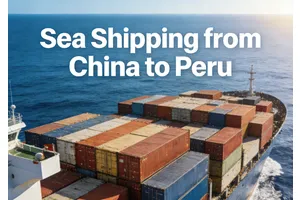
Shipping time from China to Peru in 2026 is two different answers depending on one decision: whether your container takes the new direct corridor to Chancay or the traditional transshipment route through Manzanillo or Balboa to Callao. Direct sailings from Yantian or Shanghai reach the Chancay megaport in 23–28 days. Transshipped cargo needs 32–45 days. Air freight delivers in 5–10 days door-to-door. That 10–12 day gap between direct and transshipment is the biggest change on this lane in a decade — and most importers still plan against the old numbers.
This guide breaks the journey into the legs that actually eat time — pickup, consolidation, ocean transit, Callao clearance, and inland delivery — with the port-pair times we see on real 2026 bookings, the customs timeline at Callao that catches first-time importers, and the seasonal windows when everything slows down. If you are still comparing methods rather than routes, our sea freight from China overview covers the FCL/LCL baseline first.
How Long Does Shipping from China to Peru Take? The Short Answer
| Shipping Mode | Port-to-Port | Door-to-Door |
|---|---|---|
| Sea freight — direct (Chancay) | 23–28 days | 30–38 days |
| Sea freight — transshipment (Callao) | 32–45 days | 40–52 days |
| Sea freight LCL | +5–8 days on FCL times | 45–55 days |
| Air freight | 3–8 days | 5–10 days |
| Express courier | 2–4 days | 3–7 days |
Two numbers matter more than the headline transit. First, the ocean leg is only half the total: origin handling, customs, and inland delivery add 7–14 days on top. Second, LCL is slower than FCL twice — once at consolidation in China and again at deconsolidation in Callao. If you are quoted a door-to-door time shorter than the port-to-port time, someone is quoting you the vessel's sailing schedule, not your shipment.
Direct Shipping Time from China to Peru: The Chancay Megaport Factor
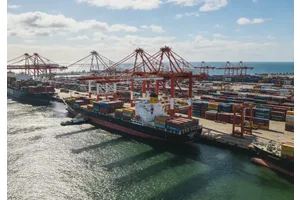
Chancay, 80 km north of Lima, opened as a deep-water port with a purpose-built direct corridor to Asia. Chinese carriers now run direct rotations from Yantian and Shanghai that bypass the traditional transshipment hubs entirely. The result: ocean transit of 23–28 days instead of 35–45 — a cut of roughly 10–12 days, which matters enormously for retailers timing a seasonal launch or manufacturers holding inventory.
| Route | Direct Transit (Chancay) | Via Manzanillo / Balboa (Callao) |
|---|---|---|
| Shenzhen (Yantian) → Peru | 23–28 days | 32–38 days |
| Shanghai → Peru | 24–28 days | 35–42 days |
| Ningbo → Peru | 25–28 days | 35–42 days |
The trade-off is frequency and cost. Direct services sail on fixed weekly rotations with limited slots; transshipment services offer more sailing options and, in soft market periods, slightly lower rates. For a time-sensitive order, the direct booking pays for itself in avoided stockout cost. For routine restocking with flexible lead times, transshipment remains a workable budget option — as long as you plan for the extra 10–12 days.
Transshipment Routes and Their Shipping Times from China to Callao
Callao, the port of Lima, still handles the majority of China-origin container traffic. Almost all of it arrives via transshipment: the mother vessel drops your container at Manzanillo (Mexico), Balboa (Panama), or occasionally Buenaventura (Colombia), and a feeder vessel carries it down the coast to Callao. Each stop adds handling time and a slot in the feeder schedule — which is why the port-pair times below vary by origin.
| Origin Port | Destination | Typical Transit | Notes |
|---|---|---|---|
| Shenzhen | Callao | 32–38 days | Fastest southern gateway |
| Shanghai | Callao | 35–42 days | Most frequent sailings |
| Ningbo | Callao | 35–42 days | Similar to Shanghai |
| Guangzhou | Callao | 34–40 days | Feeder to mainline |
| Qingdao / Tianjin | Callao | 38–45 days | Longest, northern gateways |
These are port-to-port numbers. The feeder leg from the transshipment hub is the unpredictable part — if the feeder is full or delayed, your container waits at Manzanillo or Balboa for the next slot, and the total can stretch past 45 days. A forwarder that tracks the feeder schedule and books the connection at origin, rather than hoping for the best, is the difference between 38 days and 48.
How Much Does Faster Shipping from China to Peru Cost? 2026 Rate Ranges
Speed is a purchasable option on this lane, and the price ladder is steep. These are the 2026 ranges we quote on real China–Peru bookings, consistent with our sea shipping from China to Peru guide:
| Shipping Option | Rate (2026) | Typical Total Time |
|---|---|---|
| Sea FCL 20ft — Shenzhen → Callao/Chancay | $1,850–$2,400 | 32–38 days (transshipment) / 23–28 days (direct) |
| Sea FCL 20ft — Shanghai → Callao/Chancay | $1,950–$2,500 | 35–42 days / 24–28 days |
| Sea FCL 40ft — Shenzhen → Callao/Chancay | $2,800–$3,900 | Same as 20ft routing |
| Sea LCL | $65–$125 per CBM | 40–55 days door-to-door |
| Air freight | $5.00–$10.00 per kg | 5–10 days |
| Express courier | $12–$18 per kg | 3–7 days |
The direct-to-Chancay premium over transshipment is usually a few hundred dollars per container — in the Q4 peak it can disappear entirely. Air freight, by contrast, costs 5–10× the sea rate per kilo: a 1,000 kg shipment that costs roughly $2,000–2,500 by sea runs $5,000–10,000 by air. The decision framework we use with clients is simple: divide the value of the days saved by the premium paid. A $200-per-day stockout cost justifies the direct booking on almost any container; it takes a $1,000-per-day problem to justify air on regular volumes. Destination charges — THC, the visto bueno document release fee, and inland drayage — add $300–600 per container regardless of mode, so they should never be the deciding factor between routes. For repeat orders, the comparison compounds: twelve transshipment shipments a year at 50 days each mean a full extra cycle of inventory in motion versus the direct routing — a working-capital cost that never appears on a freight invoice but shows up in every quarterly review.
Door-to-Door Shipping Time from China to Peru
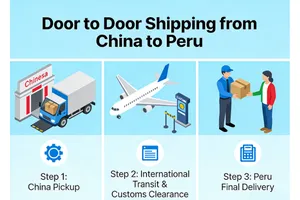
A door-to-door shipment is five separate legs, and each has its own timeline. Here is how a typical FCL booking from Shenzhen to a Lima warehouse actually stacks up in 2026:
| Leg | Duration | Running Total |
|---|---|---|
| Supplier pickup & inland to Chinese port | 1–3 days | Day 1–3 |
| Consolidation / container loading & export clearance | 2–4 days | Day 3–7 |
| Ocean transit (direct or transshipment) | 23–45 days | Day 7–52 |
| Berth wait & discharge at Callao/Chancay | 1–3 days | Day 8–55 |
| Customs clearance (despacho anticipado filed pre-arrival) | 2–7 days | Day 10–62 |
| Inland delivery to Lima / Arequipa / Trujillo | 1–3 days | Day 11–65 |
For an FCL to Lima, budget 30–38 days door-to-door on the direct route and 40–52 days transshipped — matching what we see across our door to door shipping from China to Peru bookings. For LCL, add 3–5 days of deconsolidation at the Callao warehouse before clearance can even begin. The honest planning number for most importers is: ocean transit + two weeks. Anyone quoting a door-to-door figure identical to a port-to-port figure is quoting the vessel, not your supply chain.
Callao Port Clearance Time: What Happens After the Vessel Arrives
Peru mandates despacho anticipado — advance clearance. Your customs declaration must be filed with SUNAT before the vessel arrives, using the manifest data and your commercial invoice, packing list, and B/L. Importers who pre-file clear in 2–3 days after discharge; importers who wait for the vessel to arrive before starting paperwork lose a week to processing plus storage charges. The mechanics of the declaration sit inside our customs clearance from China guide; what matters here is the timeline it buys you.
Operational insight: across the shipments we clear in Callao, the fastest way to add 5–7 days to your total is a vague commercial invoice. SUNAT's risk engine routes shipments with incomplete descriptions or mismatched values into the red channel, which means a physical inspection and 3–7 working days of delay plus daily storage fees. We file despacho anticipado with the full commercial documentation the day the vessel sails — the declaration is already waiting when the ship ties up. First-time importers who skip this are almost always the ones paying red-channel storage.
Once cleared, two more realities apply. Truck congestion on Avenida Faucett, the main access road to the Callao terminals, routinely adds 24–48 hours to pickup — schedule the truck for off-peak hours. And for high-value cargo moving inland, an armed escort (resguardo) on the Pan-American Highway is standard practice for electronics and branded goods; it adds a day but removes the theft risk that plagues unescorted high-value loads.
Beyond Lima, inland delivery scales with distance: Arequipa adds roughly 1–2 days by truck from Callao, Trujillo and Chiclayo 1 day north, and Cusco or the southern highlands 2–3 days including the mountain leg. Peruvian importers also pay an 18% IGV (16% general sales tax plus 2% municipal promotion tax) on the CIF value, and most Chinese goods enter at 0% duty under the China–Peru Free Trade Agreement when the supplier provides a valid Form R certificate of origin. Neither tax changes your transit time — but both change how long clearance takes if the paperwork is missing, because customs will hold the declaration until the tax basis is verified.
LCL vs FCL Shipping Time from China to Peru
| Factor | FCL | LCL |
|---|---|---|
| Ocean transit | 23–45 days | Same ocean + 2–4 days consolidation |
| Destination handling | Direct container release | 3–5 days deconsolidation at Callao warehouse |
| Customs start | On arrival | Only after deconsolidation |
| Typical total (door-to-door) | 30–52 days | 40–55 days |
| Break-even volume | — | ~13–15 CBM |
LCL makes sense under ~15 CBM, but the timeline penalty is real: consolidation in China, then deconsolidation in Callao before customs can start. If your volume is anywhere near the break-even, pricing a 20ft container usually wins on both cost per unit and total days — one of the reasons we push FCL for steady repeat orders on this lane.
Air Freight and Express Shipping Time from China to Peru
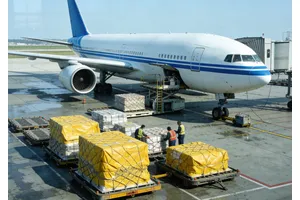
When the ocean timeline is too long, air freight compresses the journey to days. There are no direct cargo flights between China and Lima, so standard air moves via Miami (MIA), São Paulo (GRU), or Frankfurt (FRA) — still reaching Jorge Chávez International (LIM) within 5–10 days door-to-door.
| Service | Transit | Best For |
|---|---|---|
| Express courier (DHL/FedEx/UPS) | 3–7 days | Samples, documents, e-commerce parcels |
| Standard air freight | 5–10 days | Electronics, spare parts, fashion, urgent restocks |
| Sea-air combos | 15–22 days | Mid-cost, mid-speed compromise |
Air rates are tiered by chargeable weight — the greater of actual weight and volumetric weight (for air, 1 CBM ≈ 167 kg). Typical 2026 levels run $5–7 per kg for 45–100 kg consignments, dropping to $4.50–6 per kg above 300 kg, with express at $12–18 per kg. The rates and carrier options are detailed in our air shipping from China to Peru guide.
Air costs 5–10× sea per kilo, so the decision is a simple inventory question: does the stockout cost of waiting 35 days exceed the air premium? For a $50,000 seasonal order, often yes — the air freight on a 500 kg restock runs roughly $2,500–3,500, against a potential $10,000+ in lost sales if the shelves stay empty through the launch window. For routine replenishment with a stable forecast, sea remains the right call and the timeline math above applies. One practical note: Peruvian customs applies the same valuation scrutiny to air cargo, so the invoice and product descriptions on an air waybill must match the goods exactly — an inconsistency that would cost you days at the port costs the same at the airport, only with higher daily storage rates per kilo.
When Delays Happen: Port Strikes, Peak Season, and the Q4 Window
The ocean leg is the reliable part. The delays are local and seasonal:
| Delay Window | What Happens | Buffer to Plan |
|---|---|---|
| Q4 peak (before year-end holidays) | Vessel bunching, slot shortages, rate spikes | +1–2 weeks |
| Chinese New Year (Q1) | Factory closures, port backlog before and after | +1–2 weeks |
| Peruvian port strikes | Dockworker stoppages at Callao | +1–3 weeks (unpredictable) |
| Weather / heavy seas | Slow steaming, schedule deviations | +3–5 days |
| Transshipment hub congestion | Missed feeder connections at Manzanillo/Balboa | +1 week |
The practical rule we give every importer: plan the ocean leg at its advertised time, but build a two-week buffer before a hard deadline. The importers who get burned are the ones who book the cheapest transshipment slot with zero buffer and then watch a Callao strike eat their launch window.
Operational insight: in the Q4 peak we book direct Chancay rotations aggressively — the premium over transshipment narrows to a few hundred dollars while the schedule reliability gap widens. If your cargo is time-boxed, the direct route is not a luxury; it is the plan.
A Real China to Peru Shipment Timeline: Planning Numbers That Work
To see how the legs compound, take a typical 20ft booking from a Shenzhen supplier to a Lima warehouse, run two ways:
| Step | Direct (Chancay) | Transshipment (Callao) |
|---|---|---|
| Pickup in Shenzhen + export clearance | Days 1–4 | Days 1–4 |
| Ocean transit | Days 4–28 | Days 4–42 |
| Berth wait + discharge | Day 29–31 | Day 43–45 |
| Despacho anticipado clearance | Days 31–34 | Days 45–48 |
| Truck to Lima warehouse | Days 34–36 | Days 48–51 |
| Total door-to-door | ~36 days | ~51 days |
Both shipments leave the same factory on the same day — the two columns are how DTFU lays out routing options on real bookings. The transshipment route costs less on the ocean line and arrives 15 days later. For a Lima retailer stocking for a Q4 sales window, those 15 days are the difference between full shelves and a half-empty storefront — which is why we route time-boxed cargo direct even when the rate table says otherwise. The same logic applies to LCL: an LCL consignment on the direct rotation runs roughly 45–55 days door-to-door once consolidation and Callao deconsolidation are counted, versus 40–52 days for FCL.
How to Reduce Shipping Time from China to Peru
Five habits, in order of impact:
- Book direct to Chancay for time-sensitive cargo — cuts 10–12 days off the ocean leg.
- File despacho anticipado with complete documents before the vessel arrives — saves 5–7 days at Callao.
- Have your CPFTA Form R certificate of origin ready — it zeroes the duty on most Chinese goods, and a missing certificate triggers value checks that stall release.
- Book space 2–3 weeks ahead in peak windows — rollovers at origin are the silent killer of "guaranteed" dates.
- Track the feeder connection if transshipping — a forwarder that books the Manzanillo/Balboa connection at origin protects you from the missed-slot wait.
DTFU books this lane weekly out of Shenzhen and Shanghai with direct carrier contracts, files despacho anticipado on every consignment, and tracks each container through Callao or Chancay with 24/7 visibility — the China to Americas network is built for exactly this kind of planning. You can follow the same tracking view we hand to every client on our cargo tracking page.
FAQs
1. How long does sea freight take from China to Peru?
Direct sailings to Chancay take 23–28 days port-to-port. Transshipped cargo via Manzanillo or Balboa to Callao takes 32–45 days. Add 7–14 days for customs and inland delivery to get the door-to-door total.
2. Is shipping to Peru faster through Chancay or Callao?
Chancay. Direct China–Chancay rotations cut ocean transit by 10–12 days compared with transshipment to Callao. As of 2026 the direct corridor runs 23–28 days.
3. How long does it take to ship from Shanghai to Callao?
35–42 days port-to-port via transshipment. Booking a direct service to Chancay reduces the ocean leg to 24–28 days.
4. How long does air freight take from China to Peru?
Standard air freight delivers in 5–10 days door-to-door via Lima's Jorge Chávez airport; express courier takes 3–7 days. No direct China–Lima flights exist, so cargo transits via Miami, São Paulo, or Frankfurt.
5. How long does door-to-door shipping from China to Peru take?
FCL door-to-door runs 30–38 days on the direct route and 40–52 days transshipped. LCL adds 3–5 days of deconsolidation in Callao, for a total of 45–55 days.
6. How long does customs clearance take at Callao port?
With despacho anticipado filed before arrival, clearance runs 2–3 days after discharge. Red-channel inspections add 3–7 working days plus daily storage fees.
7. How long does shipping take during Chinese New Year?
Plan for 1–2 extra weeks around the Q1 holiday window, when factories close and ports back up before and after. The Q4 peak carries the same +1–2 week risk.
8. What is the fastest way to ship from China to Peru?
Express courier (3–7 days) is fastest for parcels; standard air (5–10 days) for larger cargo; direct sea to Chancay (30–38 days door-to-door) for containers. The right choice depends on the value and deadline of the goods.
9. How much does it cost to ship a 20ft container from China to Peru?
Sea freight runs $1,850–$2,500 for a 20ft from Shenzhen or Shanghai, depending on routing. LCL is $65–125 per CBM, and air freight runs $5–10 per kg. Destination THC, the visto bueno fee, and drayage add $300–600 per container.
Send your cargo details — commodity, weight, volume, origin city in China, and destination in Peru — and DTFU Logistics will come back with a leg-by-leg timeline and quote: direct Chancay booking if your deadline demands it, despacho anticipado filed the day the vessel sails, Callao or Chancay clearance managed with our local team, and 24/7 tracking from pickup to delivery. The planning number you get is the number we run the shipment against.