Are you struggling to estimate the true costs and navigate the notorious customs hurdles of importing into South America's largest market? Sea shipping from China to Brazil presents massive opportunities for importers, but it is fraught with hidden fees, complex tax structures, and strict regulatory requirements.
In my 10+ years of managing global supply chains at DTFU International Logistics, I've seen countless shipments delayed at the Port of Santos because of a single misplaced decimal on a Commercial Invoice. Just last Q4, we took over an account where a new importer had their cargo held in a "red channel" inspection for 21 days due to an incorrect NCM code, racking up thousands in local armazenagem (storage) fees. Working alongside our dedicated local Despachantes Aduaneiros in São Paulo, we've built a system to bypass these common traps. This complete guide provides the exact 2026 cost estimates, transit times, and operational strategies you need to optimize your supply chain, clear customs without fines, and maximize your profit margins.
Major Ports for Sea Shipping Between China and Brazil
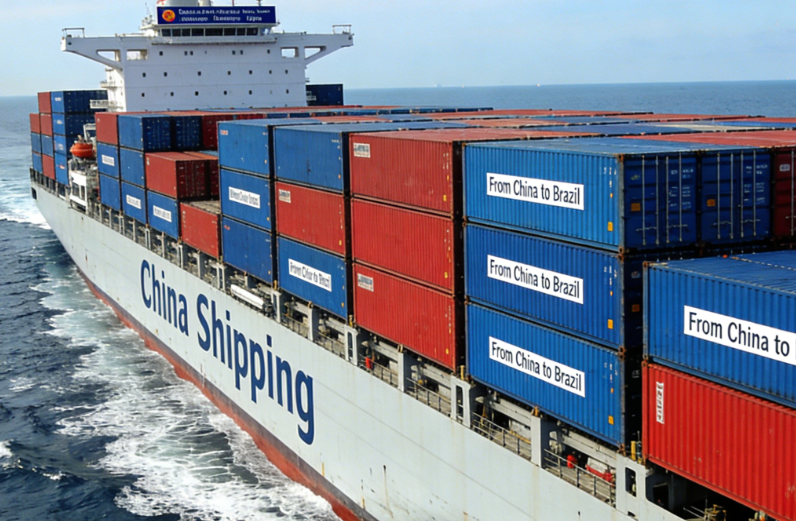
Choosing the right routing is the foundation of an efficient supply chain. The distance between China and Brazil is vast (over 10,000 nautical miles), and local port infrastructure constraints can significantly impact your delivery schedule.
Key Origin Ports in China
China boasts some of the world's busiest and most efficient maritime hubs. Selecting the closest port to your supplier reduces domestic trucking costs.
- Port of Shanghai: The busiest port globally, ideal for goods manufactured in eastern China. We frequently use Shanghai for high-volume consumer goods.
- Port of Shenzhen: The go-to hub for electronics and high-tech manufacturing from the Pearl River Delta.
- Port of Ningbo: Offers excellent alternatives to Shanghai, often with slightly less congestion for heavy manufacturing goods during peak seasons.
- Port of Qingdao: The primary choice for heavy machinery, tires, and industrial products from northern China.
Main Destination Ports in Brazil
Brazil's coastline is extensive, but commercial cargo is heavily concentrated in a few key entry points.
- Port of Santos (SP): The largest and busiest port in Latin America. It handles the vast majority of containerized cargo entering Brazil. Note: In our experience, once cargo clears Santos, the inland trucking route up the steep Serra do Mar highway to São Paulo distribution centers requires specialized carriers, so factor in an extra 1-2 days for this inland leg.
- Port of Paranaguá (PR): A crucial alternative to Santos, highly efficient for agribusiness, but susceptible to weather-related delays during the rainy season.
- Port of Navegantes (SC): Highly efficient and increasingly popular for importers looking to avoid Santos' occasional bottlenecks.
- Port of Rio de Janeiro (RJ): Essential for cargo destined directly for the Rio metropolitan area and surrounding industries.
Navigating Brazil's Complex Import Market
Why is importing to Brazil so difficult? The Brazilian customs authority enforces some of the strictest regulations in the world, prioritizing local industry protection and meticulous tax collection.
Understanding Receita Federal and Local Realities
The Receita Federal (Brazilian Federal Revenue) oversees all import activities via the Siscomex portal. They operate with a zero-tolerance policy for documentation discrepancies. Furthermore, Receita Federal auditors occasionally hold standard strikes (greves), making flawless paperwork even more critical to avoid being pushed to the back of the queue.
Pro Tip: Brazil strictly requires the importer's CNPJ (National Registry of Legal Entities) number to be clearly stated on the Bill of Lading. Without it, the cargo cannot even be manifested upon arrival in the local Mercante system. We always advise our clients to double-check every character before the vessel departs China.
The Importance of RADAR, NCM, and the Despachante Aduaneiro
Before you can import a single container, your Brazilian company must obtain a RADAR registration. This license proves your financial capacity to import.
Crucially, you cannot navigate this alone. You must appoint a licensed Despachante Aduaneiro (Customs Broker). They will classify your products with the correct NCM code (Mercosur Common Nomenclature) based on the official TEC database. Misclassifying an item to get a lower tax rate is considered fraud and will result in confiscation of goods and severe financial penalties. If your goods require health or agricultural clearance, your Despachante will also coordinate with ANVISA or MAPA.
Why DDP is Not Supported for Brazil
Can I ship DDP to Brazil? No, DDP (Delivered Duty Paid) is not a legally supported Incoterm for commercial B2B imports into Brazil.
The Brazilian government requires the official Importer of Record (a locally registered Brazilian entity with a RADAR license) to pay the import duties and taxes directly to the Receita Federal from a local Brazilian bank account. Foreign companies cannot remit these specific taxes on behalf of the buyer. Therefore, you must use Incoterms like FOB, CIF, or EXW, where the Brazilian buyer takes responsibility for the final customs clearance and tax payments.
Sea Freight Services: Choosing FCL vs. LCL
Deciding between booking a full container or sharing space depends entirely on your cargo volume, budget, and timeline.
Full Container Load (FCL): 20ft & 40ft Container Benefits
FCL involves renting an entire container for your goods. If your shipment volume exceeds 15 cubic meters (CBM), a 20ft container usually becomes more economical than LCL.
- Lower Risk of Damage: Your cargo is sealed at the factory in China and not opened until it reaches your warehouse in Brazil.
- Faster Transit: FCL bypasses the consolidation and deconsolidation processes at the ports, shaving 3-5 days off your total transit time.
- Cost Efficiency: For large volumes, the per-unit shipping cost is significantly lower.
Less than Container Load (LCL): Advantages for Smaller Shipments
LCL is the practice of consolidating your goods with cargo from other importers inside a single container.
- Ideal for Startups: Perfect for trial orders or shipments between 1 and 15 CBM where you don't have enough volume to fill a container.
- Pay for What You Use: You are only billed for the exact space (measured in CBM or weight) your cargo occupies.
- Important Risk Warning: LCL takes longer, and you must be aware of high destination terminal handling charges (THC) and armazenagem (storage) fees at Brazilian bonded warehouses. Deconsolidation fees in Brazil are notoriously high and often surprise first-time LCL importers. Always ask your forwarder for a breakdown of destination charges before booking.
Cost Analysis: How Much Does Sea Shipping to Brazil Cost?
How much does it cost to ship a container from China to Brazil? For 2026, thanks to stabilized carrier capacities, the average cost to ship a 40ft container ranges from $2,200 to $3,800, while LCL rates typically sit between $50 and $90 per CBM. These rates fluctuate based on seasonality and fuel surcharges (BAF).
20ft & 40ft Container Price Trends and Key Influencing Factors
Ocean freight rates are highly volatile. Below is an informational estimate of current, highly competitive market averages for port-to-port shipping:
| Container Type | Average Cost Range (USD) | Best For |
|---|---|---|
| 20ft Container | $1,500 - $2,200 | Heavy, dense cargo (e.g., tiles, machinery) |
| 40ft Container (HC) | $2,200 - $3,800 | Voluminous, lighter goods (e.g., textiles, furniture) |
| LCL (Per CBM) | $50 - $90 | Small shipments under 15 CBM |
Note: These are baseline estimates. Peak season (August to October) will drive these prices higher.
Breakdown of Brazilian Import Taxes & The AFRMM
Shipping costs are only one piece of the puzzle. The true cost of importing to Brazil lies in the taxes, which have a cascading effect (taxes are calculated on top of other taxes). According to Brazilian federal guidelines, the primary taxes include:
- II (Import Duty): 0% to 35% based on the NCM code.
- IPI (Industrialized Products Tax): 0% to 300% (typically 0-15% for most consumer goods).
- PIS & COFINS: Federal social contributions, usually totaling around 9.25% to 11.75%.
- ICMS: State value-added tax, varying by the destination state (typically 17% to 18%, but applied on the CIF value plus all other taxes).
- AFRMM (Merchant Marine Tax): Specifically for sea freight, Brazil applies a tax of exactly 8% on the total ocean freight cost to fund their merchant marine.
How to Get Accurate Sea Freight Quotes
To avoid hidden charges, your quote request must be comprehensive. Always provide your forwarder with the exact Incoterms, total weight, dimensions, origin factory address, and the destination zip code in Brazil. At DTFU International Logistics, we provide transparent, itemized quotes so you know exactly what your landed costs will be before you commit.
How Long Does Sea Freight Take from China to Brazil?
How long is the sea voyage from China to Brazil? The port-to-port transit time typically ranges from 30 to 45 days. Including domestic trucking, customs clearance, and final delivery, you should plan for an end-to-end lead time of 45 to 60 days.
Major Port-to-Port Transit Times and What Affects Them
The exact duration depends heavily on the specific port pairs and whether the vessel is on a direct routing or requires transshipment (often in Singapore or South Africa).
| Origin Port (China) | Destination Port (Brazil) | Estimated Transit Time |
|---|---|---|
| Shanghai | Santos | 32 - 36 Days |
| Shenzhen | Paranaguá | 34 - 38 Days |
| Ningbo | Rio de Janeiro | 35 - 40 Days |
| Qingdao | Navegantes | 38 - 45 Days |
Pro Tips to Ensure Timely Delivery and Avoid Delays
- Book in Advance: Secure your container space at least 2 to 3 weeks prior to the vessel departure, especially before Chinese New Year (usually January/February).
- Pre-Clearance Checks: Have your Brazilian Despachante review the Commercial Invoice and Packing List while the cargo is still on the water.
- Beware of Demurrage: Demurrage fees at Santos can easily exceed $100 to $150 per day after your 7-14 days of free time expire. Clear customs rapidly to avoid these margin-killing penalties.
Step-by-Step Process of Sea Shipping to Brazil
Executing a successful shipment requires meticulous coordination between the supplier, forwarder, and your local Brazilian team.
Essential Documentation
Without flawless paperwork, your cargo will not enter Brazil. The mandatory documents include:
- Original Bill of Lading (OBL): Must show the exact freight charges. Brazil generally does not accept Telex Releases or Seaway Bills for commercial imports without a heavily scrutinized formal request.
- Commercial Invoice: Must be signed in blue ink, stamped, and detail the exact unit price, freight, and insurance costs.
- Packing List: Detailed breakdown of weights, dimensions, and materials.
- Certificate of Origin: Required for certain products to claim preferential duty rates.
Packing, Loading, and Handling Procedures
Because of the long, 30+ day voyage across multiple climate zones (crossing the equator), your cargo is highly susceptible to "container rain" (condensation). In our operations, we mandate that suppliers use heavy-duty export cartons, pallets that comply with ISPM-15 standards (fumigated wood), and hang at least 6-8 large desiccant bags inside a 40ft container to prevent moisture damage.
Tracking and Monitoring Your Shipment
Visibility is critical. A reliable forwarder will provide you with a cargo tracking portal linked to the carrier's system. You should be monitoring the vessel's departure (ETD), transshipment status, and arrival (ETA) to coordinate with your Brazilian customs broker for immediate action once the ship docks.
Why Choose DTFU International Logistics for China-Brazil Routes?
Navigating the logistics between Asia and South America demands a partner with deep regional expertise. At DTFU International Logistics, we specialize in streamlining this exact corridor.
Instead of dealing with unpredictable spot market rates, our clients benefit from our preferential contract rates with top ocean carriers, ensuring stable pricing even during peak seasons. We handle the complexities of origin consolidation, rigorous document verification against strict Receita Federal standards, and seamless coordination with your designated Despachante Aduaneiro in Brazil. Our benefit-oriented approach guarantees that you receive transparent service, priority loading, and below-market average overall logistics costs, allowing you to focus on growing your market share in Brazil rather than fighting customs fires.
FAQs
How long does a cargo ship take from China to Brazil?
A cargo ship takes approximately 30 to 45 days to travel port-to-port from China to Brazil. When factoring in customs clearance and final inland delivery, the total door-to-door shipping process typically takes 45 to 60 days.
What is the average cost of shipping a 40ft container to Santos?
For 2026, the average port-to-port ocean freight cost for a 40ft container from major Chinese ports to Santos is highly competitive, ranging between $2,200 and $3,800. This rate varies based on seasonal demand, fuel costs (BAF), and carrier availability.
Why is DDP shipping not allowed in Brazil?
DDP (Delivered Duty Paid) is not allowed in Brazil for commercial imports because local tax laws require the registered Importer of Record (a Brazilian entity with a RADAR license) to pay import duties and taxes directly to the Receita Federal via local banking systems. Foreign sellers cannot legally remit these taxes.
How can I avoid costly customs fines in Brazil?
To avoid fines, ensure your Brazilian entity has an active RADAR registration, use the exact NCM code for your products (verified against the TEC database by a licensed Despachante), and ensure your Commercial Invoice and Bill of Lading match perfectly with zero typos. Pre-checking documents with your local broker before the ship departs China is essential.
What is the cheapest month to ship via sea freight to Brazil?
The cheapest time to ship is typically during the post-Chinese New Year slump (March to May) and the mid-summer lull (June to early July), before the peak season rush begins in August for Q4 holiday inventory.