Importing goods from China to Mauritania has never been more accessible — yet finding a reliable freight forwarder from China to Mauritania remains one of the biggest pain points for Mauritanian importers. Between complex transshipment routes, mandatory ECTN certification, and opaque customs duty calculations, even experienced traders can find themselves facing costly delays. Whether you're a construction company sourcing building materials from Guangdong, a mining operation importing heavy machinery from Shanghai, or a small business owner testing the waters with your first LCL shipment from Yiwu — the right logistics partner can make or break your supply chain. This guide covers everything you need to know: shipping methods, port-by-port transit times, 2026 container rates, the ECTN/BESC application process, import duty calculations, and how to choose a freight forwarder that delivers on its promises. For a complete service overview, visit our dedicated Shipping from China to Mauritania page with real-time rate estimates and booking options.
Why Ship from China to Mauritania?
China has been Mauritania's largest trading partner for over a decade, with bilateral trade driven by infrastructure development, mining expansion, and a growing consumer market. The China-Africa trade corridor — anchored by the Belt and Road Initiative — has transformed Nouakchott's Port de l'Amitié into a vital gateway for Chinese goods entering Northwest Africa.
Understanding what types of cargo move along this route helps you anticipate logistics requirements before you ship. These are the most common categories of goods imported from China to Mauritania:
Construction Materials. Steel rebar, cement, ceramic tiles, sanitary ware, and aluminum profiles dominate the shipping construction materials from China to Mauritania lane. Mauritania's ongoing infrastructure projects — including road networks, housing developments, and port expansion — create consistent demand. Most construction material shipments move via FCL sea freight due to their weight and volume.
Machinery & Equipment. Mining equipment, agricultural machinery, generators, and industrial processing lines are the backbone of shipping machinery to Mauritania from China. The country's iron ore and gold mining sectors rely heavily on Chinese-manufactured heavy equipment, much of which requires breakbulk or flat rack container handling due to oversized dimensions.
Electronics & Consumer Goods. Smartphones, home appliances, solar panels, and LED lighting products represent the fastest-growing segment for importing electronics from China to Mauritania. These high-value, volume-sensitive goods often benefit from air freight or consolidated LCL sea freight, depending on urgency and order size.
Vehicles & Auto Parts. Commercial trucks, construction vehicles, and aftermarket auto parts make up the shipping vehicles from China to Mauritania category. Ro-Ro (Roll-on/Roll-off) shipping is the preferred method for fully assembled vehicles, while containerized shipping works better for parts and components.
Textiles & Daily Necessities. Apparel, footwear, household goods, and plastic products from Yiwu and Guangzhou wholesale markets fill countless LCL containers bound for Mauritanian retailers and distributors.
For importers in any of these categories, partnering with an experienced freight forwarder means the difference between a predictable supply chain and a constant firefight. DTFU Logistics serves the broader West Africa corridor as well — if your business also imports into Shipping From China To Nigeria, Shipping From China To Ghana, or Shipping From China To Senegal, consolidating your regional logistics under one forwarder can unlock significant cost efficiencies. The sections that follow break down every logistics option available on this route.
Sea Freight from China to Mauritania
Sea freight from China to Mauritania is the most economical choice for the vast majority of shipments. There are no direct ocean services between Chinese ports and Mauritania — all containers transit through major hubs like Tanger Med in Shipping From China To Morocco or Las Palmas (Canary Islands, Spain) before being feeder-vesseled to Nouakchott. Despite the added transit time, sea freight remains the backbone of China-Mauritania trade.
FCL (Full Container Load) Shipping
FCL shipping is the right call when your cargo volume exceeds roughly 15–18 cubic meters (CBM). You book an entire container, which means your goods are sealed at the factory and stay sealed until they reach Mauritanian customs — reducing handling risk and giving you a single, predictable cost.
| Container Type | Internal Capacity | Max Payload | Best For |
|---|---|---|---|
| 20ft GP (General Purpose) | ~28 CBM | ~18 tons | Small-batch imports, trial orders, heavy dense cargo |
| 40ft GP | ~56 CBM | ~26 tons | Mid-to-large volume shipments, mixed cargo |
| 40ft HQ (High Cube) | ~68 CBM | ~26 tons | Bulky but lightweight goods (furniture, insulation, packaging) |
For specialized cargo, your forwarder can arrange Open Top (OT) containers for over-height machinery, Flat Rack (FR) containers for over-width equipment, and Reefers (refrigerated containers) for temperature-sensitive goods like food or pharmaceuticals.
Real-World Example: A Nouakchott-based construction materials importer ships three 40ft HQ containers of ceramic tiles and bathroom fixtures from Foshan every six weeks. By booking FCL with a single forwarder and signing an annual contract, they lock in preferential rates and guaranteed space — even during peak season.
LCL (Less than Container Load) Shipping
If you're not ready for a full container — maybe you're testing a new product line or your order is only 3–8 CBM — LCL shipping (Less than Container Load) is your answer. Your goods share container space with other importers' cargo, and you only pay for the space you use.
The LCL workflow looks like this: factory pickup across Chinese cities → consolidation at a CFS (Container Freight Station) warehouse, typically in Shenzhen, Guangzhou, or Shanghai → stuffing into a shared container → ocean transit via Tanger Med or Las Palmas → deconsolidation at a CFS in Nouakchott → customs clearance → last-mile delivery.
Expect an extra 3–7 days on each end for consolidation and deconsolidation. The trade-off is clear: lower cost per shipment in exchange for longer transit time and marginally higher handling risk compared to FCL.
Real-World Example: A Mauritanian small trader sources mixed goods — clothing from Guangzhou, small electronics from Shenzhen, household items from Yiwu — totaling 5 CBM per order. Using LCL consolidation door-to-door, all three supplier shipments are gathered at one Chinese warehouse, loaded into a single shared container, and delivered to their shop in Nouakchott as one consolidated delivery.
Special Cargo: Ro-Ro, Breakbulk & Dangerous Goods
Not everything fits neatly inside a standard shipping container. Vehicles and self-propelled machinery are best shipped via Ro-Ro (Roll-on/Roll-off) vessels, where they are driven directly onto the ship and secured on dedicated decks. Mining excavators, wind turbine components, and other oversized cargo that exceeds container dimensions require breakbulk handling — loaded directly onto the vessel's deck or hold.
For dangerous goods (DG) such as industrial chemicals, lithium batteries, or compressed gases, your forwarder must hold DG certification and prepare a Material Safety Data Sheet (MSDS) plus a Dangerous Goods Declaration (DGD). Not all freight forwarders have DG capability — this is one area where credentials like IATA and FIATA certification become non-negotiable.
Air Freight from China to Mauritania
When speed matters more than cost, air freight from China to Mauritania is the only option. For a focused breakdown of air cargo options on this route, see our dedicated Air Shipping from China to Mauritania guide covering express, standard, and consolidated air freight services. All air cargo destined for Mauritania arrives at Nouakchott–Oumtounsy International Airport (NKC), with the most common departure airports in China being Guangzhou Baiyun (CAN), Shanghai Pudong (PVG), Beijing Capital (PEK), and Shenzhen Bao'an (SZX).
When Air Freight Makes Sense
The air freight decision comes down to four scenarios. First, you're up against a deadline — construction can't proceed without that specialized component, or your retail shelves are empty. Second, your goods are high-value and compact — consumer electronics, luxury items, or precision instruments where the carrying cost of inventory tied up in a 50-day ocean voyage exceeds the air freight premium. Third, you're shipping samples or small-batch test orders before committing to a container. Fourth, your product is seasonal or time-sensitive — Ramadan-related consumer goods need to arrive before the shopping surge, not after it.
A practical rule of thumb: if your shipment is under 0.5 CBM and has a high per-unit value, air freight often delivers better total landed cost economics once you factor in inventory holding costs and opportunity cost.
Air Freight Service Types
| Service Type | Transit Time (Door-to-Door) | Best For |
|---|---|---|
| Standard Air Freight | 5–10 days | Regular commercial shipments, 100 kg+ |
| Express Air Freight | 3–6 days | Urgent small parcels via DHL/FedEx/UPS |
| Consolidated Air Freight | 7–12 days | Cost-optimized shipments sharing air pallet space |
Understanding Air Freight Pricing
Air freight uses chargeable weight — whichever is greater between gross weight and volumetric weight (L × W × H in cm ÷ 6,000). This means lightweight, bulky boxes can surprise you with higher-than-expected bills. Optimize your packaging density to keep costs down.
The per-kilogram rate drops significantly with volume. Expect to pay $7.00–$12.00/kg for shipments under 100 kg, $5.50–$8.00/kg at the 100–300 kg tier, $4.50–$6.50/kg at 300–500 kg, and as low as $3.80–$5.50/kg for consolidated shipments over 500 kg. Guangzhou (CAN) and Shanghai (PVG) offer the most competitive rates due to higher cargo consolidation volumes on the West Africa lane. Many shipments to Mauritania transit through North African air hubs — for context on the regional air freight landscape, see our Air Shipping from China to Morocco guide.
Main Ports, Routes & Transit Times from China to Mauritania
China to Mauritania shipping time depends on three variables: your departure port in China, the transshipment connection at the hub, and conditions at the destination port. Here is the complete breakdown.
Chinese Departure Ports at a Glance
| Port | Region Served | Best If Your Suppliers Are In… |
|---|---|---|
| Shanghai | East China (Yangtze River Delta) | Jiangsu, Zhejiang, Shanghai |
| Shenzhen (Yantian / Shekou) | South China (Pearl River Delta) | Shenzhen, Dongguan, Huizhou |
| Ningbo-Zhoushan | East China | Zhejiang, southern Jiangsu |
| Qingdao | North China | Shandong, Hebei, Tianjin, Beijing |
| Guangzhou (Nansha) | South China | Guangzhou, Foshan, Zhongshan |
Choosing the departure port closest to your suppliers minimizes domestic trucking costs in China — sometimes saving $300–$800 per container before it even hits the water.
Destination Ports in Mauritania
Port of Nouakchott (Port de l'Amitié / PANPA) is Mauritania's primary commercial seaport, handling over 90% of the country's containerized imports. Originally constructed with Chinese assistance and later expanded, it is the natural entry point for goods destined for the capital region and southern Mauritania.
Port of Nouadhibou, located in the north near the Moroccan border, primarily serves the mining and fishing industries. Its free trade zone status offers import duty advantages for qualifying businesses, making it the preferred port for mining equipment and supplies bound for the northern iron ore operations. If your end destination is in the free zone or the northern mining corridor, routing through Nouadhibou can reduce your total landed cost compared to Nouakchott. Importers serving the wider Maghreb region may also be interested in our Shipping From China To Algeria route, which shares similar transshipment patterns through the Western Mediterranean.
Sea Freight Transit Times (Port-to-Port)
| Origin Port → Destination Port | Ocean Transit | Door-to-Door (Estimated) | Transshipment Hub |
|---|---|---|---|
| Shanghai → Nouakchott | 40–50 days | 50–65 days | Tanger Med / Las Palmas |
| Shenzhen → Nouakchott | 42–52 days | 52–67 days | Tanger Med / Las Palmas |
| Ningbo → Nouakchott | 41–49 days | 51–64 days | Tanger Med / Las Palmas |
| Qingdao → Nouakchott | 45–55 days | 55–70 days | Tanger Med / Las Palmas |
| Guangzhou → Nouakchott | 42–52 days | 52–67 days | Tanger Med / Las Palmas |
⚠️ Important: There are no direct ocean services between China and Mauritania. Every container transships through Tanger Med (Morocco) or Las Palmas (Canary Islands, Spain). The WA1 feeder service connecting Tanger Med to Nouakchott sails approximately every two weeks. Missing this connection can add 7–14 days to your transit. For importers wanting a deeper look at Morocco as both a transshipment hub and a destination market, see our Sea Shipping cost from China to Morocco breakdown.
Transit Time Comparison Chart
The chart below visualizes the ocean transit time and total door-to-door time from each major Chinese departure port to Nouakchott. Use this to set realistic expectations and plan your inventory accordingly.
Air Freight Transit Times
| Departure Airport → NKC | Total Transit (Including Handling) |
|---|---|
| Guangzhou CAN → NKC | 5–8 days |
| Shanghai PVG → NKC | 6–9 days |
| Beijing PEK → NKC | 7–10 days |
| Shenzhen SZX → NKC | 5–9 days |
Factors That Add Time to Your Shipment
Several variables can stretch these estimates. Transshipment misconnection — missing the feeder vessel at Tanger Med — is the single biggest source of delay, potentially adding two weeks. Port congestion at Nouakchott spikes during peak season (August–October and the 4–6 weeks before Ramadan), sometimes adding 3–7 days of waiting for a berth. Red Sea routing disruptions have added 10–15 days when vessels are forced to divert around the Cape of Good Hope — though recent developments signal a gradual return to normal transit patterns. For the latest updates, see our analysis on Red Sea Shipping Returns Under Tight Security. Chinese New Year (late January to mid-February annually) brings factory shutdowns, port labor shortages, and extreme space crunches — book at least 6 weeks in advance if your shipment falls near this window.
Container Shipping Costs & Rates to Mauritania
Budgeting accurately requires understanding the range of container shipping cost from China to Mauritania across all modes. The figures below represent port-to-port ocean freight for 2026 market conditions. Actual door-to-door costs are higher once customs clearance, duties, inland trucking, and ECTN fees are included.
FCL Ocean Freight Rates (Port-to-Port, 2026 Reference)
| Container Type | Rate Range (USD) | Capacity | Ideal Scenario |
|---|---|---|---|
| 20ft GP | $2,800 – $3,800 | ~28 CBM | Small-batch imports, trial shipments |
| 40ft GP | $4,200 – $5,800 | ~56 CBM | Regular commercial volume |
| 40ft HQ | $5,500 – $7,200 | ~68 CBM | Maximizing volume for lightweight goods |
Rates fluctuate based on carrier, season, fuel surcharges (BAF), and peak season surcharges. A recent PSS announcement added approximately $600 per TEU on the China–West Africa corridor and what it means for importers.
LCL Sea Freight Rates
| Shipment Volume | Rate per CBM (USD) |
|---|---|
| 1–5 CBM | $160 – $280 |
| 5–10 CBM | $130 – $200 |
| 10–15 CBM | $110 – $160 |
The FCL vs LCL break-even point sits around 15 CBM. At this volume, a 20ft container typically becomes more cost-effective than paying LCL rates — and you get the added benefit of a sealed, single-shipper container.
Air Freight Rates
| Weight Bracket | Rate per KG (USD) | Key Departure Airports |
|---|---|---|
| 45–100 kg | $7.00 – $12.00 | All major Chinese airports |
| 100–300 kg | $5.50 – $8.00 | CAN, PVG, SZX |
| 300–500 kg | $4.50 – $6.50 | CAN, PVG, SZX |
| 500+ kg | $3.80 – $5.50 | CAN, PVG (highest consolidation volumes) |
Six Ways to Get the Cheapest Shipping from China to Mauritania
- Book 3–4 weeks ahead. Last-minute bookings during peak season can cost 20–40% more.
- Compare departure ports. Rates from Shanghai vs Shenzhen vs Ningbo for the same destination can differ by 10–20%.
- Use LCL consolidation instead of air freight whenever timing allows — the savings are dramatic.
- Negotiate an annual contract. Consistent monthly volume earns preferential rates and space guarantees.
- Optimize packaging density. Reducing dimensional weight lowers both LCL (per-CBM) and air freight (volumetric) costs.
- Avoid the 4 weeks before Ramadan. This is the most expensive window on the West Africa corridor — if your shipment isn't time-sensitive, ship earlier or later.
ECTN/BESC Certificate for Mauritania: What It Is & How to Get It
If there is one compliance requirement that catches first-time importers off guard, it is the ECTN — the Electronic Cargo Tracking Note. Officially called BESC (Bordereau Electronique de Suivi des Cargaisons) in French-speaking Mauritania, this document is non-negotiable: without a valid ECTN, your cargo cannot clear customs in Mauritania.
What the ECTN Does
The Mauritanian government uses the ECTN system to pre-screen all incoming cargo before it arrives at port. Customs authorities review shipment details — commodity descriptions, quantities, values, and shipper/consignee information — to combat under-invoicing, prevent smuggling, and compile accurate trade statistics. Think of it as an electronic passport for your shipment: no ECTN, no entry.
How to Apply
The application window opens after your cargo departs China and closes before it arrives in Mauritania. Ideally, submit your application within 5 days of vessel departure to allow ample processing time.
You will need:
- Commercial Invoice — showing goods description, quantity, unit price, total value, and Incoterms
- Draft Bill of Lading (B/L) or Booking Confirmation — confirming vessel name, voyage number, container number, and ports of loading/discharge
- Packing List — itemizing contents per package with gross/net weights and dimensions
- Freight Invoice — showing the ocean/air freight charges (required by the ECTN issuing authority)
The process flows as follows: your forwarder submits the documents to the authorized ECTN issuing office → the office reviews and generates a unique ECTN/BESC number → this number must be noted on the Bill of Lading in the remarks field → the validated ECTN certificate accompanies your shipment documents through customs clearance.
Time and Cost
| Item | Detail |
|---|---|
| Processing time | 1–3 working days (with complete documentation) |
| Cost per shipment | $150 – $350 (varies by number of B/Ls and cargo complexity) |
| Who handles it | Your freight forwarder — a professional forwarder like DTFU Logistics manages the entire ECTN process on your behalf |
What Happens Without an ECTN
The consequences are severe. Your container sits at Nouakchott port unable to clear customs, accumulating demurrage charges (port storage fees) and detention charges (container rental fees) daily. Mauritanian customs typically impose a fine of 5–10% of the CIF value of the shipment. In the worst case, cargo is seized or ordered for re-export at the importer's expense. Given that the ECTN costs only a few hundred dollars, there is no justification for skipping this step — yet it remains one of the most common causes of shipment delays on this route.
Customs Clearance, Import Duties & Required Documents
Navigating customs clearance for Mauritania imports from China requires understanding the tax structure, preparing the right paperwork, and knowing what goods face additional restrictions.
Mauritania Import Duty & Tax Breakdown
| Charge | Rate | Applied To |
|---|---|---|
| Customs Duty (Droit de Douane) | 5% – 20% | CIF value, depending on HS Code classification |
| VAT (TVA) | 16% | CIF value + customs duty + other levies |
| Statistical Tax (Redevance Statistique / RS) | ~1% | CIF value |
| Community Levy (Prélèvement Communautaire / PC) | ~1% | CIF value |
The total tax burden typically ranges from 25% to 40% on top of CIF value, depending on the product's HS code classification. Consumer goods and luxury items tend to attract higher duty rates than industrial equipment and raw materials.
Worked Example: Import Duty Calculation
Let's walk through a real-world scenario. You import a shipment of electronics from Shenzhen with a CIF value of $20,000. The applicable customs duty rate is 10%.
| Calculation Step | Formula | Amount (USD) |
|---|---|---|
| CIF Value | — | $20,000 |
| Customs Duty (10%) | $20,000 × 10% | $2,000 |
| Statistical Tax RS (1%) | $20,000 × 1% | $200 |
| Community Levy PC (1%) | $20,000 × 1% | $200 |
| VAT Base | $20,000 + $2,000 + $200 + $200 | $22,400 |
| VAT (16%) | $22,400 × 16% | $3,584 |
| Total Import Charges | — | $5,984 |
Your total landed cost before last-mile delivery is $25,984 — meaning import duties and taxes added approximately 30% to your CIF value. This is why accurate HS code classification matters: a misclassified product can trigger a higher duty rate and inflate your costs by thousands of dollars.
Required Shipping Documents Checklist
| Document | Purpose | Provided By |
|---|---|---|
| Commercial Invoice | Itemizes goods, quantities, unit/total values, Incoterms | Exporter / Supplier |
| Packing List | Details contents of each package — weights, dimensions, carton counts | Exporter / Supplier |
| Bill of Lading (B/L) | Contract of carriage and proof of ownership for sea freight | Shipping Line / Freight Forwarder |
| Certificate of Origin | Verifies country of manufacture; required for preferential tariff treatment under trade agreements | CCPIT / China Inspection |
| ECTN/BESC | Mandatory electronic cargo tracking note (see previous section) | Freight Forwarder |
| Freight Invoice | Shows freight charges (needed for ECTN application) | Freight Forwarder |
| Import License (if applicable) | Required for regulated goods — pharmaceuticals, food, chemicals, telecom equipment | Importer, from Mauritanian authorities |
Restricted & Prohibited Items
Mauritania restricts imports of pharmaceuticals, medical devices, food products, chemicals, telecommunications equipment, and animal/plant products — all require special permits or licenses from the relevant ministry. Prohibited items include weapons and ammunition (without special authorization), ********s, hazardous waste, and goods that violate Islamic precepts. Always confirm with your freight forwarder whether your product category requires an import license before your supplier ships — discovering this at the port of entry is a costly mistake.
Door-to-Door & DDP Shipping from China to Mauritania
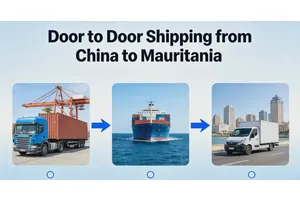
For importers who want a hassle-free experience — especially those without an in-house logistics team or an established customs broker in Mauritania — door-to-door shipping from China to Mauritania and DDP shipping from China to Mauritania are the most practical solutions. Our comprehensive Door to Door Shipping from China to Mauritania guide walks through the entire process step by step.
Choosing the Right Incoterms
| Incoterm | Seller (China Exporter) Covers | Buyer (Mauritania Importer) Covers | Best For |
|---|---|---|---|
| EXW (Ex Works) | Factory gate only | Everything — pickup, export clearance, freight, import clearance, duties, delivery | Large importers with their own logistics teams |
| FOB (Free on Board) | Delivery to Chinese port + export clearance | Ocean freight + import clearance + duties + inland delivery | Importers with a nominated freight forwarder |
| CIF (Cost, Insurance, Freight) | Delivery to Nouakchott port (freight + insurance included) | Import clearance + duties + inland transport | Importers who want to lock in ocean costs but handle customs themselves |
| DDP (Delivered Duty Paid) | Everything — door-to-door including all duties and taxes | Nothing — just receive the goods | First-time importers, SMEs without customs capabilities |
| DAP (Delivered at Place) | Door-to-door excluding duties and taxes | Import duties and VAT only | Importers who can handle tax payments but want logistics managed |
Our recommendation: If this is your first time importing from China to Mauritania, DDP shipping is the simplest path. Your freight forwarder handles every step — factory pickup, Chinese export clearance, ocean freight, ECTN certification, Mauritanian import clearance, duty and tax payment, and final delivery to your door. You receive one all-inclusive quote and one delivery. For a deeper comparison of Incoterms and how they affect your total cost and risk exposure, read our guide on DDP vs FOB: Which Option Saves Time and Reduces Hassle.
The Door-to-Door Journey
Here is the complete workflow, whether by sea or air: Supplier factory pickup across China → Export customs clearance at the departure port → International freight (ocean via transshipment or air via intermediate hubs) → ECTN/BESC validation → Mauritanian import clearance and duty/VAT payment → Last-mile trucking to your address in Nouakchott, Nouadhibou, Kiffa, Rosso, Zouerate, Atar, or any other Mauritanian city.
- Sea freight door-to-door: 50–70 days total
- Air freight door-to-door: 7–14 days total
Cargo Insurance & Shipment Tracking
The West Africa shipping route involves multiple handling points and transshipment hubs — each transfer introduces risk. Cargo insurance is not optional; it is essential. All Risks coverage (Institute Cargo Clauses A) protects against loss, damage, and theft. For high-value shipments ($50,000+), consider adding War Risk and Strikes Risk endorsements. Before you ship, review our breakdown of shipping container insurance cost for shipments from China to budget accurately.
Equally important is real-time shipment tracking. A professional freight forwarder should provide a 24/7 online tracking platform that lets you monitor your cargo's location from factory pickup to final delivery. DTFU Logistics offers a dedicated tracking portal and assigns a personal account manager who proactively communicates milestone updates — so you are never left wondering where your goods are.
Amazon FBA Shipping to Mauritania
While Mauritania does not yet have a domestic Amazon marketplace, some regional sellers use the country as a transshipment and distribution hub for West and North African markets. Amazon FBA prep services — including labeling, compliant packaging, and sea/air forwarding into the region — are available through freight forwarders with FBA expertise. If your business model involves distributing to multiple African markets, discuss your regional strategy with your forwarder early.
FAQs
Q1: How long does door-to-door shipping from China to Mauritania really take?
Sea freight door-to-door typically takes 50–70 days, while air freight door-to-door takes 7–14 days. The biggest variable on the ocean side is the feeder vessel connection at Tanger Med — missing the connection adds up to two weeks. An experienced freight forwarder plans buffer time into the schedule and monitors vessel connections proactively.
Q2: What is the cheapest way to ship from China to Mauritania?
LCL sea freight at $110–$280 per CBM is the most economical option for shipments under 15 CBM. For volumes above 15 CBM, FCL (20ft container) becomes more cost-effective per unit. Regardless of mode, sea freight is always significantly cheaper than air freight — reserve air for urgent or high-value cargo.
Q3: How much import duty and tax should I budget for Mauritania?
Plan for 25–40% on top of your CIF value, broken down as: customs duty 5–20% (varies by HS code), VAT 16%, and minor levies (RS ~1%, PC ~1%). Consumer goods generally face higher duty rates than industrial equipment. See the detailed calculation example in the Customs Clearance section above.
Q4: Can DTFU ship dangerous goods from China to Mauritania?
Yes — batteries, chemicals, and other regulated cargo can be shipped, provided the proper documentation is in place: MSDS (Material Safety Data Sheet), DGD (Dangerous Goods Declaration), and UN-certified packaging. Not every freight forwarder holds DG certification — verify that your forwarder has FIATA and IATA credentials before booking hazardous cargo.
Q5: Is there direct shipping from Shenzhen or Guangzhou to Nouadhibou?
No. All China–Mauritania services — whether to Nouakchott or Nouadhibou — require transshipment through Tanger Med or Las Palmas. Nouadhibou, as a northern free trade zone port, is an excellent choice for mining equipment and supplies destined for the northern industrial corridor. Your forwarder can advise whether routing through Nouadhibou (vs Nouakchott) reduces your total landed cost.