DDP shipping from China to Paraguay is the one number every importer wants and the one number most quotes quietly disagree on. Two forwarders can quote the same 5 CBM shipment at $95 per CBM and $1,300 per CBM. Neither is lying. They are quoting different legs of a journey that crosses a neighbouring country before your cargo ever reaches Asunción — and only one of them has the taxes inside the price.
This guide takes the 2026 lane apart in the order that matters: what DDP actually covers, why a landlocked country makes the all-in model the default, how to put two differently-priced quotes on the same page, which of the three transit corridors fits your cargo, and how Paraguay's import duty and 10% IVA are calculated. You also get the part almost nobody publishes: who is allowed to be the importer of record, and what happens when you don't have a Paraguayan company. For the wider service picture on this lane — sea, air and door delivery — start with Shipping From China to Paraguay.
What Is DDP Shipping from China to Paraguay? DDP vs DDU vs DAP vs FOB
DDP (Delivered Duty Paid) is the Incoterms 2020 term with the heaviest seller obligation. Under DDP the seller carries the cargo to a named destination and pays everything to get it there — freight, transit, customs clearance, import duty, IVA and final delivery. The buyer receives goods at their door with nothing left to pay.
That is the theory. In practice, "DDP to Paraguay" means something narrower, and the difference decides whether your quote is complete. The division of labour underneath all of this is worth understanding before you shop: The Strategic Role of Freight Forwarders in Modern Supply Chains explains where a forwarder sits between carrier, broker and customs authority.
| Leg | DDP | DDU / DAP | FOB | EXW |
|---|---|---|---|---|
| Pickup and export clearance in China | Seller | Seller | Seller | Buyer |
| Ocean or air freight | Seller | Seller | Buyer | Buyer |
| Transit-country customs and inland leg | Seller | Seller | Buyer | Buyer |
| Paraguayan import clearance | Seller | Buyer | Buyer | Buyer |
| Duty, IVA and ISC | Seller | Buyer | Buyer | Buyer |
| Final delivery | Seller | Seller (duty unpaid) | Buyer | Buyer |
| Importer of record (IOR) | Arranged by seller | Buyer | Buyer | Buyer |
The one thing DDP does not do: it does not remove the importer of record
This is the most misunderstood point on the lane. DDP transfers cost and operational responsibility. It does not transfer legal import status. Paraguay still requires a valid RUC (Registro Único del Contribuyente) behind the entry, and clearance still has to be filed by a licensed despachante de aduanas. A bill of lading naming a foreign consignee can be rejected at the manifest stage — before the vessel is even discharged.
So "can a Chinese company do DDP to Paraguay?" has a narrow answer: yes, as the service provider, but not as the importer. We unpack the compliant routes in the customs section below.
Why Paraguayan importers lean toward DDP anyway
For a first-time importer, DDP collapses three coordination problems into one invoice: a transit-country customs procedure, a river or road leg, and a Paraguayan entry with taxes attached. That is genuinely hard to assemble alone. Smaller importers without a standing despachante relationship, and e-commerce sellers shipping to a Mercado Libre or third-party warehouse, are the two groups that benefit most.
Why Landlocked Paraguay Makes DDP the Default Choice
Paraguay is one of only two landlocked countries in South America — Bolivia is the other, and importers there work through the same inland logic, which is why Shipping From China to Bolivia reads like a parallel playbook. Paraguay has no seaport. Every container arrives through a neighbour's port and then travels inland by river barge or truck — a structural fact that shapes every quote you will ever receive.
China is Paraguay's largest import partner, yet the two countries have no free trade agreement, so there is no preferential tariff to claim on Chinese-origin goods. You pay the standard MERCOSUR tariff.
Two physical doors into the country
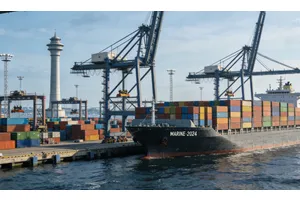
The waterway. The Paraná-Paraguay Hidrovía runs roughly 3,442 km from Puerto Cáceres in Brazil to Nueva Palmira in Uruguay, and it moves the clear majority of Paraguay's trade — commonly cited at 80–90% of import and export cargo by volume. Vessels discharge at Montevideo or Buenos Aires, and cargo is relayed on river barges to inland ports such as Villeta (Terport), Puerto Fénix, Caacupemi and Puerto de Asunción.
The road. Cargo can also cross by truck — from Brazil at the Foz do Iguaçu–Ciudad del Este Friendship Bridge, or from Argentina at Clorinda–Puerto Falcón and Encarnación–Posadas.
A container's actual journey
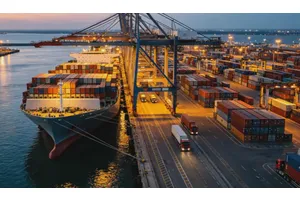
Shenzhen or Ningbo → export clearance → ocean freight to Montevideo (Uruguay) or Buenos Aires (Argentina) → transit-port discharge and customs transit → river barge or cross-border truck → Paraguayan inland port or land border → import clearance and tax payment → final delivery to Asunción, Ciudad del Este or Encarnación.
Our industry insight — the middle leg is the whole story. On coastal lanes, the port is the last mile of the freight problem. On Paraguay, the port is roughly the halfway point. In our weekly sailings from South China via Montevideo, the inland leg regularly accounts for a third or more of total freight cost — and it is the first thing a cheap quote quietly leaves out. When a quote is dramatically lower than the rest, it is almost never better pricing. It is a shorter scope.
DDP Shipping Cost from China to Paraguay: 2026 Rates & the Quote-Caliber Problem
Before comparing a single number, you need to know which of five scopes you are looking at. This table is the most useful thing on this page.
| Caliber | What is covered | Typical wording | Ask this |
|---|---|---|---|
| ① Port-to-port | Ocean freight only | "$95–160 per CBM" | Are origin and destination charges inside? |
| ② Plus origin charges | ① + origin THC, docs, export clearance | "$110–260 per CBM" | Are destination and transit charges inside? |
| ③ Plus transit leg | ② + transit-port THC, barge or truck, customs transit | Rarely quoted separately | Are Paraguayan clearance and taxes inside? |
| ④ Cleared and taxed (true DDP) | ③ + duty + IVA + ISC + broker fee | "$800–1,300 per CBM" | Is final delivery inside? How long is the rate valid? |
| ⑤ Delivered to door (full DDP) | ④ + delivery to Asunción or Ciudad del Este | One flat delivered price | What is the free time, and who eats a low-water surcharge? |
A caliber ① quote and a caliber ⑤ quote for the same box are not competing prices. They are different products.
2026 rate ranges — read the caliber column first
| Mode | 2026 market range | Caliber | Notes |
|---|---|---|---|
| LCL sea freight | $95–160 per CBM | ① / ② | Minimum 1 CBM; handling increases with volume |
| FCL 20GP | $2,900–7,100 | ① / ② | The wide band reflects booking date and carrier |
| FCL 40GP / 40HQ | $4,200–7,740 | ① / ② | 40HQ for light, bulky consumer goods |
| Air freight | $6.50–11.00 per kg | Airport-to-airport | Chargeable weight, not gross weight |
| Express courier | ~$16.50 per kg | Door-to-door | Paraguayan duty and IVA usually not included |
| Sea DDP, all-in | ~$800–1,300 per CBM | ④ / ⑤ | Taxes and delivery inside the price |
| Air DDP, all-in | $8–18 per kg | ④ / ⑤ | Fastest cleared option |
Rates reflect available market data from Q2–Q3 2026, port-to-port unless stated. This lane reprices quickly — a June-to-September swing on 20ft boxes was reported above 60% — so treat every figure as an order of magnitude and confirm against a live quote. Quote validity here is typically two to three weeks.
Because most published figures are port-to-port, cargo insurance is one of the items that silently falls outside the number. Shipping container insurance cost for shipments from China covers what cargo insurance actually costs and where the gaps sit.
Why the same route shows a 2x spread
Three variables explain almost all of it: scope (caliber ① versus ⑤), surcharges (whether BAF, PSS and LSS are inside the rate or added later), and booking date relative to the peak. Only the third is a market event you cannot negotiate — and it is exactly why a quote without a stated validity date cannot be compared to anything.
The Hidden Transit-Leg Costs: Montevideo, Buenos Aires and Brazil Compared
Every DDP quote to Paraguay contains a middle leg that has no equivalent on a coastal lane. On the busiest routing that leg begins in Uruguay — see Shipping from China to Uruguay — while the river-and-road alternative runs through the Argentine gateway covered in Shipping From China to Argentina. Here is what actually gets charged between the ocean vessel and your warehouse.
| Charge | Nature | Who bills it |
|---|---|---|
| Transit-port THC (Montevideo / Buenos Aires) | Discharge, stacking, transit handling | Transit terminal |
| River barge freight | Priced per CBM or per container | Barge operator |
| Cross-border trucking | The substitute when barges cannot load | Road carrier |
| Customs transit and bond fees | Transit-country customs procedure | Transit broker |
| Paraguayan river-port handling | Unloading at Villeta, Terport and similar | Inland terminal |
| Documentation, security and delivery order fees | Small, cumulative | Various |
None of these is optional, and none can be genuinely removed by a lower quote — only relocated off the price sheet.
| Corridor | Route | Transit profile | Best for |
|---|---|---|---|
| Montevideo (UY) — river barge | Ocean to MVD → transit clearance → Hidrovía barge → Asunción | Longer, lowest unit cost | Large volumes, flexible deadlines, Asunción and the interior |
| Buenos Aires (AR) — truck or barge | Ocean to BA → road or river into Paraguay | Mid-range | Northern destinations and Clorinda crossings |
| Brazil (Santos / Paranaguá) — road | Ocean to Brazil → truck via Foz do Iguaçu | Varies with border queues | Ciudad del Este and Brazil-facing trade |
Low water is the risk nobody prices
The Hidrovía is a river, and rivers have seasons. During the dry window — typically August to October — water levels fall enough that barges must sail part-loaded, and at the extreme the cargo moves by truck instead. Draft restrictions are set by navigation authority resolution and revised as levels change; in early September 2026, readings at Asunción and Villeta were around 0.75–1.11 metres and falling roughly 2 cm per day. The 2026 season has been milder than the droughts of 2022–2024, but the risk has not gone away.
Our industry insight — put the water level in the contract, not in the fine print. When we quote DDP to Paraguay, we name the corridor and state how a low-water surcharge is handled. If a forwarder cannot tell you which corridor they are booking, or who pays if the barge has to be replaced by trucks, the quote is not yet a price — it is an estimate with an escape clause. Ask before you sign, not after the barge is cancelled.
How Long Does DDP Shipping from China to Paraguay Take?
| Stage | Typical duration |
|---|---|
| Factory pickup and consolidation in China | 1–3 days |
| Export clearance and loading | 2–5 days |
| Ocean freight to the transit port | 30–45 days |
| Transit-port handling and customs transit | 2–5 days |
| River barge or cross-border truck | 5–12 days |
| Paraguayan clearance and tax payment | 1–3 days when documents are clean |
| Final delivery (Asunción / Ciudad del Este / interior) | 1–3 days |
| Door to door | roughly 45–70 days |
Why you will see everything from 14 days to 55 days
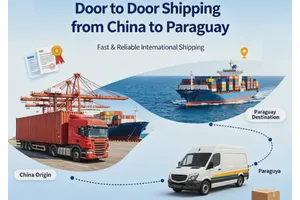
Published transit times on this lane are not really contradictory — they are measuring different things. A port-to-port ocean transit is not a door-to-door delivery. A coastal figure gets pasted onto a landlocked route. And a dry-season schedule gets quoted as if the river were at full depth. When you compare two providers, compare like with like: same origin port, same corridor, same destination address, same season. If your delivery point is a warehouse rather than a port, the only number that matters is the Door to Door Shipping from China to Paraguay figure.
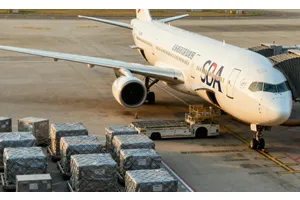
Air DDP is the outlier. Routing through São Paulo, Buenos Aires, Miami or Panama City into Silvio Pettirossi International (ASU) at Luque, air freight runs 6–10 days airport-to-airport and roughly 12–15 days cleared and delivered — a different product at a different price point. Several of those routings stage through a South American hub first; Air Shipping from China to Argentina covers the Buenos Aires option in detail.
Four windows that need buffer
Dry-season low water on the Hidrovía; peak-season capacity crunches and blank sailings; Paraguayan holidays and the year-end slowdown; and Chinese New Year plus Golden Week, when origin capacity tightens. Add three to seven days of cushion on the eastbound lane if any of these overlaps your delivery date.
Paraguay Import Duty, IVA 10% and Clearance: Who Can Be the Importer of Record?
This is where a shipment either releases in three days or sits for three weeks. Paraguay's customs and tax authority is DNIT, formed in 2023 when the former DNA (Dirección Nacional de Aduanas) was merged with the tax administration. Older guides still say "DNA" — the merger changed the name, not the procedure.
Who is allowed to import
Paraguay requires a valid RUC behind the import declaration and a licensed despachante de aduanas to file it. The practical consequence for foreign sellers is blunt: a bill of lading showing a foreign consignee can be refused at the manifest stage. No local importer, no discharge.
If you have no Paraguayan entity, three routes exist, and only two are comfortable:
- A RUC-holding import agent or broker files as the declarant, with cargo ownership and tax treatment agreed in writing. Workable, but the paperwork must be explicit about who owns the goods.
- A free-zone entity in Ciudad del Este or Villeta, which suits re-export and distribution models.
- Switch to FOB and clear it yourself, if you already have a RUC and a standing despachante. See the final section — for some importers this is simply the better deal.
The three-layer tax structure
| Charge | Base | Typical rate |
|---|---|---|
| Import duty (Arancel) | CIF value | 0–35% under the MERCOSUR TEC / AEC, set by NCM code |
| IVA (VAT) | CIF + duty | 10% standard, 5% on selected essentials |
| ISC (excise) | Per product schedule | Applies to specific categories only |
Duty bands are wide because the tariff is product-specific. As a rough guide, industrial and capital goods often land near the bottom of the range, while finished consumer goods — apparel, some electronics, homeware — sit considerably higher. Your NCM classification, not the invoice description, decides where you land.
There is no de minimis. Paraguay's threshold for taxable commercial imports is effectively zero, so samples and small trial orders are formally entered and taxed like anything else. If you are testing a supplier, budget for a real customs entry.
Worked example — US$15,000 CIF, 20% duty line: duty = $3,000. IVA = ($15,000 + $3,000) × 10% = $1,800. Tax total = $4,800, before broker fees and any storage.
IVA is money you float, not money you lose
Here is the point that changes how you judge DDP. For a RUC-registered importer, the IVA paid at import is creditable — it is reclaimed against future tax liability, which makes it a cash-flow item rather than a permanent cost.
- If you can credit IVA back, DDP's value is convenience and price certainty. You are buying predictability, not a discount.
- If you cannot credit it — an individual, an unregistered buyer, a foreign seller absorbing the tax — IVA is a hard cost, and an all-in DDP price that bundles it is genuinely doing you a favour.
Same tax, two completely different conclusions. Ask which one you are before you ask for the cheapest number. The all-in model is not unique to this market either — DDP shipping from China to Canada runs the same convenience-versus-cost trade-off on a very different lane.
Clearance flow and the compliance checklist
Entry is filed electronically through SOFIA, with the import declaration commonly referred to as the DUI. Cargo is released through selectivity channels — green, yellow or red — which determines whether it moves straight to release or stops for documentary and physical inspection. Lodge your documents with the broker before arrival rather than after; a pre-cleared entry is what turns a three-day release into a same-week one.
Have these ready: commercial invoice, packing list, original or telex-released bill of lading, insurance certificate, NCM code, and — depending on the product — an import permit from INAN (food, cosmetics, health), SENAVE or SENACSA (plant and animal health), INTN (standards and metrology) or CONATEL (telecom and electronics). Wood packaging must be ISPM-15 heat-treated and stamped. Labeling must be in Spanish. Permits are the single most common cause of cargo sitting in storage, and they take weeks to obtain — start before production, not before sailing.
Our industry insight — the cheapest way to save three weeks is paperwork. In our experience on this lane, the shipments that clear fastest are not the ones with the lowest duty. They are the ones whose NCM classification was checked before the invoice was issued, whose permits were filed while the goods were still in production, and whose broker had the documents 48 hours before arrival. Everything else is a storage invoice with extra steps.
Sea DDP vs Air DDP: Costs, Break-Even and Two Landed-Cost Walkthroughs
| Dimension | Sea DDP (FCL / LCL) | Air DDP |
|---|---|---|
| Unit of pricing | Per container (FCL) or per CBM (LCL) | Per chargeable kg |
| 2026 all-in range | ~$800–1,300 per CBM | ~$8–18 per kg |
| Transit, door to door | ~45–70 days | ~12–15 days |
| Works best for | Volume, heavy goods, planned demand | Urgent, high-value, seasonal goods |
| Restrictions | Fewer | Batteries, liquids, powders, magnets |
Both halves of that table are priced on this lane: Sea Shipping from China to Paraguay covers the ocean product, and Air Shipping from China to Paraguay covers the time-critical one.
When air genuinely beats sea
Air costs several times more per kilogram, so it looks like it always loses. It doesn't, if you price the whole picture. Move 500 kg by air instead of waiting six weeks for a container and you release inventory value immediately: the cash tied up in that stock, plus the sales you did not miss while waiting, can exceed the air premium outright. The calculation is not "freight per kg versus freight per kg" — it is inventory carrying cost and stockout risk versus the air premium. For first launches and short seasonal windows, the premium often pays for itself.
Chargeable weight, in one paragraph
Airlines bill the greater of actual and volumetric weight. Volumetric weight is derived from volume using a standard divider, so bulky low-density cargo pays more than its scale weight. Repackaging tightly is one of the few cost levers you control on air shipments.
The landed-cost ladder
Work down the stack: EXW value → origin charges → international freight → insurance → CIF → transit leg (transit-port THC + barge or truck + customs transit) → import duty → IVA 10% → broker fee → storage or detention → inland delivery → total landed cost.
Walkthrough 1 — 5 CBM of homeware, FOB $15,000, LCL DDP to Asunción. Freight and origin charges are priced per CBM, then the transit leg is added at cost. Duty is applied to CIF, IVA to CIF plus duty, and the broker fee and delivery are fixed per shipment. Roughly, taxes land in the $4,000–6,000 band depending on the duty line, with freight, transit and delivery on top. Small LCL shipments carry a per-shipment cost floor that a container does not.
Walkthrough 2 — one 20GP of machinery, FOB $40,000, FCL DDP to Ciudad del Este. Here the freight and transit leg become a smaller share of landed cost and the taxes dominate. The corridor matters more than the rate: booking via Brazil shortens the inland leg to Ciudad del Este, while Montevideo suits Asunción. On high-value cargo, confirming your NCM classification is worth more than any freight negotiation.
Matching the mode to the cargo
| Cargo type | Entry requirement to plan for | Usual mode |
|---|---|---|
| E-commerce and Mercado Libre stock | Spanish labels, clean commercial invoice | Sea DDP, air for replenishment |
| Machinery and equipment | NCM review, weight and lifting plan | FCL sea |
| Building materials and tiles | Heavy cargo, weight distribution | FCL 20GP |
| Auto parts | NCM review, brand documentation | FCL or LCL |
| Electronics and phones | CONATEL homologation | Air DDP or FCL sea |
| Food and cosmetics | INAN registration | FCL sea, air for samples |
Consolidating is the quietest lever available. Four South China suppliers producing 45–55 CBM between them can be picked up, inspected, labeled and palletized into a single 40HQ rather than shipped as four LCL lots — fewer handlings, less damage, and one transit leg instead of four.
DDP to Ciudad del Este: Free Zones, Re-Export and When FOB Beats DDP
Ciudad del Este is not primarily a Paraguayan consumer market. Sitting at the junction of Brazil, Argentina and Paraguay, it is a re-export and border-trade hub — goods enter and leave again, largely for Brazil.
Free zones under Ley 523/95, including Ciudad del Este and Villeta, allow warehousing, sorting, labeling, light processing and re-export with duty and tax treatment that differs from a normal import. The Régimen de Turismo de Comercio (Decreto 2063) and the Maquila regime (Ley 1064/97) cover other flows. The operational rule that trips people up is documentary: the applicable regime must be stated on the entry. Confirm the current treatment with the authorities before committing a shipment, because these regimes are the difference between a distribution operation and an expensive storage arrangement.
Delivery point changes the corridor, and the corridor changes the cost. Ciudad del Este is usually served from Brazil — Sea Shipping from China to Brazil covers that routing — while Asunción is served from Montevideo.
When FOB is the better deal
DDP is not automatically the right answer, and a forwarder who says otherwise is selling rather than advising. DDP vs FOB: Which Option Saves Time and Reduces Hassle breaks that trade-off down further. If you hold a RUC, work with a despachante you trust, and can credit IVA back, then FOB plus your own clearance typically costs less and leaves you in full control of the goods and the tax position. DDP earns its premium when coordination is the hard part — first shipments, no local team, a delivery deadline you cannot miss.
| Your situation | Usually better |
|---|---|
| First import, no local entity, one delivery address | DDP |
| E-commerce seller replenishing across multiple SKUs | DDP |
| RUC holder with a standing broker, creditable IVA | FOB |
| Buyer with in-house customs or a freight team | FOB |
| Cargo destined for re-export via a free zone | DDP or free-zone regime |
Whichever you choose, insurance is a separate decision. DDP does not automatically mean full cover. Verify what is insured, under which Institute Cargo Clauses (A, B or C), who the beneficiary is, and how a claim is filed — the river leg and the inland truck segment are precisely where a policy's exclusions tend to hide.
FAQs
How much does DDP shipping from China to Paraguay cost?
All-in sea DDP is commonly quoted around $800–1,300 per CBM, or $8–18 per kg by air. Port-to-port FCL runs $2,900–7,100 for a 20GP. Always confirm which scope a quote covers before comparing.
How long does it take door to door?
Roughly 45–70 days by sea including the transit leg and clearance, and 12–15 days by air. Port-to-port ocean transit alone is 30–45 days.
What is included in a DDP quote?
Freight, origin charges, the transit-country leg, Paraguayan clearance, duty, IVA and delivery — if it is a genuine DDP quote. Ask specifically whether transit-port THC, the barge fee and final delivery are inside.
Who pays duty and IVA under DDP?
The seller does, as part of the price. The legal importer of record, however, still has to be a RUC-holding Paraguayan entity.
How is the 10% IVA calculated?
On CIF value plus import duty, not on CIF alone. A $15,000 CIF shipment at 20% duty pays $3,000 duty plus $1,800 IVA.
Do I need a Paraguayan company to import under DDP?
You need a RUC-backed importer of record. Without your own entity, the compliant options are a RUC-holding import agent or a free-zone entity.
Is DDP legal in Paraguay?
Yes — providing the importer of record and the customs broker are correctly registered. Problems arise when a foreign entity is named as consignee.