Customer Background
The customer is a foodservice disposables importer based in the U.S. Midwest. They supply single-use tableware to restaurants and catering companies across the region and were expanding a private-label line of injection-molded plastic tableware (forks, spoons, knives, and plates) sourced directly from China.
This container carried part of the first production run of that private-label line. The commercial objective was a per-unit landed cost that stayed competitive against established national brands while meeting the compliance requirements that food-contact plasticware carries on entry into the United States. DTFU Logistics was engaged to handle the ocean freight and the documentation chain from the factory in Xiamen to the customer's warehouse in the Chicago area.
Cargo Information
| Item | Detail |
|---|---|
| Commodity | Plastic tableware (injection-molded forks, spoons, knives, plates) |
| Mode | Ocean freight FCL |
| Origin | Xiamen, China |
| Destination | Chicago, IL, United States (IPI via Long Beach) |
| Incoterm | FOB Xiamen |
| Container | 1×40HQ |
| Gross weight | 7,800 kg |
| Volume | 55 CBM |
| Pallets | 19 |
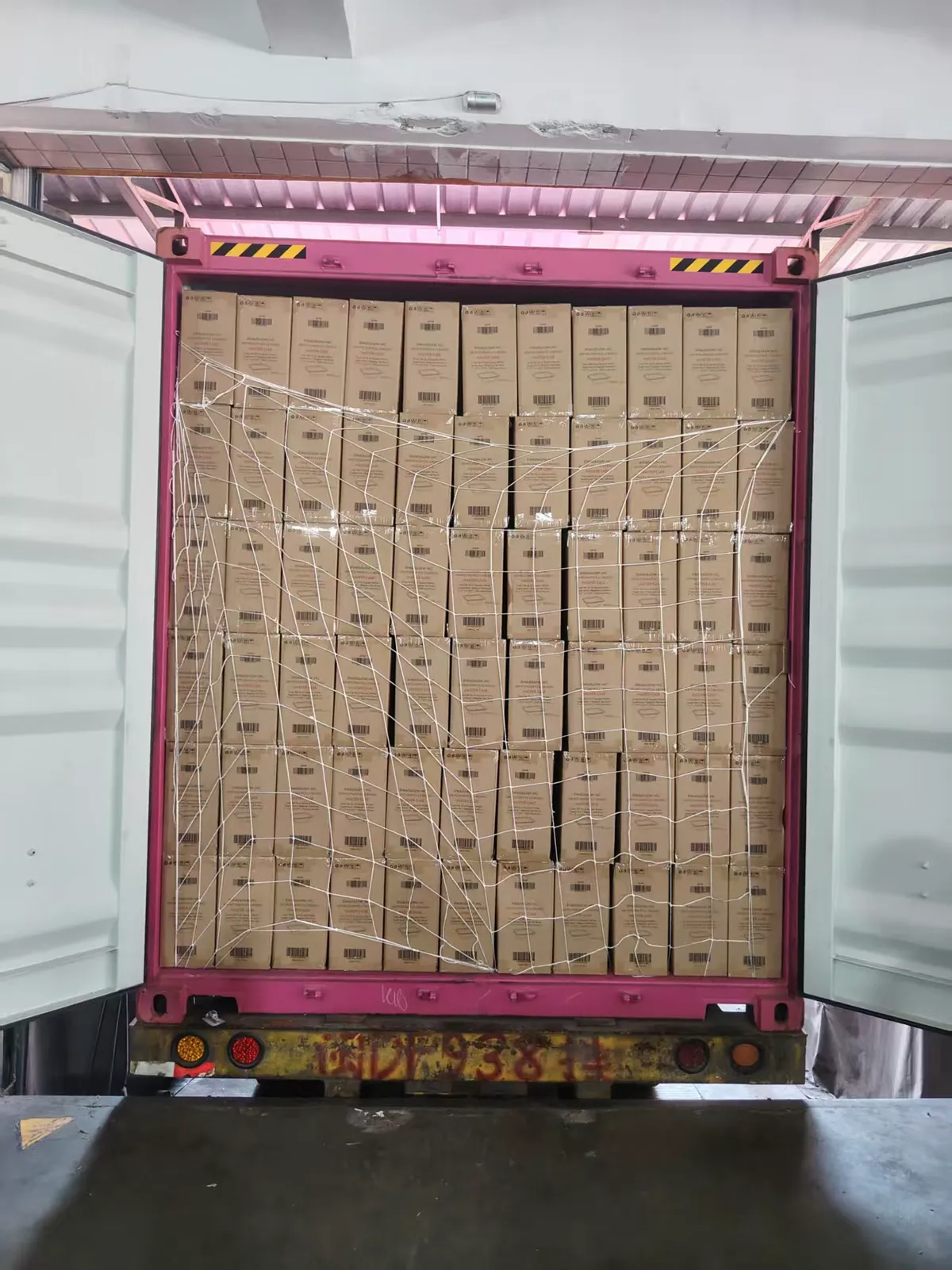
The shipment consisted of injection-molded tableware cartons from a single production run. The 7,800 kg gross weight against 55 CBM marks the cargo as light-bulky: it cubes out well before it weighs out, sitting at roughly 55 CBM against a 40HQ usable volume of about 67 CBM and far below the ~26 t payload limit. The uniform SKU cartons were double-stacked on 19 export pallets.
Why This Shipping Method
A 40HQ full-container move was selected over LCL consolidation. At 55 CBM the cargo exceeded the range where LCL becomes cost-effective, and for a food-contact product the additional handling and re-sorting of consolidation would have added touch points without benefit. Keeping the shipment as a single FCL also preserved the document trail between the factory's test report and the specific production run it covered.
For the inland leg, the container moved under the standard IPI (Interior Point Intermodal) model: ocean to Long Beach, then rail to the Chicago ramp, then drayage to the warehouse. This routing was chosen over an all-water East Coast service because it offered a materially shorter door-to-door window at a comparable all-in cost for a Midwest destination.
The light-bulky profile governed the equipment choice. Because the cargo cubes out at 55 CBM, a 20GP could not hold the volume; the 40HQ decision was driven by cube rather than weight.
Shipping Process
Step 1 — Factory loading (Xiamen)
An empty 40HQ was dropped at the factory. The uniform injection-molded tableware cartons were loaded double-stacked on 19 export pallets with stretch wrap and edge protection, following a standardized pallet pattern agreed before the container drop. Loading was supervised by the factory export team and completed within the day. The container was sealed with a high-security bolt seal; container and seal numbers were recorded.
Step 2 — Export customs clearance (Xiamen)
The commercial invoice, packing list, and export declaration were filed through the China Customs single window. The HTS line for the plastic tableware was declared consistently with the U.S. entry classification to keep the invoice and customs data aligned downstream for the ISF and entry filing. The declaration cleared the same day.
Step 3 — Ocean freight (Xiamen → Long Beach)
The container loaded onto a scheduled transpacific service at Xiamen. The ocean crossing to the Port of Long Beach, California took 13 days.
Step 4 — U.S. customs clearance and FDA document review (Long Beach)
After discharge, the entry was filed. Because plastic tableware is a food-contact article, the FDA-related documentation was reviewed at entry: the third-party ISO 17025 migration test report and the supplier's English Declaration of Compliance with the QR-linked test report. The declaration had been published on the factory's foreign-trade website before the vessel sailed, in line with the requirement that took effect in August 2026. The entry was released without a sampling hold.
Step 5 — Rail inland haulage (Long Beach → Chicago)
After release, the container transferred to a rail ramp for the inland leg. The rail transit from Southern California to the Chicago ramp took five days on the double-stack network.
Step 6 — Drayage and unloading (Chicago)
The container was drayed from the Chicago rail ramp to the customer's warehouse. Unloading took approximately two hours; all cartons were received intact and the seal number matched the bill of lading.
Challenges Encountered
1. FDA food-contact compliance and the new DoC disclosure rule
Plastic tableware is a food-contact article and falls under FDA 21 CFR Part 177, which imposes migration limits on polymer components. The evidence CBP checks at entry is not a certificate but a third-party migration test report from an ISO 17025-accredited laboratory. From August 2026, FDA also requires the exporting supplier to publish an English Declaration of Compliance with a QR-linked test report on its foreign-trade website. This shipment landed in the same month the requirement took effect, so the compliance package had to be complete in both the paper file and the online disclosure by the time the vessel reached Long Beach — otherwise the entry risked a hold and a sampling order.
2. Section 301 landed-cost exposure
Plastic tableware is classified under HTS 3924, which is subject to the Section 301 List 3 additional duty on goods of Chinese origin. For a private-label line being priced against domestic alternatives, the duty materially changed the per-unit landed cost and had to be confirmed and included before the customer committed to the order.
3. Light-bulky cube utilization
The cargo weighed 7,800 kg at 55 CBM — the constraint was cube, not weight. Loaded without a plan, a light-bulky cargo of this profile can leave a 40HQ under-used, directly inflating the per-unit freight the customer was benchmarking against local supply.
How We Solved Them
For the FDA compliance package:
Before booking, the migration test report was verified to exist, to cover the resin system and colorants in the actual production run, and to have been issued by an ISO 17025-accredited laboratory. The factory's English Declaration of Compliance, with the QR-linked test report, was confirmed to be published on its foreign-trade website before the vessel sailed, in line with the August 2026 requirement. The full document set — test report, Declaration of Compliance, commercial invoice, and packing list — traveled with the shipment, so the FDA-related documentation was reviewed at entry without a sampling hold.
For the Section 301 exposure:
The HTS 3924 classification was confirmed before booking, and the Section 301 List 3 rate was factored into the landed-cost model given to the customer, so the per-unit comparison reflected the duty-inclusive figure. The same tariff line was used consistently on the export declaration, the ISF, and the U.S. entry to avoid a rate revision.
For the cube utilization:
A standardized pallet pattern was set before the container drop: uniform SKU cartons in consistent layers, double-stacked on 19 export pallets with stretch wrap and edge protection, reaching 55 CBM against the 40HQ's usable volume. For a cargo that cubes out before it weighs out, the palletization plan was the controlling variable on per-unit freight.
Final Timeline
| Milestone | Timing |
|---|---|
| Empty container drop and factory loading (Xiamen) | Day 1 |
| Export customs clearance (Xiamen) | Day 2 |
| Vessel departure Xiamen | Day 3 |
| Arrival Long Beach | Day 16 |
| U.S. customs clearance and FDA document review | Day 18 |
| Rail departure Long Beach | Day 19 |
| Arrival Chicago rail ramp | Day 24 |
| Drayage and warehouse unloading | Day 25 |
Total door-to-door transit time: 25 days
Final Cost
| Item | Cost (USD) |
|---|---|
| Ocean freight (1×40HQ, Xiamen → Long Beach) | $2,900 |
| Origin THC, documentation, port fees | $410 |
| ISF filing | $45 |
| U.S. customs clearance | $160 |
| Rail IPI (Long Beach → Chicago) | $1,180 |
| Drayage (Chicago ramp → warehouse) | $380 |
| Total door-to-door | $5,075 |
Note: figures reflect the spot rates for this shipment (August 2026) and vary with season, fuel surcharge, and carrier capacity. Section 301 List 3 duty on the HTS 3924 line is collected separately at entry and was quoted to the customer as part of the landed-cost model. The FDA migration test report was prepared by the factory before shipment and is outside the freight table.
Customer Review
"The container cleared entry without a hold on the strength of the migration test report and the supplier's Declaration of Compliance, which was published on the factory's website by the time the vessel arrived. The Section 301 duty was in the landed-cost model from the start, so the per-unit number held. Door-to-door was 25 days."
— The customer's supply chain manager, Chicago
Lessons Learned
- FDA food-contact compliance is a pre-booking verification, not an entry-time task. For 21 CFR Part 177 articles, the ISO 17025 migration test report is the evidence CBP checks at entry, and under the August 2026 requirement the supplier's English Declaration of Compliance with QR-linked test report must be live online before the vessel departs. Completing both before shipment removed the hold risk.
- Section 301 exposure has to be inside the per-unit number. HTS 3924 plastic tableware carries a List 3 additional duty; locking the tariff line before booking and using it consistently across the export declaration, ISF, and entry kept the private-label pricing accurate.
- Light-bulky cargo cubes out before it weighs out. At 7,800 kg and 55 CBM, the 40HQ was a cube decision; standardized double-stacked palletization on 19 pallets was what recovered the usable volume against the container's limit.
- IPI rail remains the default inland leg for Midwest FCL. A 13-day ocean crossing plus 5-day rail transit delivered 25 days door-to-door to Chicago, shorter than an all-water East Coast routing for a Midwest destination.