Customer Background
The customer is a natural-stone importer and distributor based in Northern California. They supply marble slabs to fabricators and kitchen/bath showrooms across the Bay Area, holding warehouse inventory that fabricators draw from for countertop and flooring projects.
The company had shipped marble slabs from Xiamen before, but on those earlier orders the equipment had been selected on a volume basis and a 40HQ was used. This order was planned from the outset as a 20GP move because the cargo was known to weigh out before it cubed out. The equipment decision, the weight management, and the slab protection plan were the three operational constraints that defined this shipment.
Cargo Information
| Item | Detail |
|---|---|
| Commodity | Marble slabs (natural stone, dimension stone) |
| Mode | Ocean freight FCL, 1×20GP |
| Origin | Xiamen, China |
| Destination | Oakland, CA, United States |
| Incoterm | FOB Xiamen |
| Gross weight | 26,400 kg |
| Volume | 22 CBM |
| Units | 6 timber-framed crates |
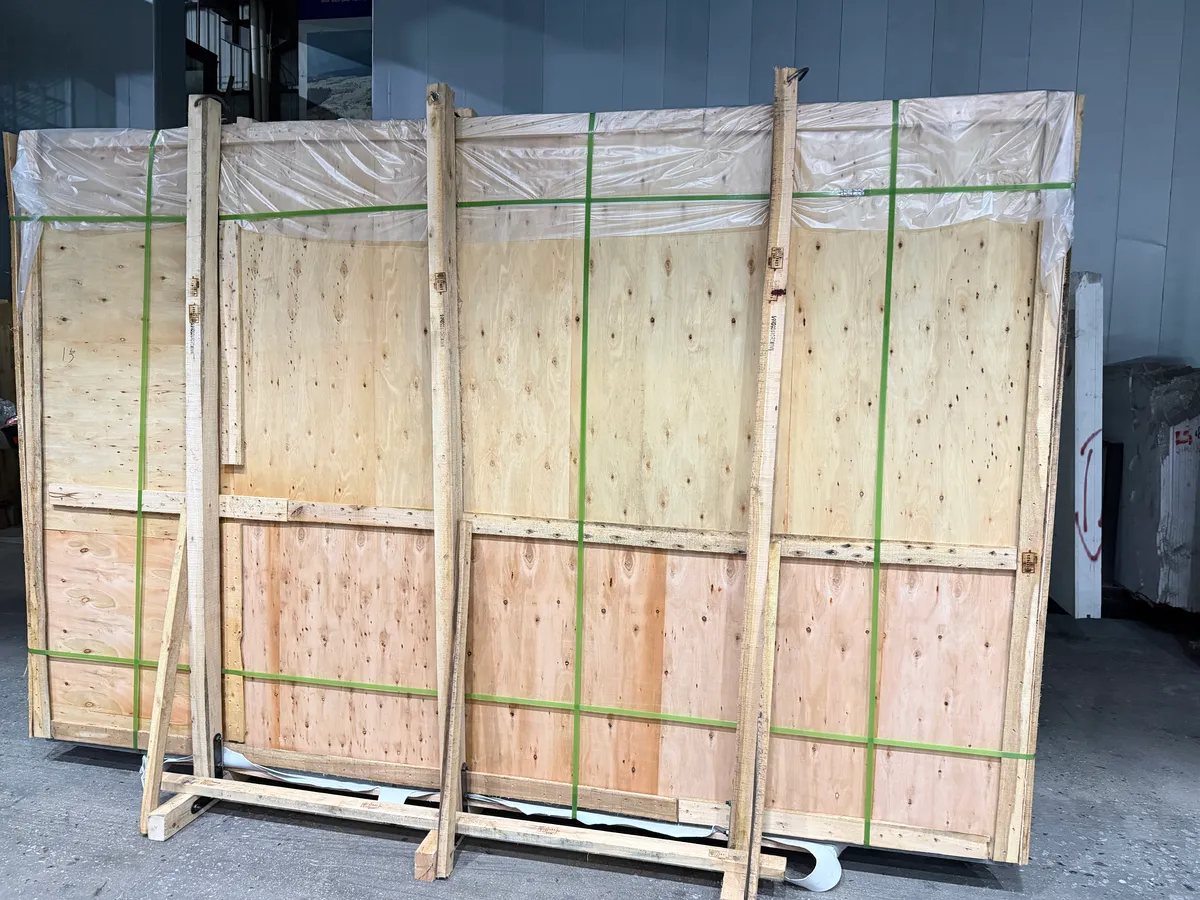
The cargo consisted of 6 timber-framed crates of polished marble slabs supplied by a Xiamen stone exporter, packed with the polished faces turned inward. At 26,400 kg the shipment sat approximately 1,600 kg below the 20GP payload ceiling of roughly 28,000 kg — a margin of about 6%. Against a 20GP usable volume of roughly 28 CBM, the 22 CBM of cargo filled most of the cube while the gross weight governed the operation. Weight, not volume, was the binding constraint.
Why This Shipping Method
A 20GP was selected over a 40HQ because the cargo weighs out, not cubes out. At 22 CBM the load would occupy roughly one-third of a 40HQ's usable volume, yet the 26,400 kg gross weight would still consume the full payload capability of either container. A 20GP carries essentially the same payload ceiling (~28,000 kg) as a 40HQ at a materially lower ocean freight rate, so for a dense load that reaches the weight limit before a quarter of the 40HQ cube is used, the 20GP is the correct equipment. The rate advantage was the deciding factor, not the cube.
The routing used a West Coast direct service from Xiamen to Oakland. Oakland was chosen as the discharge port over Los Angeles / Long Beach because it is the traditional West Coast port for construction materials and dimension stone serving Northern California, and it positions the cargo roughly an hour of drayage from the customer's Bay Area warehouse, shortening the inland leg.
Natural stone (HTS 2515) carries no Section 301 exposure, so the landed-cost calculation for this cargo was dominated by the freight weight rather than by duty. That also simplified the equipment decision: with no tariff line to factor in, the 20GP-versus-40HQ question reduced purely to a freight-weight calculation.
Shipping Process
Step 1 — Crating inspection and container loading (Xiamen)
Before the empty 20GP was dropped, the 6 timber-framed crates were inspected at the loading point: polished faces turned inward, protective film and foam interlayers between slabs, and cross-braced timber framing with steel strapping. The crates were then loaded on edge (vertical orientation), with the slab faces running along the container length so the faces sat in compression rather than flexing. Each crate was weighed and logged as it was loaded, and the crates were positioned so the heavier units sat forward of the container's midpoint and the lighter units toward the rear, with dunnage and shoring placed between crates and against the container walls to prevent fore-aft shift. Loading was supervised in full and the seal number recorded.
Step 2 — Export customs clearance (Xiamen)
The commercial invoice, packing list, and export declaration were filed through the China Customs single window. Natural stone is not a restricted export from China, and the declaration cleared the same working day.
Step 3 — Ocean freight (Xiamen → Oakland)
The container was loaded onto a scheduled transpacific service at the Xiamen terminal. The ocean crossing to Oakland took 14 days.
Step 4 — Terminal handling and U.S. customs clearance (Oakland)
On arrival at the Oakland terminal, the container's gross weight was checked against the 20GP limit and confirmed within tolerance; no overweight surcharge was applied. The ISF had been filed 24 hours before lading. U.S. customs clearance was processed without examination, as natural stone under HTS 2515 requires no special permits.
Step 5 — Drayage and warehouse delivery
The container was drayed from the Oakland terminal to the customer's warehouse in the Bay Area. Unloading used a forklift and crane in the reverse of the loading sequence, crate by crate, so that weight distribution was managed on the way out as it had been on the way in. All 6 crates were received intact and the seal number matched the bill of lading.
Challenges Encountered
1. Weight limit, overloading risk, and terminal handling
At 26,400 kg the shipment was approximately 1,600 kg below the 20GP payload ceiling. The margin was workable but not large: an error in the declared weight, an overweight reading at the terminal scale, or a difference between the booked and actual weight could have triggered an overweight surcharge or a terminal refusal to handle the box. The West Coast terminal overweight thresholds and the certified weight on discharge were both points of exposure.
2. Slab face protection and crate integrity
The polished marble faces carry the commercial value of the cargo; scratches, chips, or edge damage at any handling point reduce slabs to second-grade stock, and a damage claim on this cargo class is large relative to the freight bill. The crates had to survive crane and forklift lifting, the vertical stacking inside the container, and 14 days of vessel motion without racking. Face-to-face contact without protection, or a crate that deformed under the concentrated load, was the primary damage vector.
3. Center-of-gravity control in a dense 20GP load
A 20GP has an internal length of roughly 5.9 m, and 26,400 kg concentrated in 6 crates is an exceptionally dense load for that footprint. Weight distribution along the container length had to be controlled: a mass concentrated at one end creates an axle-imbalance on the chassis, and a single concentrated load at the exact midpoint is the classic cause of bottom-rail and floor point-load damage on heavy stone containers.
How We Solved Them
For the weight limit and terminal handling:
The declared weight was verified against the shipping line's payload limit and the Oakland terminal's overweight threshold before the booking was confirmed. The 26,400 kg figure was carried consistently on the packing list and the bill of lading so the terminal had the certified number at discharge. Because the load sat within tolerance with a ~6% margin, no overweight surcharge applied and no weighing dispute arose. The 20GP was selected precisely because it offers the same payload ceiling as a 40HQ at a lower rate — the objective was to confirm the load stayed under the ceiling, not to lighten it.
For the slab face protection and crate integrity:
Crating was inspected at the loading point before the container drop, and the inward-facing polished faces with film and foam interlayers were confirmed before loading. The crates were loaded on edge so the slab faces ran along the container length, keeping the faces in compression and minimizing flex under vessel motion. Dunnage and shoring were placed between crates and against the container walls so the load could not shift fore-aft during the crossing.
For the center-of-gravity control:
The 6 crates were weight-sequenced during loading: heavier crates forward of the midpoint, lighter crates toward the rear, avoiding a single concentrated mass at the container's exact center. Per-crate weights were logged, and the same sequence was used for de-vanning at the warehouse. The distribution kept the load within the container floor's point-load and distributed-load ratings for the full 19-day cycle.
Final Timeline
| Milestone | Timing |
|---|---|
| Empty container drop, crating inspection and loading (Xiamen) | Day 1 |
| Export customs clearance (Xiamen) | Day 2 |
| Vessel departure Xiamen | Day 3 |
| Arrival Oakland (ocean, 14 days) | Day 17 |
| U.S. customs clearance and terminal handling (Oakland) | Day 18 |
| Drayage and warehouse delivery | Day 19 |
Total door-to-door transit time: 19 days
Final Cost
| Item | Cost (USD) |
|---|---|
| Ocean freight (1×20GP, Xiamen → Oakland) | $2,980 |
| Origin THC, port, documentation and crating supervision | $430 |
| ISF filing | $45 |
| U.S. customs clearance | $170 |
| Oakland terminal handling | $260 |
| Drayage (Oakland terminal → warehouse) | $340 |
| Total door-to-door | $4,225 |
Note: figures reflect the spot rates for this shipment (July 2026) and vary with season, fuel surcharge, and carrier capacity. No overweight surcharge applied because the gross weight was confirmed within the 20GP limit at both origin and discharge. Natural stone (HTS 2515) carries no Section 301 exposure, so no separate tariff line was factored into the landed-cost model.
Customer Review
"We had moved marble in 40HQ containers before, and this order was the first time we put the same weight in a 20GP. The container reached Oakland in 19 days with all six crates intact, the gross weight confirmed within the terminal's limit, and the seal matching the bill of lading. No slabs were rejected at receiving."
— The customer's purchasing manager, Northern California
Lessons Learned
- For dense stone that weighs out before it cubes out, the 20GP is the correct equipment. At 26,400 kg and 22 CBM, a 40HQ would have billed the same payload weight at a higher rate while using a fraction of the cube. The equipment decision for heavy-dense cargo is a weight calculation, not a volume calculation.
- Weight verification before booking removes terminal-handling risk. Confirming the declared weight against the 20GP payload ceiling and the destination terminal's overweight threshold before the container dropped meant no overweight surcharge, no weighing dispute, and no terminal refusal at discharge.
- Vertical loading with inward-packed polished faces is the load plan for slabs. Orientating the crates on edge with the faces in compression and shoring the load fore-aft kept the polished surfaces damage-free across 14 days of vessel motion. The commercial value of the cargo was protected at the load-plan stage, not by a damage claim afterward.
- Center-of-gravity control is a real constraint on a dense 20GP. Weight-sequencing the crates fore-aft and logging the distribution kept the load within the floor's point-load rating and gave the warehouse a de-vanning sequence that mirrored the loading sequence.