Are you routing containers into Colón for re-export across the Caribbean and Latin America, and still unsure what happens between the ship's arrival and your buyer's customs entry? Here is the sequence we run on this lane: who may trade in the zone, what the entry file needs, what re-export now requires, and what each step costs.
What shipping to the Colon Free Zone actually changes about your cargo
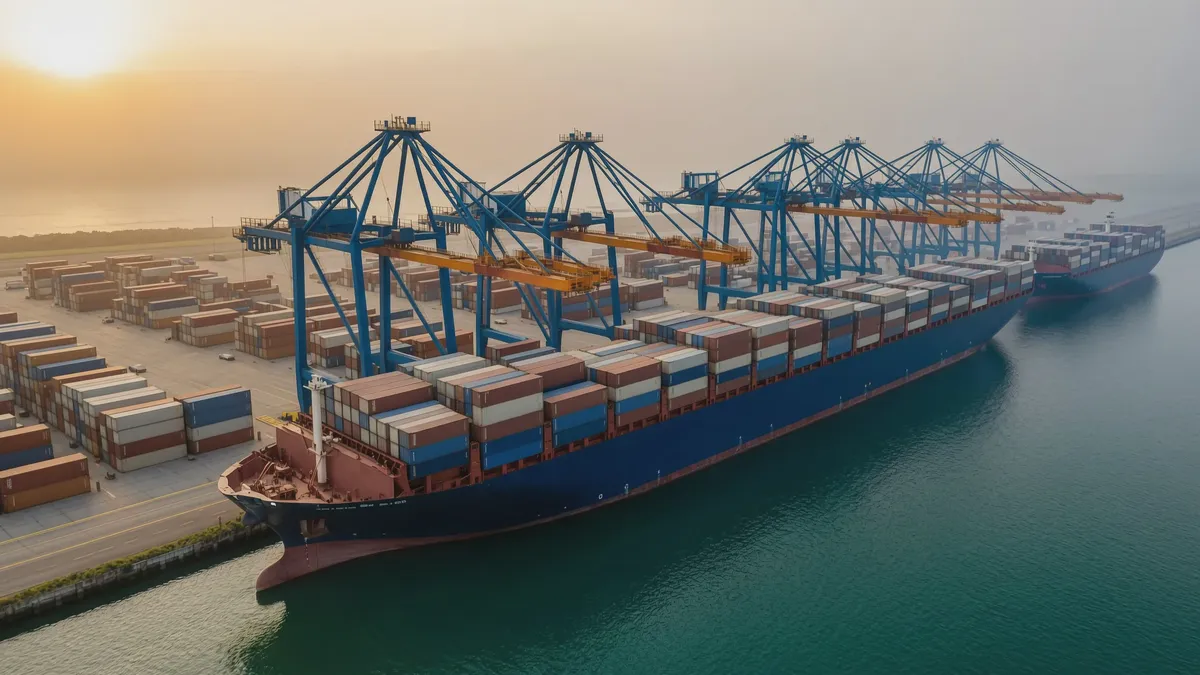
The Zona Libre de Colón is not a port and not an ordinary warehouse district. It is a customs-segregated commercial territory of roughly 400 hectares inside Colón city, on Panama's Atlantic side, opened in 1948 and hosting more than 2,000 user companies. Cargo that enters it has not been imported into Panama. Duty and the 7% ITBMS attach only when goods cross into Panamanian national territory, and never attach if the goods leave for another country.
The regime sits in Law 8 of 2016, amended by Law 412 of 21 November 2023, which widened permitted activity into services, multimodal logistics and nearshoring. Article 46-C is the provision importers care about: merchandise introduced into the zone whose final destination is abroad is exempt from ITBMS.
Three outcomes are possible once your container is inside, and they are taxed completely differently.
| Outcome | Customs act | Panamanian duty and ITBMS | Typical buyer |
|---|---|---|---|
| Goods stay in the zone | DMCE-Entrada only | None while in the zone | Regional distributor, showroom sale |
| Goods leave for another country | DMCE-Salida plus re-export declaration | None in Panama; destination duty applies in full | Caribbean or Andean importer |
| Goods enter Panama | DMCE-Salida under import for consumption (despacho definitivo) | Arancel 0–15% plus ITBMS 7% | Panamanian retailer or chain |
The last two rows are where money gets lost: same gate, same truck, a different tax bill.
Who can ship into the zone: Colon Free Zone user status and what it costs in 2026
You do not need to own a Panamanian company to ship into the zone, but somebody in the transaction does. Cargo is consigned to a ZLC user — a company holding an operational key (clave de operación) issued by the zone administration. That key is the number that lets a company declare movement, lease space and import or re-export.
| Establishment route | What it involves | Published ZLC cost |
|---|---|---|
| Empresa usuaria | Lease a warehouse from a private landlord inside the zone; hold your own permit and key | $5,560 guarantee deposit, $2,400/yr operating permit, $2,500/yr operational key |
| Empresa representada | Trade under a representation agreement with an established user | $2,500/yr operational key |
| Land or premises lease | Lease directly from the zone and build your own facility | Three-month deposit, $2,500/yr key, lease by area |
| Public warehouse | Use the zone's bonded warehouse with your own key | $2,500/yr key |
There is no commercial licence requirement and no minimum capital stipulated — the barrier is process, not money. The "about $4,900 a year" figure that circulates is the operating permit plus the operational key. Floor-area charges sit on top: refuse collection roughly $15–$100, security $65–$3,195, and $300 for the DMCE system.
The file is notarised: articles of incorporation, a public registry certificate under three months old, cédula or passport for legal representatives, an authenticated lease, one trade reference, one bank reference and a paz y salvo, the tax clearance proving you owe nothing. Foreign documents need an apostille. Four to eight weeks to an active key is realistic.
Most importers never do this. They consign to an established operator holding the key and warehouse and pay per pallet, which removes the annual fixed cost and the compliance filing. That is what DTFU recommends below four containers a year.
The entry file: DMCE-Entrada documents for Colon Free Zone cargo
Every movement in and out is declared through the DMCE, the Declaración de Movimiento Comercial Electrónico. There are four declaration types, and using the wrong one is the commonest filing error we see from new buyers.
| Declaration | Used for | Fee (balboa = USD) |
|---|---|---|
| DMCE-Entrada | Goods arriving from abroad or from Panamanian territory | $25 per marine entry plus $15 form; $10 per air waybill plus $15 form |
| DMCE-Salida | Export of zone-made goods, import for national consumption, re-export to other countries or duty-free shops | $15 |
| DMCE-Traspaso | Transfer between two zone companies inside the zone | $15 |
| DMCE-Descarte | Writing off expired, damaged or unsaleable inventory with authorisation | $15 |
The declaration is filed before the container reaches the gate and must reconcile with the transport document: a bill of lading naming the ZLC user as consignee with the operational key, a commercial invoice itemised by SKU, a packing list with carton counts and weights, a certificate of origin, a marine insurance certificate where terms are CIF or CIP, and ten-digit HS codes.
The failure mode is almost never the invoice. It is the consignee. If the bill names a Hong Kong trading entity or the factory's export arm, no ZLC user can declare the cargo in, and the container sits while a telex release and bill amendment are arranged — $150–$300 for the amendment plus storage from the day free time ends. We build the consignee field around the user's registered name and key before booking. Companies operating from premises outside the perimeter (extramuros) have until the following day to file, but nothing moves without the gate record.
Re-export rules in 2026: the Declaración de Reexportación and SIGA-DMCE
This is the part of the playbook that changed this year, and the part most English-language guides have not caught up with. Panama's National Customs Authority (ANA) has been phasing in a formal re-export declaration for zone cargo under the CAUCA and RECAUCA framework. Phase one covers the declaration and re-export certificates; phase two, adding the export declaration and internal transit, has no published date. The dates moved twice: the 1 February 2026 start slipped to 1 April, and mandatory filing slipped from 10 August to 22 September 2026.
What is not negotiable is the registration: a user must be registered with ANA as an exporter or re-exporter before filing a re-export declaration. The file goes through a lawyer to ANA's legal advisory office with a notarised power of attorney to the Director General, a public registry certificate, evidence of activity in the zone, the legal representative and SIGA user, an RUC certificate and the SIGA activation form. Missing it risks losing the ability to clear cargo out of Colón — a different problem from a late fee.
The logic ANA applies is simple: what leaves has to match what came in. A user that declared 4,800 cartons of one SKU on entry cannot re-export 5,200 without a documented explanation, and cannot re-export the same goods twice. That is why the DMCE inventory has to carry lot references from the first container rather than being reconstructed at audit.
Per re-export shipment the file is a DMCE-Salida, the SIGA re-export declaration with destination and buyer, a commercial invoice to the foreign buyer, a packing list matching the load, a certificate of origin, the feeder bill of lading, and consular legalisation for the Andean markets that still demand it.
ZLC re-exports reached $16.12 billion in 2025 against total zone trade of $27.89 billion, up 11.9% year on year. Re-export is the business; imports are the front half of it.
Shipping from China to Colon Free Zone: routes, carriers and transit times
The China leg is the least complicated part of this lane: Panama takes direct transpacific calls, so there is no relay hub or feeder connection to miss inbound. What varies is which side of the isthmus your vessel discharges on.
Asia–Panama strings typically call Balboa first and then transit the canal to Manzanillo, CCT or Cristóbal, though several services run the Atlantic call first westbound. The same string can put you in Colón three to five days earlier or later. Zone-bound cargo should discharge Atlantic; Balboa means a 76 km truck move or the canal railway, both of which add cost and a day. Our sea freight from China pages carry current rotations, and air freight from China into Tocumen is the only fast alternative.
| Origin | Destination terminal | 20ft | 40ft / 40HQ | Transit |
|---|---|---|---|---|
| Shenzhen / Yantian | Balboa or Colón | $2,550–$3,150 | $3,150–$4,000 | 28–36 days |
| Shanghai | Balboa or Colón | $2,650–$3,250 | $3,250–$4,200 | 30–38 days |
| Ningbo | Manzanillo (MIT) | $2,750–$3,450 | $3,450–$4,300 | 30–40 days |
| Guangzhou (Nansha) | Balboa or Colón | $2,650–$3,250 | $3,250–$4,100 | 30–38 days |
| Qingdao | Balboa or Colón | $2,650–$3,450 | $3,450–$4,200 | 35–45 days |
CMA CGM, COSCO, ONE and MSC all serve this pair weekly, and the spread on a 40HQ is usually inside $200 — less than a week of destination storage. Aim for a Monday-to-Wednesday discharge; a Friday arrival often waits until Monday for a gate appointment.
Shipping cost to the Colon Free Zone in 2026: FCL, LCL and air rates
Ocean freight is where the budget lives. These are the port-to-port ranges we are quoting on real bookings this year, before origin charges, destination handling and the zone fees below.
| Mode | Specification | Rate | Transit |
|---|---|---|---|
| FCL | 20ft dry, Shenzhen/Yantian to Balboa or Colón | from $2,550 | 28–36 days |
| FCL | 40ft / 40HQ, Shenzhen/Yantian to Balboa or Colón | from $3,150 | 28–36 days |
| FCL | 40ft / 40HQ, Shanghai or Nansha to Colón | from $3,250 | 30–38 days |
| LCL | Per cubic metre, China base ports to Colón | $80–$150 per CBM | 35–45 days |
| Air freight | Per chargeable kg to Tocumen (PTY) | $5.00–$9.00 per kg | 4–7 days |
| Express courier | Per kg, door to door | $8.00–$12.00 per kg | 2–5 days |
LCL carries a 5–10 day penalty against FCL and adds a CFS charge at both ends that the per-CBM rate does not show. The crossover sits at 12–15 CBM. Air to Tocumen needs another 80 km of trucking to Colón, so air into the zone is for samples and launch stock. The shipping cost from China to Panama breakdown covers the same model port by port.
A full 40HQ build-up into a ZLC warehouse looks like this on a Shenzhen booking.
| Cost line | Amount (USD) |
|---|---|
| Ocean freight, 40HQ Yantian to MIT | $3,400 |
| Origin charges (THC, documentation, seal, export declaration) | $385 |
| Destination THC and documentation, Colón | $430 |
| Drayage MIT to ZLC warehouse, including gate appointment | $210 |
| DMCE-Entrada, marine | $40 |
| Warehouse receiving, devanning and palletising | $320 |
| Total to the zone, duty and ITBMS free | $4,785 |
At 65 usable CBM in a 40HQ that is $73.62 per cubic metre, under the bottom of the LCL range — the arithmetic behind the crossover.
Two costs get left out. Terminal free time here is counted in days, and demurrage accrues per container per day once it expires at rates set by the carrier's tariff. Documentation changes after the container is on the water are billed per amendment. For a port-pair view of the same numbers, see Sea Shipping from China to Panama.
Nationalization: what arancel and ITBMS cost when goods leave the zone
When part of a consignment is sold into Panama rather than re-exported, it is nationalised: declared under import for consumption and taxed on its CIF value at that moment.
| Tax | Rate | Base |
|---|---|---|
| Arancel (import duty) | 0–15%, commonly 5–10% on finished consumer goods; 0% on much capital equipment and raw material | CIF value |
| ITBMS (VAT) | 7% standard; 10% alcoholic beverages; 15% tobacco products | CIF value plus arancel |
| ITBMS on services | 7% | Service value |
Take 20% of a container with a CIF value of $36,000, nationalised for local retail.
| Step | Calculation | Amount |
|---|---|---|
| CIF value of the nationalised portion | given | $36,000.00 |
| Arancel at 7% | 36,000 × 0.07 | $2,520.00 |
| ITBMS base | 36,000 + 2,520 | $38,520.00 |
| ITBMS at 7% | 38,520 × 0.07 | $2,696.40 |
| Total tax | 2,520 + 2,696.40 | $5,216.40 |
| Effective burden | 5,216.40 ÷ 36,000 | 14.49% |
Fourteen and a half per cent of CIF is the figure to carry for consumer goods. It rises to 15–18% on textiles and footwear where arancel hits the top of the band, and falls toward 7% flat on machinery entered at 0% duty, where ITBMS applies to CIF alone.
ITBMS paid at import is creditable against the tax a Panamanian VAT-registered importer collects on resale, so for a local distributor the 7% is cash flow, not cost — but only if the importer of record is the Panamanian entity, not the ZLC user. Partial nationalisation also requires inventory separation, which is the first thing an audit asks for. Our China customs clearance service builds that split into the documentation before the container sails.
In-zone operations: storage, labeling, repacking and regional distribution
Law 412 widened what a user may lawfully do inside the perimeter: introduce, store, exhibit, condition, pack and repack, split consignments, label, assemble, blend, preserve, and since 2023 provide multimodal and logistics services, manage third-party inventory and run nearshoring operations. That is why buyers from the Caribbean fly in, walk a floor of sample rooms and order against stock held 90 minutes from a feeder berth.
Commercially that covers most of what a regional distributor needs: labelling for Caribbean and Andean buyers, manuals inserted, bundles kitted, cartons re-boxed, SKUs price-ticketed, products photographed for a catalogue, safety stock held for four or five countries off one container. None of it requires leaving the zone or paying duty.
Space quotes at roughly $9–$15 per square metre per month depending on clear height and showroom frontage, on twelve-month minimum leases. Handling is billed per carton in and out, repacking per unit.
Two limits. Retail selling to the Panamanian public is not what the zone is for — trade runs between registered users and foreign buyers. And regulated categories stay regulated inside the fence: pharmaceuticals and medical devices need MINSA authorisation. If your suppliers sit across Guangdong and Zhejiang, consolidating at our warehouse services in China before loading is cheaper than repeating the labelling.
Choosing a terminal: Manzanillo, CCT, Cristóbal or Balboa
Four terminals matter here, three on the Atlantic side and one on the Pacific, and the choice follows where your cargo goes next.
| Terminal | Operator | Capacity and berths | Draft | Position for ZLC |
|---|---|---|---|---|
| Manzanillo International (MIT) | SSA Marine, since 1995 | 81,237 TEU yard, 605,764 m², 1,240 m main berth plus two 400 m neo-panamax berths, 2,430 reefer plugs | 16 m at neo-panamax berths | Manzanillo Bay, 6.7 km from Colón; default for FCL into the zone |
| Colón Container Terminal (CCT) | Evergreen, since 1997 | 74.33 ha, 4 berths, 11 quay cranes, 2.4 million TEU capacity, 1.74 million TEU in 2025 (88% transshipment) | 16.4 m channel | Coco Solo North, 5 km from Colón city, on-dock rail, bonded logistics park |
| Cristóbal | Hutchison Ports PPC | 3 berths, 970 m dock, 2 million TEU capacity | Panamax and post-panamax | Atlantic entrance, minutes by truck to the zone |
| Balboa | APM Terminals | 7 berths, 1,710 m quay, 65,835 TEU yard, 3,612 reefer plugs | 16.5 m | Pacific side, 76 km from the Atlantic by rail or road |
For zone-bound cargo, Atlantic discharge answers almost every case. MIT is the workhorse for straight FCL because of yard depth and reefer capacity; CCT fits when you need on-dock rail or the bonded park next door, and handles most of the transshipment volume physically. Cristóbal is legitimate when a carrier's rotation only calls there.
Balboa makes sense when cargo is ultimately for Panama City or the Pacific coast, or when the carrier offers a materially better rate there. Then you pay $350–$600 per 40HQ for the isthmus move plus a day. The same rule holds across multi-country programmes, which is why the Shipping From China to Americas lane structure starts with the discharge decision.
Five Colon Free Zone shipping mistakes that cost importers money
Treating zone entry as tax-free access to the Panamanian market. Goods in the zone owe nothing; goods sold into Panama owe arancel plus ITBMS on nationalisation. A distributor who budgets 7% and meets 14.5% has priced the product wrong.
Expecting to sell retail from a showroom. The zone is wholesale. Consumer sales need nationalised goods, a Panamanian invoice and ITBMS collected.
Missing the ANA exporter or re-exporter registration. An unregistered user cannot complete the outbound file. That is a stopped shipment, and the registration goes through a lawyer before it goes through a system.
Under-budgeting storage and demurrage. Terminal free time is days, rent starts the day pallets land, and a missed devanning slot in a peak week can absorb a month of freight saving.
Confusing the zone with Colón city, or with Balboa. The ZLC is a fenced commercial area inside Colón, not the city and not the port. Balboa is 76 km away on the other ocean, and a container routed to the wrong coast costs a day and several hundred dollars.
Peak season and booking windows for Colon Free Zone cargo
Two calendars run in parallel. The transpacific one: rates climb from August through November as holiday inventory moves, and again in the four to six weeks before Chinese New Year, which falls in February 2027. Booking three to four weeks ahead is normal here; booking inside two weeks in peak season means taking whatever space is left and the PSS with it.
The local one: Panama's rainy season runs roughly May to December and slows drayage and receiving, so build a day of slack into gate appointments in September and October. Canal draft restrictions in dry years push carriers into reduced loading and transit surcharges even on services that only call the Atlantic side, because rotation and tolls are set vessel-wide. The zone itself peaks ahead of Caribbean Christmas and carnival, when feeder space out of Colón tightens exactly when your stock needs to leave.
We hold space on this lane through direct carrier contracts rather than buying spot, which keeps a 40HQ confirmable in the first week of November. If your re-export timetable is fixed by a retail season, give DTFU the in-zone date rather than the sailing date. Door-to-door coverage sits on the Door to Door Shipping from China to Panama page.
FAQs
How much does it cost to ship a 40ft container to the Colon Free Zone?
Ocean freight runs $3,150–$4,000 from Shenzhen and $3,250–$4,200 from Shanghai. Add about $1,385 for origin charges, destination THC, drayage, DMCE and devanning: a 40HQ lands in a ZLC warehouse near $4,785.
How long does shipping from China to Colón take?
28–36 days from Shenzhen, 30–38 from Shanghai or Nansha, 30–40 from Ningbo into Manzanillo, 35–45 from Qingdao. Add 3–7 days for declaration, devanning and put-away.
Do I pay import duty if goods go into the Colon Free Zone?
No. Goods introduced into the zone and destined abroad are exempt under article 46-C of Law 8 of 2016. Duty applies only on nationalisation, at 0–15% plus 7% ITBMS on the CIF-plus-duty base.
Can I ship there without owning a company in Panama?
Yes, by consigning to an established ZLC user holding the key and warehouse. Your own key costs a $5,560 deposit plus $2,400 a year for the permit and $2,500 a year for the key.
What is the DMCE and which declaration do I need?
The zone's electronic commercial movement declaration. Inbound cargo uses DMCE-Entrada ($25 per marine entry plus $15 form); re-export, export or nationalisation uses DMCE-Salida ($15); transfers use DMCE-Traspaso; write-offs use DMCE-Descarte.
Is the new re-export declaration mandatory now?
Yes. ANA made the Declaración de Reexportación mandatory on 22 September 2026, after two postponements. The user must first be registered with ANA as exporter or re-exporter, filed through a lawyer.
What documents do I need to re-export from Colón?
A DMCE-Salida, the SIGA re-export declaration, a commercial invoice, a packing list, a certificate of origin, the feeder bill of lading, and consular legalisation where the destination requires it.
What is the difference between the Colon Free Zone and Balboa?
The ZLC is a customs-segregated commercial territory inside Colón on the Atlantic side. Balboa is a container terminal on the Pacific, 76 km away by rail or road.
Can goods be labelled or repacked inside the zone?
Yes. Law 412 of 2023 permits labelling, repacking, splitting, assembling, blending, kitting and inventory management. Retail sales to consumers are not permitted.
How much free time do I get before demurrage?
Typically three to five days on this coast depending on the carrier's tariff, then demurrage per container per day. In-zone rent runs from put-away with no grace period.
Contact DTFU with the supplier list, SKU count and destination countries, and we will come back with the routing, the zone entry file and a landed cost that separates what stays duty-free from what will be nationalised. Current port-by-port numbers are on the Shipping From China to Panama lane page.