Are you wondering how much sea shipping cost from China to Canada could impact your business bottom line? Navigating the complexities of sea freight, from ever-changing rates to hidden charges and customs requirements, can be overwhelming for importers and Amazon FBA sellers. In this comprehensive guide, we break down the key factors affecting ocean freight, compare costs with other transport modes, and share proven strategies to reduce your expenses when shipping from China to Canada. Let’s dive in and make your next shipment smarter and more cost-effective!
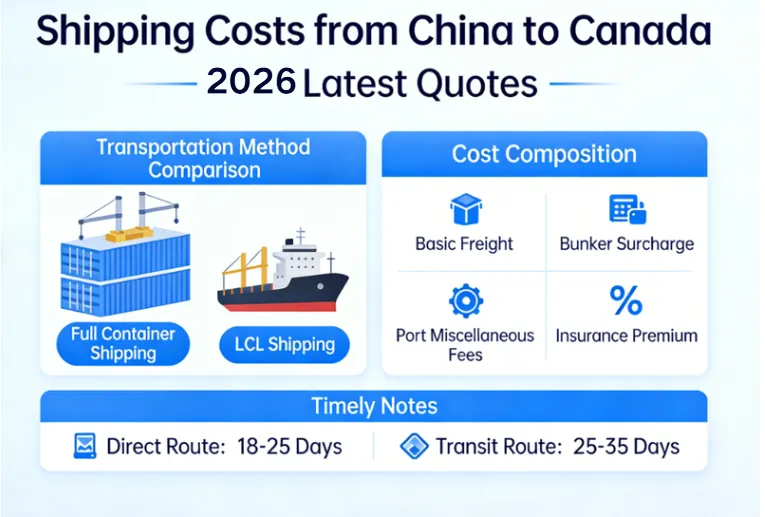
Key Takeaways for March 2026:
- Current Rates: As of March 2026, shipping a 20FT container from China to Canada costs between $1,400 and $2,660, while a 40FT container ranges from $2,240 to $4,200.
- Transit Time: Expect 15–22 days to the West Coast (Vancouver) and 28–35 days to the East Coast (Montreal).
- Cost-Saving Tip: Consolidating LCL into FCL and booking during off-peak seasons (March to June) can reduce costs by up to 30%.
- Hidden Fees: Always account for Canadian destination charges, CBSA customs duties, and GST (5%) when calculating your total landed cost.
Overview of Sea Shipping Cost from China to Canada
What is the Average Sea Freight Cost?
Direct Answer: In March 2026, the average sea freight cost from China to Canada is $1,400–$2,660 for a 20FT container, and $2,450–$4,410 for a 40HQ container. LCL shipments average $85–$175 per CBM. Rates vary based on the port of origin, destination, and current market demand.
Sea shipping is a cost-effective and reliable solution for importers and exporters moving goods between China and Canada. As of March 2026, average sea freight costs have stabilized, offering favorable rates for large-volume shipments compared to previous years.
The average sea shipping cost from China to Canada depends on several factors, including container size, cargo type, and shipping route. Here is a general reference for full container loads (FCL):
| Container Size | Average Rate (USD) | Typical Transit Time |
|---|---|---|
| 20FT (28 CBM) | $1,400 - $2,660 | 18-28 days |
| 40FT (56 CBM) | $2,240 - $4,200 | 18-28 days |
| 40HQ (68 CBM) | $2,450 - $4,410 | 18-28 days |
| LCL (per CBM) | $85 - $175 | 20-32 days |
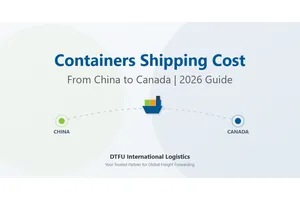
Note: Rates fluctuate based on seasonality, port congestion, and fuel surcharges. For the latest quotation, consult a professional freight forwarder like DTFU International Logistics Co.,Ltd. For detailed reference on shipping rates, see this Containers Shipping Cost from China to Canada guide.
Why Choose Sea Freight for Your China-Canada Imports?
Direct Answer: Sea freight is the most economical choice for shipments over 2 CBM or 500 kg. It offers massive capacity, lower per-unit costs than air freight, and is suitable for diverse cargo types, making it ideal for standard inventory replenishment.
Sea freight is the preferred shipping method for many businesses due to its balance of cost, safety, and scalability. Here are key reasons why importers and exporters choose sea shipping:
- Cost-Effectiveness: Sea freight, especially for FCL, offers much lower per-unit costs compared to air freight.
- Capacity: Containers (20FT, 40FT, 40HQ, 45HQ) accommodate large and heavy shipments that are not feasible by air.
- Eco-Friendliness: Ships have a smaller carbon footprint per ton-kilometer compared to planes or trucks. For more on maritime sustainability, visit the World Shipping Council.
- Versatility: Suitable for a wide range of goods, including general cargo, dangerous goods, oversized, and breakbulk shipments.
- Reliability: Regular sailings and established shipping routes ensure stable transit times.
Key Factors Influencing Sea Shipping Rates
Cargo Volume: FCL vs. LCL Shipping Costs Explained
Direct Answer: FCL (Full Container Load) charges a flat rate for an entire container and is best for shipments over 15 CBM. LCL (Less than Container Load) charges per cubic meter (CBM) and is ideal for smaller shipments between 2 and 15 CBM, though it has higher per-unit handling costs.
The volume and type of your cargo significantly affect shipping rates:
- FCL (Full Container Load): You rent an entire container. Best for shipments that can fill or nearly fill a container (20FT: 28CBM, 40FT: 56CBM, 40HQ: 68CBM, 45HQ: 78CBM). Per-unit cost is lower, more security and less handling.
- LCL (Less than Container Load): Your cargo is consolidated with others'. Ideal for smaller shipments. You pay based on volume (CBM). Slightly higher per-unit cost due to consolidation and extra handling.
Comparison Table
| Shipping Type | Container Size | Suitable For | Typical Cost Structure |
|---|---|---|---|
| FCL | 20FT/40FT/40HQ/45HQ | Shipments ≥15 CBM | Fixed per container |
| LCL | N/A | Shipments <15 CBM | Per CBM (with minimum charges) |
Port of Origin and Destination: Major China & Canada Ports
The choice of port of loading and port of discharge directly impacts cost and transit time.
Major China Ports:
- Shanghai: The world’s largest container port, offers the most frequent sailings to Canada.
- Shenzhen: Ideal for goods from South China, with rapid sailings to West Coast Canada.
- Ningbo: Strong for manufacturing hubs in Zhejiang.
Major Canada Ports:
- Vancouver: The primary entry point for sea freight from Asia, offering excellent rail and truck connections to the rest of Canada.
- Prince Rupert: Fast-growing, with shorter sailing times from North China.
- Montreal: Main gateway for Eastern Canada, but with longer transit times from China.
China-Canada Port Pair Examples
| China Port | Canada Port | Approx. Transit Time | Notes |
|---|---|---|---|
| Shanghai | Vancouver | 16-22 days | Most frequent, direct services |
| Shenzhen | Vancouver | 16-22 days | Key for electronics, textiles |
| Ningbo | Vancouver | 18-24 days | Competitive rates |
| Shanghai | Prince Rupert | 15-19 days | Shortest sailing time |
| Shanghai | Montreal | 28-35 days | Via Panama Canal, less frequent |
Pro tip: Shipping to West Coast Canada (Vancouver) is faster and cheaper than to the East Coast (Montreal). For further insights on transit times, check Shipping from Shanghai to Canada.
Seasonality: Peak Season Surcharges (PSS) & GRI
Direct Answer: Shipping costs spike during Peak Season (August to November) and before Chinese New Year due to Peak Season Surcharges (PSS) and General Rate Increases (GRI). Booking during the off-peak season (March to June) ensures the lowest rates.
March 2026 Update: As we move through Q1 2026, rates are currently in a more stable, off-peak phase, making it an excellent time to ship before summer demand kicks in.
Additional Fees: Customs, Duties, and Taxes (GST/HST)
Beyond the basic ocean freight, importers must consider a range of additional fees in both China and Canada. For official tariff classification, always refer to the Canada Border Services Agency (CBSA).
- Customs Clearance Fees: Charges by brokers for handling import/export documentation.
- Duties and Tariffs: Varies by product; classified using the HS code.
- Goods and Services Tax (GST): 5% on most imported goods to Canada.
- Harmonized Sales Tax (HST): Applied in some provinces.
- Destination Handling & Delivery Fees: Unloading, storage, trucking, and other local charges.
Sample Cost Breakdown for a 20FT FCL (Shanghai to Vancouver):
| Fee Type | Estimated Cost (USD) |
|---|---|
| Ocean Freight | $1,750 |
| Destination Handling | $245 |
| Customs Brokerage | $105 |
| Duties & Taxes | Varies by product |
| GST (5%) | Based on CIF value |
| Door Delivery (optional) | $210-$420 |
Detailed Breakdown of Sea Freight Charges
Ocean Freight vs. Local Charges (Origin & Destination)
Direct Answer: Total sea shipping costs consist of Ocean Freight (the port-to-port transport cost) and Local Charges (origin and destination handling, customs, and port fees). Local charges typically add $210–$560 per container on each side.
-
Ocean Freight:
- The base cost for transporting your container.
- For example, as of March 2026, typical ocean freight rates (excluding surcharges) are:
| Route | 20FT Container | 40FT Container | 40HQ Container |
|---|---|---|---|
| Shanghai to Vancouver | $700–$1,050 | $1,260–$1,540 | $1,330–$1,680 |
| Shenzhen to Toronto | $1,400–$1,680 | $2,240–$2,590 | $2,380–$2,800 |
| Ningbo to Montreal | $1,610–$1,890 | $2,450–$2,870 | $2,660–$3,150 |
-
Local Charges:
- Origin Charges (China): Terminal handling, customs clearance, trucking to port.
- Destination Charges (Canada): Offloading, warehousing, import clearance, final delivery.
Understanding Incoterms: FOB vs. CIF vs. DDP Costs
Direct Answer: FOB means the buyer pays for ocean freight and Canadian local charges. CIF means the seller pays ocean freight, but the buyer pays destination charges. DDP means the seller covers all costs, including shipping, Canadian duties, and delivery to your door.
| Term | Who Pays Ocean Freight | Who Handles Customs | Who Pays Duties/Taxes | Who Arranges Delivery |
|---|---|---|---|---|
| FOB | Buyer | Buyer (Canada) | Buyer | Buyer |
| CIF | Seller | Buyer (Canada) | Buyer | Buyer |
| DDP | Seller | Seller | Seller | Seller |
Insurance Costs for Sea Shipments: Is It Worth It?
Direct Answer: Yes, marine cargo insurance is absolutely worth it. It typically costs only 0.1% to 0.3% of your cargo's commercial value and protects against total loss, damage, or theft during the 15-30 day ocean transit.
- Example: Shipping $50,000 worth of electronics from Shenzhen to Vancouver may have an insurance premium of just $50–$150.
How to Calculate Total Landed Cost from China
Direct Answer: Landed Cost = Ocean Freight + Origin Charges + Destination Charges + Canadian Duties + Taxes (GST/HST) + Insurance + Final Delivery Fees. Calculating this accurately is essential for determining your true profit margin.
Practical Example: Real-World Landed Cost (March 2026)
To give you a realistic picture, let's look at a sample calculation for importing a 20FT FCL of LED Desk Lamps (Commercial Invoice Value: $34,500) from Shenzhen (Yantian) to a warehouse in Vancouver, BC under FOB terms.
Note: In Canada, GST is calculated on the "Duty-Paid Value" (Value of goods + Duties).
1. Freight & Logistics Costs:
- Ocean Freight (Yantian to Vancouver): $1,350.00
- Origin Charges (FOB terms - Paid by Supplier): $0.00
- Destination Local Charges (THC, D/O, Port Fees): $525.00
- Customs Brokerage Fee: $125.00
- Final Inland Delivery (Port to Richmond Warehouse): $350.00
- Marine Cargo Insurance: $105.00
2. Canadian Customs & Taxes:
- Duties (e.g., 7% based on HS Code 9405.21): $2,415.00
- GST (5% of Duty-Paid Value: $34,500 + $2,415): $1,845.75
Total Landed Cost: $1,350.00 + $525.00 + $125.00 + $350.00 + $105.00 + $2,415.00 + $1,845.75 = $6,715.75
(Insight: In this realistic scenario, the shipping, customs, and taxes add approximately 19.4% to the original product cost).
5 Proven Tips to Reduce Your Sea Shipping Expenses
Direct Answer: To lower shipping costs, consolidate LCL shipments into FCL, optimize container space, negotiate contract rates with a forwarder, avoid peak season shipping (August-October), and use a single provider for end-to-end logistics.
1. Consolidate Small Shipments
Combining multiple small LCL consignments into a single FCL (Full Container Load) reduces handling, documentation, and local charges.
| Shipping Scenario | Total Volume | Estimated Cost (March 2026) |
|---|---|---|
| 3 x LCL (8CBM each) | 24 CBM | $1,890 (approx. $630 x 3) |
| 1 x FCL 20FT (28CBM) | 28 CBM | $1,260 |
2. Optimize Container Loading
Select the right container size (20FT, 40FT, 40HQ) to maximize space utilization and minimize unused volume costs.
3. Negotiate Better Rates with Freight Forwarders
Consistent business with a reliable forwarder like DTFU International Logistics enables preferential pricing and priority service.
4. Time Your Shipments to Avoid Peak Seasons
Plan shipments during the off-peak season (March to June) to avoid Peak Season Surcharges (PSS).
5. Leverage Integrated Logistics Solutions
Working with a one-stop provider offers bundled services—sea freight, customs clearance, warehousing, and delivery—translating into significant cost savings.
Why Choose DTFU for Your China-Canada Logistics?
Competitive Sea Freight Rates & Transparent Pricing
DTFU International Logistics Co.,Ltd is committed to providing highly competitive and transparent pricing for all your sea shipping needs from China to Canada. Instead of relying on volatile spot market prices, we leverage our deep carrier networks to secure preferential contract rates that are consistently below market average.
With no hidden fees, you receive a clear, benefit-oriented logistics solution. We focus on maximizing your profit margins through optimized routing and bundled services, ensuring you get the best value without compromising on transit speed or reliability.
Reliable End-to-End Solutions
With over a decade of industry experience, DTFU delivers comprehensive, one-stop logistics solutions including:
- Sea Freight (FCL/LCL)
- Air Freight and Rail Freight
- Amazon FBA Shipping
- Warehousing & Distribution
- Cargo Insurance & Risk Management
- Customs Clearance (China & Canada)
- Door-to-Door Services
Our dedicated team leverages advanced tracking systems and maintains direct relationships with top ocean carriers. This ensures your cargo receives priority handling, reliable transit, and professional issue resolution.
FAQs
Q1: How long does sea shipping from China to Canada take? A: FCL shipments typically take 15–22 days to the West Coast (Vancouver) and 28–35 days to the East Coast (Montreal). LCL shipments may take 3-5 days longer for consolidation.
Q2: What is the difference between FCL and LCL? A: FCL (Full Container Load) means you rent an entire container, offering better rates for large volumes. LCL (Less than Container Load) means sharing a container, ideal for smaller shipments under 15 CBM.
Q3: What documents are required for customs clearance in Canada? A: Essential documents include the Bill of Lading, Commercial Invoice, Packing List, and Canada Customs Invoice (CCI).
Q4: How are sea freight costs calculated? A: Costs depend on cargo volume (CBM), container type, origin/destination ports, and seasonal surcharges.
Q5: Are there any hidden costs in sea shipping? A: Yes, watch out for destination handling fees, customs duties, GST/HST, and potential demurrage charges if your cargo is not cleared promptly.
For further questions or a free shipping quote, contact Ivan Chan, Senior Logistics Analyst at DTFU International Logistics Co.,Ltd. Your China-Canada sea shipping is in expert hands.