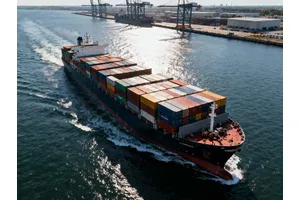
Shipping oversized machinery, industrial equipment, or construction vehicles requires precision, expertise, and the right logistics partner. Out of Gauge (OOG) cargo shipping from China to Spain is a complex process that goes beyond standard containerization, demanding specialized equipment and rigorous planning to ensure safety and compliance.
At DTFU International Logistics, we understand that OOG shipments are often high-value and time-sensitive. Whether you are moving a production line to Barcelona or heavy excavators to Valencia, this guide covers everything you need to know about costs, routes, and operational best practices.
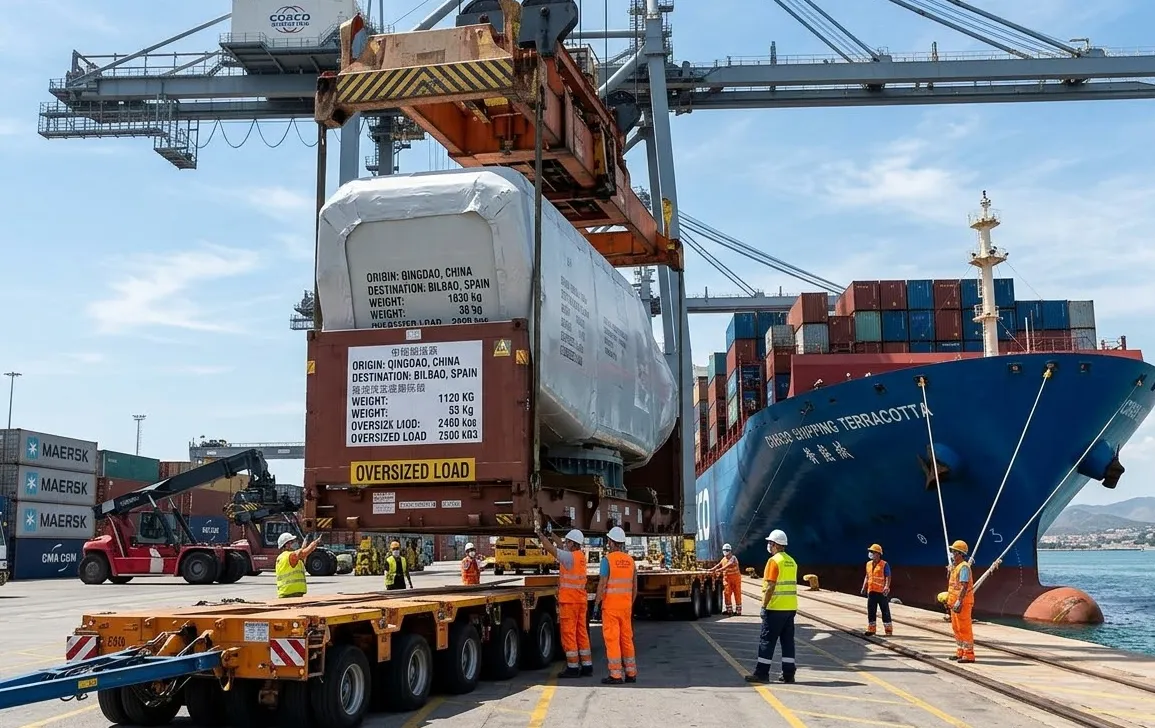
Key Takeaways
- Equipment Selection: Choose between Flat Rack (FR), Open Top (OT), or Breakbulk based on specific dimensions to minimize costs.
- Cost Drivers: Freight rates are heavily influenced by "lost slots" on the vessel and specialized Terminal Handling Charges (THC).
- Transit Time: Direct services from China to Spain typically take 25-35 days; transshipment can add 7-14 days and increase risk.
- Documentation: Accurate weight/dimension declarations are critical to avoid rolling and customs fines in Spain.
Understanding Out of Gauge (OOG) Cargo Types
What classifies as OOG cargo? Out of Gauge (OOG) cargo is freight that exceeds the standard dimensions of a 20ft or 40ft container in length, width, or height. Unlike standard cargo, OOG shipments cannot be loaded into a regular closed box and require specialized equipment like Flat Racks or Open Tops to accommodate their unique geometry.
What are Flat Rack and Open Top Containers?
Flat Rack (FR) and Open Top (OT) containers are the primary equipment for OOG cargo. Flat Racks have no side walls or roof, ideal for wide or heavy loads. Open Tops have a removable tarpaulin roof, suitable for over-height cargo that fits within the width of a standard container.
-
Flat Rack Containers (20'FR / 40'FR): These feature collapsible end walls and a reinforced floor. They are designed for heavy point loads and cargo that is over-width or over-length.
- Best for: Large machinery, boats, transformers, and industrial crates.
-
Open Top Containers (20'OT / 40'OT): These allow for crane loading from the top. While they have standard walls, the roof bows and tarpaulin can be removed.
- Best for: Scrap metal, tall machinery, and glass sheets.
| Feature | 20' Flat Rack | 40' Flat Rack | 20' Open Top | 40' Open Top |
|---|---|---|---|---|
| Internal Length | ~5.6m | ~11.6m | ~5.9m | ~12.0m |
| Internal Width | ~2.2m | ~2.2m | ~2.3m | ~2.3m |
| Payload Capacity | Up to 31,000 kg | Up to 40,000 kg | Up to 28,000 kg | Up to 30,000 kg |
| Primary Use | Over-width/Over-length | Heavy/Bulky items | Over-height only | Over-height only |
Breakbulk vs. RoRo: Best Options for Non-Containerized Cargo
When cargo is too large even for Flat Racks, Breakbulk (BB) and Roll-on/Roll-off (RoRo) are the alternatives. Breakbulk involves loading individual pieces directly onto the vessel's hold, while RoRo is specifically for self-propelled or towable cargo that can be driven onto the ship.
- Breakbulk (BB): Essential for massive items like wind turbine blades or giant autoclaves. The cargo is secured directly to the ship's deck or hold. It is often more expensive due to slow loading times.
- RoRo (Roll-on/Roll-off): The safest and most cost-effective method for vehicles, trucks, cranes, and excavators. It requires the cargo to be on wheels or a Mafi trailer.
Key Routes & Ports for OOG Shipping from China to Spain
What are the main shipping routes? The primary maritime route for OOG cargo shipping from China to Spain connects major Chinese industrial hubs to key Spanish gateways via the Suez Canal. Selecting the right port pair is crucial for minimizing inland haulage costs for heavy loads.
Major Loading Ports in China (Shanghai, Tianjin, Shenzhen)
We operate out of all major Chinese ports, but specific ports are better equipped for OOG handling:
- Shanghai (CNSHA): The world's busiest port, offering the highest frequency of sailings and specialized heavy-lift cranes. Ideal for machinery from the Yangtze River Delta.
- Tianjin (CNTSN): The primary gateway for North China (Beijing/Hebei). It specializes in heavy industrial equipment and mining machinery.
- Shenzhen (CNSZX) / Guangzhou (CNNSA): Best for electronics manufacturing equipment and machinery originating from the Pearl River Delta.
Top Destination Ports in Spain (Barcelona, Valencia, Algeciras)
- Valencia (ESVLC): Spain's largest container port, serving Madrid and the central region. It has excellent rail and road connectivity for heavy haulage.
- Barcelona (ESBCN): The main hub for Catalonia and Southern France. It offers advanced terminal facilities for handling complex breakbulk projects.
- Algeciras (ESALG): A key transshipment hub. While efficient, direct delivery is often preferred for OOG to avoid handling risks during transfer.
Step-by-Step Process for Shipping OOG Cargo
How do you ship OOG cargo? Shipping OOG cargo involves a rigorous four-step process: accurate measurement, equipment selection, professional lashing, and customs clearance. Skipping any detail in the planning phase can lead to shipment rejection at the terminal.
Step 1: Accurate Measurement and Cargo Survey
Precision is non-negotiable. You must provide the carrier with exact dimensions (Length x Width x Height) and Weight (Gross + Tare). Even a 5cm discrepancy can result in the terminal refusing to load the cargo or significant "dead freight" charges.
- DTFU Tip: We always recommend a pre-shipment survey where our team physically measures the cargo to verify the packing list data against reality.
Step 2: Choosing the Right Equipment (20'FR, 40'FR, 40'OT)
Based on the survey, we select the optimal equipment.
- If the cargo is over-height only, an Open Top is usually cheaper.
- If the cargo is over-width, a Flat Rack is required.
- Center of Gravity (COG): For heavy machinery, knowing the COG is vital to ensure the load is balanced on the Flat Rack to prevent tipping during lifting.
Step 3: Professional Lashing and Securing Standards
Lashing is the art of securing cargo to the container to withstand rough seas. It involves using chains, steel wires, turnbuckles, and chocks. Carriers require a Lashing Certificate from a certified surveyor before loading OOG cargo.
- Materials: We use high-tensile steel chains and heavy-duty nylon straps.
- Inspection: A 3rd party marine surveyor will inspect the lashing points, tension, and weight distribution to issue the approval for loading.
Step 4: Customs Clearance and Documentation in Spain
OOG shipments often attract scrutiny from Spanish Customs. You must have the Commercial Invoice, Packing List, Bill of Lading, and specific HS Codes ready. For machinery, ensure you have the CE Declaration of Conformity to prove compliance with EU safety standards. For DDP services, see our guide on DDP shipping from China to Spain.
Cost Factors for OOG Shipping from China to Spain
Why is OOG shipping expensive? The cost of OOG shipping from China to Spain is driven by "lost slots" (space wasted on the ship), equipment scarcity, and specialized handling fees. Unlike standard containers, rates are not fixed and fluctuate based on vessel utilization. For general cost comparisons, you might also be interested in Shipping Cost from China to Spain.
How Dimensions and Weight Impact Freight Rates
Carriers charge based on how many "slots" your cargo kills. If your cargo protrudes 20cm on the side of a Flat Rack, it prevents containers from being loaded next to it. You pay for your slot plus the empty slots around you.
- In-Gauge OOG: Cargo fits within the footprint but requires special equipment (e.g., Open Top). Cheapest OOG option.
- Out-of-Gauge: Cargo protrudes. The wider/higher it is, the more slots are lost, and the higher the price.
Understanding Surcharges and Terminal Handling Charges (THC)
- OOG Surcharge: A base fee added to the ocean freight for the complexity of handling.
- OOG THC (Terminal Handling Charge): Ports charge significantly more to lift OOG containers because they require special spreaders and manual labor.
- Loading/Lashing Fees: The cost of the professional team securing the cargo and the materials used.
Transit Times: How Long Does OOG Shipping Take?
What is the transit time? Transit times for OOG cargo from China to Spain generally range from 25 to 40 days, depending on the service loop. However, OOG cargo is more susceptible to "rolling" (being left behind) if the vessel is overbooked, as standard containers are easier to stack. For standard shipping, check Shipping From China to Spain or how long to ship from China to Spain.
Direct Service vs. Transshipment Options
Direct Service (e.g., Shanghai to Valencia) takes ~28 days and is safer as the cargo is not moved. Transshipment (via Singapore or Rotterdam) takes ~35-45 days and increases the risk of damage during the transfer between vessels.
- Recommendation: For high-value machinery, DTFU always prioritizes direct vessels to minimize handling risks.
Impact of Port Congestion on Heavy Lift Projects
OOG cargo requires specific crane availability. If a port like Barcelona is congested, OOG containers are often the last to be unloaded because they disrupt standard operations. We monitor terminal status to route your cargo to the most efficient entry point.
Why Choose DTFU International Logistics for OOG Shipments?
Why partner with us? Shipping Out of Gauge cargo isn't just about moving a box; it's an engineering challenge. At DTFU, we don't just act as a freight forwarder; we serve as your Project Logistics Architects. With over a decade of experience handling complex machinery for the automotive, construction, and energy sectors, we turn logistical nightmares into seamless deliveries.
1. Technical Expertise & "Method Statements"
We don't guess; we calculate. For every OOG shipment, our engineering team drafts a detailed Method Statement covering:
- Route Surveys: Analysis of road width, bridge heights, and turning radii in both China and Spain to avoid inland bottlenecks.
- Lifting Plans: Precise calculation of Center of Gravity (COG) and crane lifting points to prevent accidents during handling.
- Lashing Diagrams: Custom-designed securing schemes verified by 3rd party marine surveyors to ensure seaworthiness.
2. Priority Equipment Access (No "Rolling")
The biggest pain point in OOG shipping is equipment shortage (lack of Flat Racks).
- Carrier Tier-1 Status: Our volume agreements with COSCO, Maersk, and CMA CGM give us priority access to special equipment inventory in Shanghai, Tianjin, and Shenzhen.
- Space Protection: We secure "Protected Space" status to ensure your cargo isn't rolled (left behind), even during peak season congestion.
3. End-to-End Spanish Compliance
Shipping to Spain requires specific local knowledge.
- Permit Management: We handle the Special Transport Permits (Permiso Especial de Transporte) required by the DGT (Dirección General de Tráfico) for inland haulage in Spain.
- DDP Solutions: We can handle the VAT and Duty payments upfront, delivering the machinery to your door with zero customs delays for the receiver. Learn more about Door to Door Shipping from China to Spain.
4. Proven Track Record
- Zero Damage Protocol: Our certified lashing teams use industrial-grade materials, resulting in a 99.8% damage-free delivery rate.
- Real-Time Supervision: We provide photo and video evidence of the loading, lashing, and sealing process before the cargo ever leaves the factory.
FAQs: Shipping OOG Cargo from China to Spain
How much does it cost to ship OOG cargo from China to Spain?
Costs vary wildly based on dimensions. A standard 40'FR might cost 2-3x the rate of a standard 40'GP container. For an accurate quote, we need the exact LxWxH and weight.
What is the transit time for OOG shipments from China to Spain?
Typical port-to-port transit is 25-35 days. Door-to-door can take 45-60 days depending on the complexity of inland road permits in Spain. See Sea shipping from China to Spain or Air Shipping from China to Spain for other modes.
Are there extra surcharges for Flat Rack and Open Top containers?
Yes. Expect OOG Surcharges, higher THC, Lashing Fees, and potentially Low Sulfur Surcharges. We provide a transparent "all-in" quote so there are no surprises. We also recommend Cargo Insurance Services to mitigate risks.
Do I need special road permits for inland delivery in Spain?
Yes. If the cargo exceeds standard road limits (usually 2.55m width or 4m height), you need a Special Transport Permit from Spanish authorities, which can take 1-2 weeks to obtain.
Can DTFU handle door-to-door delivery for heavy machinery to Madrid or Barcelona?
Absolutely. We arrange the heavy-lift trucking, route surveys, and police escorts (if required) to deliver your machinery directly to your facility in Madrid, Barcelona, or anywhere in Spain.
What documentation is required for OOG shipments in Spain?
Standard shipping docs (Bill of Lading, Invoice, Packing List) plus the Lashing Certificate, Technical Drawings of the cargo, and CE Certification for machinery.
Contact DTFU International Logistics now to discuss your upcoming project shipment and experience the difference of expert-led logistics.