Are you trying to calculate the true freight cost from China to Canada to protect your profit margins? In our decade of experience managing trans-Pacific logistics, we've seen too many Amazon FBA sellers, B2B procurement managers, and growing e-commerce brands lose their bottom line to unpredictable shipping rates and hidden destination charges.
In this comprehensive guide, our forwarding experts break down the 2026 shipping rates, explain exactly how to calculate your total landed cost, and share the insider strategies our most successful clients use to lower their logistics spend without sacrificing reliability.
Key Takeaways
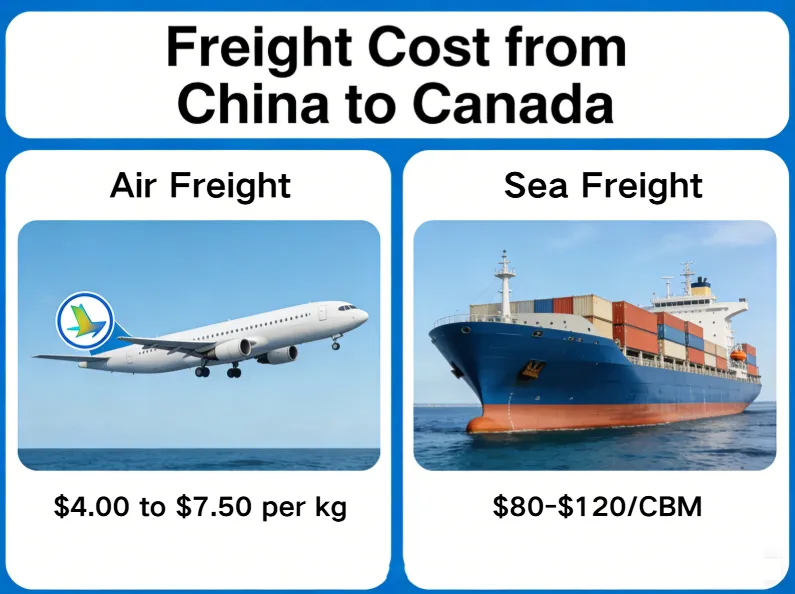
- Average Costs: Sea freight LCL costs $100-$150/CBM, while a 40ft container costs $2,000-$3,500 to Vancouver. Air freight ranges from $5.00-$8.50/kg.
- Hidden Fees to Watch: Total landed cost must include Terminal Handling Charges (THC), unstuffing fees, and CBSA customs brokerage fees.
- Cost-Saving Hack: Always buy under FOB terms rather than EXW to control origin charges, and consolidate your shipments to pay only one set of customs fees.
- Customs Rule of Thumb: Never guess your HS Code. Misclassification is the leading cause of CBSA fines and delays.
How Much Is the Freight Cost from China to Canada?
Based on our daily rate negotiations with top carriers in 2026, the shipping from China to Canada freight cost varies significantly by mode. As a general benchmark, sea freight LCL (Less than Container Load) starts around $100 to $150 per CBM. For full containers, a 20ft FCL typically ranges from $1,500 to $2,500, while a 40ft FCL costs between $2,000 and $3,500 to major West Coast ports like Vancouver. Air freight is much faster but more expensive, generally costing between $5.00 and $8.50 per kilogram, depending on the season and fuel surcharges.
Note: The logistics market is volatile. Rates fluctuate based on seasonality, fuel costs, and carrier capacity. Always request a real-time quote for your specific shipment to avoid budgeting errors.
Comprehensive Breakdown of Shipping Costs by Mode
Choosing the right shipping method is the most critical factor in managing your freight cost from China to Canada. Here is a closer look at the current market estimates based on actual bills of lading we process daily.
Sea Freight Costs: FCL vs. LCL Rates to Major Ports
Sea freight remains the most cost-effective option for large volumes. If your cargo is under 15 CBM, we generally recommend LCL (Less than Container Load). For larger shipments, booking a dedicated FCL (Full Container Load) offers better security and a lower cost per unit.
| Shipping Mode | Route (Origin to Destination) | Estimated Cost (USD) | Best For |
|---|---|---|---|
| LCL (Per CBM) | Shenzhen/Shanghai to Vancouver | $100 - $150 | Small shipments (1-15 CBM) |
| LCL (Per CBM) | Shenzhen/Shanghai to Toronto | $130 - $180 | Small shipments (1-15 CBM) |
| 20ft FCL | Shenzhen/Shanghai to Vancouver | $1,500 - $2,500 | Medium loads, heavy goods |
| 40ft FCL (HQ) | Shenzhen/Shanghai to Vancouver | $2,000 - $3,500 | Large volume, standard goods |
| 40ft FCL (HQ) | Shenzhen/Shanghai to Toronto | $3,500 - $4,800 | Large volume (via rail routing) |
The rates above are port-to-port estimates and do not include origin or destination terminal handling charges, which we detail below.
Air Freight & Express Courier Rates: When Speed is the Priority
When our clients need to restock inventory urgently or are shipping high-value, lightweight electronics, air freight is the logical choice.
- Standard Air Freight (Port-to-Port): Typically ranges from $5.00 to $8.50 per kg. It is ideal for shipments between 100 kg and 500 kg. You will still need a customs broker to clear the goods upon arrival at YVR (Vancouver) or YYZ (Toronto).
- Express Couriers (Door-to-Door): Companies like DHL, FedEx, and UPS charge between $7.00 and $12.00+ per kg. While expensive, they offer unparalleled speed (3-5 days) and handle the customs clearance process for you, making them perfect for samples or urgent parcels under 100 kg.
How to Calculate Your Total Landed Cost
Your basic freight rate is only one piece of the puzzle. To accurately price your products in the Canadian market, you must calculate the Landed Cost—the total price of a product once it has arrived at your buyer's door. We always walk our clients through these two critical factors:
Understanding Chargeable Weight: Actual vs. Volumetric
A common pitfall we see new importers make is assuming they will only be billed for the physical weight of their boxes. Freight carriers always charge based on the Chargeable Weight, which is the greater of the Actual Gross Weight or the Volumetric (Dimensional) Weight.
Logistics Calculation Formulas:
- Air Freight Volumetric Ratio:
1 CBM = 167 kg(Example: If your box is 1 CBM but only weighs 50 kg, the airline bills you for 167 kg).- Sea Freight LCL Volumetric Ratio:
1 CBM = 1,000 kg(Sea freight is almost always billed by volume/CBM unless shipping extremely dense items like steel).
Beware of Hidden Fees: Destination Charges and Customs Brokerage
Many importers are shocked by the final invoice when their goods arrive in Canada. To build trust and ensure transparency, we advise you to factor in these common destination charges:
- Terminal Handling Charges (THC): Fees charged by the Canadian port authorities (e.g., Port of Vancouver or Prince Rupert) to unload your container.
- LCL Unstuffing/De-vanning Fees: If you ship LCL, the bonded warehouse in Canada charges a fee to unpack your goods from the shared container.
- Customs Brokerage Fees: Licensed Canadian brokers charge a flat fee (usually $100 - $200) to file your entry with the CBSA.
- Inland Trucking: The cost to move your goods from the Canadian port or airport to your final warehouse or Amazon FBA fulfillment center.
Navigating Canadian Customs: Duties, GST, PST, and HST
Importing into Canada requires strict compliance with the Canada Border Services Agency (CBSA). Taxes and duties are a mandatory part of your freight cost from China to Canada.
How the CBSA Assesses Import Duties Using HS Codes
The duty rate you pay is determined entirely by your product's HS Code (Harmonized System Code). The CBSA uses this 10-digit number to classify your goods. For example, electronics might enter duty-free, while textiles and apparel could face duties of 16% to 18% under the Canadian Customs Tariff.
Expert Tip: Never guess your HS Code. In our practice, misclassification is the #1 reason for heavy fines, shipment seizures, or overpaying duties. Always consult with your freight forwarder or a licensed customs broker prior to shipping.
Step-by-Step Customs Clearance Process for Importers
To ensure smooth customs clearance without costly terminal storage fees, you must provide your customs broker with accurate documentation:
- Commercial Invoice: Must clearly state the buyer, seller, accurate HS codes, unit value, and total value in USD or CAD.
- Packing List: Detailed breakdown of weights, dimensions, and carton counts.
- Bill of Lading (B/L) or Air Waybill (AWB): The official transport document issued by the carrier.
- Payment of Taxes: In addition to duties, you must pay the 5% GST (Goods and Services Tax) on all commercial imports. Depending on the destination province, you may also be subject to PST (Provincial Sales Tax) or HST (Harmonized Sales Tax).
4 Expert Strategies to Reduce Your Shipping Costs to Canada
Over years of optimizing supply chains, we have identified four proven strategies to reduce your overall shipping spend:
1. Optimize Packaging to Lower Dimensional Weight
Since airlines and couriers charge for dead space, optimizing your packaging is the easiest way to save money. Work with your Chinese supplier to reduce carton sizes, eliminate unnecessary padding, and pack goods as densely as possible to lower your volumetric weight.
2. Choose the Right Incoterms (FOB vs. EXW)
We highly recommend buying under FOB (Free On Board) terms rather than EXW (Ex Works). With FOB, your Chinese supplier covers the cost of trucking the goods to the origin port and handling Chinese export customs. This gives you much better control over your international freight costs and avoids unexpected local origin charges in China.
Expert Pro Tip: In our experience, e-commerce importers who switch from EXW to FOB reduce their unexpected origin fees by up to 20% and gain complete control over their choice of freight forwarder.
3. Consolidate Shipments for Better Rates
If you are sourcing from multiple suppliers in China, do not ship their orders separately. Use a freight forwarder's warehouse in Shenzhen, Ningbo, or Shanghai to consolidate the goods into one single LCL or FCL shipment. One consolidated shipment means paying only one set of customs clearance and documentation fees in Canada.
4. Plan Around Peak Season Surcharges
Timing is everything. Shipping rates spike significantly and port congestion worsens during the Q4 Holiday Season (October-December) and the weeks leading up to Chinese New Year (usually late January/February). Plan your inventory and ship during off-peak months (March to July) to secure the lowest possible rates.
Why Choose DTFU International Logistics for Your Canadian Shipments?
Navigating the complexities of international shipping requires a reliable, experienced partner. At DTFU International Logistics, we specialize in optimizing the China-to-Canada trade lane for e-commerce brands and B2B importers.
Preferential Contract Rates and Transparent Pricing
Thanks to our established, long-term relationships with premium ocean carriers and airlines, we provide our clients with preferential contract rates that sit well below the market average. More importantly, we believe in 100% transparent pricing. When you get a quote from DTFU, it includes all origin and destination fees—meaning no hidden surprises when your cargo arrives in Vancouver or Toronto.
End-to-End Solutions with Fast Customer Response
We manage your entire supply chain. From picking up goods at your supplier's factory to handling Canadian customs clearance and delivering directly to your warehouse or Amazon FBA center, we offer a seamless DDP shipping from China to Canada experience. Our dedicated support team provides proactive, real-time tracking updates, ensuring you always know where your inventory is.
FAQs
How much does it cost to ship a 40ft container from China to Canada?
Currently, shipping a 40ft container from China to Canada (High Cube) from major Chinese ports like Shenzhen or Shanghai costs between $2,000 and $3,500 to Vancouver, and $3,500 to $4,800 to Toronto. These rates fluctuate based on carrier capacity and seasonal demand. A 40ft container is the most cost-effective option for large volumes of standard goods.
How much does it cost to ship a 20ft container from China to Canada?
The average cost to ship a 20ft container from China to Canada ranges from $1,500 to $2,500 for West Coast ports (Vancouver) and slightly higher for East Coast destinations. A 20ft container is ideal for extremely heavy or dense cargo, such as machinery, tiles, or building materials, where weight limits are reached before the container is physically full.
How long does sea freight take from Shenzhen to Vancouver?
Port-to-port shipping time from China to Canada typically takes 14 to 20 days from Shenzhen to Vancouver. However, for a complete door to door shipping delivery (including loading, customs clearance, and final trucking), you should expect a total timeframe of 25 to 35 days.
What is the cheapest way to ship heavy goods to Canada?
For heavy, bulky, or high-volume goods, Sea Freight (FCL or LCL) is always the most economical option. While it takes longer than air freight, the cost savings are substantial and critical for maintaining profit margins on heavy items.
Can I ship DDP (Delivered Duty Paid) to Amazon FBA in Canada?
Yes. DTFU International Logistics offers comprehensive DDP solutions tailored for Amazon FBA sellers. We handle the sea/air freight, clear the goods through Canadian customs (paying all duties and taxes on your behalf), and deliver directly to fulfillment centers like YYZ4 or YVR4.
Do I need a Canadian Business Number to import goods?
Yes, if you are importing goods for commercial purposes, you must register for a Business Number (BN) with an import/export account from the Canada Revenue Agency (CRA) before your goods arrive at the border.
How do customs delays impact total transit time?
Customs holds can delay your shipment by several days to a few weeks, racking up expensive storage and demurrage fees at the port. The best way to prevent delays is by ensuring your Commercial Invoice is 100% accurate, clearly describing the goods, and declaring the correct HS Codes and values.