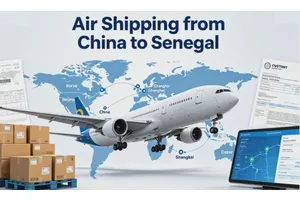
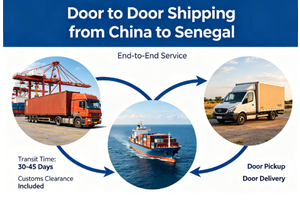
Ask two forwarders for a DDP shipping from China to Senegal quote and the numbers can look like they came from different planets. One says $150–300 per CBM, all-in. The other tells you to reserve 47% of your CIF value for Senegalese duties alone. Both can be honest — they are not quoting the same thing. And neither mentions the three documents that decide whether your container ever leaves the Port of Dakar: NINEA, DPI, and the BSC cargo tracking note, filed before the vessel sails and impossible to fix afterward.
This guide closes both gaps: how to normalize any quote onto one scale, why China–Dakar cargo always transships, how Senegal's tax layers stack into a 40–55% burden, and how the pre-shipment compliance chain actually works. Start from our Shipping from China to Senegal hub if you need the country-level overview first.
What Is DDP Shipping from China to Senegal? DDP vs DAP vs DDU vs FOB
DDP (Delivered Duty Paid) is the heaviest obligation an exporter can accept under Incoterms 2020: the seller — or the forwarder acting for it — carries the cargo from the Chinese factory door to a named place in Senegal and pays for everything in between, including Senegalese import duty and taxes. The phrase that matters most is named place: "DDP Dakar" and "DDP Touba" are different products at different prices.
| Cost & risk element | DDP | DAP / DDU | CIF | FOB |
|---|---|---|---|---|
| Factory pickup + China export declaration | Seller | Seller | Seller | Seller |
| International ocean / air freight | Seller | Seller | Seller | Buyer books |
| Transshipment handling (Tanger Med / Las Palmas) | Seller | Seller | Usually excluded | Buyer |
| Dakar import clearance | Seller (via licensed transitaire) | Buyer | Buyer | Buyer |
| CET duty, community levies, 18% TVA | Seller | Buyer | Buyer | Buyer |
| BSC/CTN filing and PSI inspection | Seller | Buyer | Buyer | Buyer |
| Final delivery to consignee | Seller | Seller (duty unpaid) | Buyer | Buyer |
| Importer of Record (IOR) | Arranged by seller | Buyer | Buyer | Buyer |
DDP does not waive importer eligibility. Senegalese customs still requires an IOR holding a valid NINEA, and declarations at Dakar can be lodged only by a licensed customs broker (transitaire). DDP transfers cost and operational responsibility — not the legal capacity to import — which is why first-time buyers and SMEs without a Dakar back office gravitate to it.
Why There Is No Direct Vessel from China to Dakar: Corridors, Ports & Terminals
There is no direct service. Every shipment is discharged at a transshipment hub and reloaded onto a feeder vessel for the final leg to the Port Autonome de Dakar (PAD) — a double-leg structure that costs transit time but buys weekly frequency.
| Carrier | Service | Transshipment hub | Port-to-port transit | Notes |
|---|---|---|---|---|
| CMA CGM | WAX (West Africa Express) | Tanger Med (Morocco) | ~30 days | Weekly from Shanghai; the dominant Franco-West African corridor |
| Maersk | West Africa service | Algeciras + Tanger Med | ~28–34 days | Bi-weekly from major Chinese load ports |
| MSC | — | Las Palmas (Canary Islands) | ~33–38 days | Longer, but often the sharpest pricing outside peak season |
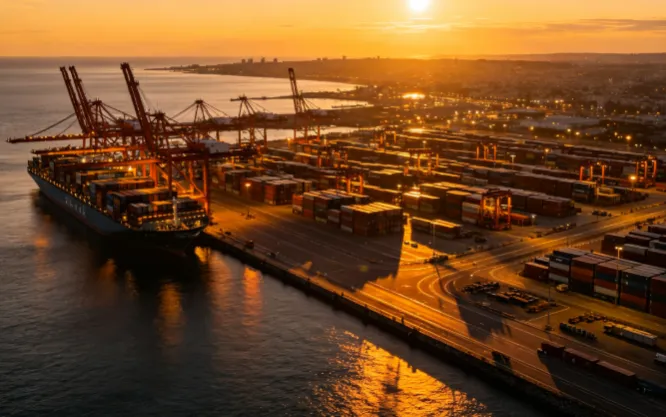
If you have read that China–Dakar cargo transships through Singapore, Dubai or Cape Town, that is wrong for this corridor. PAD handles roughly 600,000 TEU a year through a DP World Dakar-operated terminal, and free time is only 7–10 days — a short window by global standards, and where avoidable storage bills are born. One alternative routing exists: discharge at Abidjan (CICE) and move by road up Senegal's RN1 (about 1,200 km, 2–4 days), which suits Casamance / Ziguinchor cargo. Tanger Med, the corridor's main hub, is covered in our Shipping From China to Morocco page.
DDP Shipping Cost from China to Senegal
Here is the root of the pricing confusion: "DDP" describes at least five different cost layers on this lane, and almost nobody labels which one they mean.
| Caliber layer | What it covers | Typical quote language |
|---|---|---|
| ① Port-to-port | Ocean freight base only | "$55–75 / CBM" |
| ② Origin-inclusive | ① + origin THC + export declaration + BAF/EBS/CAF/PSS | "$70–100 / CBM" |
| ③ Transshipment-inclusive | ② + Tanger Med / Las Palmas handling and feeder connection | Rarely quoted alone |
| ④ Duty-paid (true DDP) | ③ + CET + all levies + 18% TVA + broker fee + PAD THC | "$150–300 / CBM" |
| ⑤ Delivered to door | ④ + delivery to Dakar / Pikine / Touba / inland | One flat delivered price |
The famous "$150–300 per CBM" sits at layer ④ — and many quotes at that level still omit PAD terminal handling, broker fees, PSI inspection and final delivery. A landed-cost model saying "reserve 47% of CIF" describes the tax and local-charge block, a different axis entirely. Compare them without normalizing and the market looks irrational — it is simply badly labeled. For the port-to-port benchmark behind those numbers, see Sea Shipping cost from China to Senegal.
| Item | Indicative 2026 range | Caliber notes |
|---|---|---|
| Ocean FCL, 20GP | $2,800–4,200 base + $400–650 surcharges | Excludes PAD THC; port-to-port |
| Ocean FCL, 40GP / 40HQ | $4,500–7,000 base + $550–900 surcharges | 40HQ for light, voluminous cargo |
| Ocean LCL (per CBM) | $55–75 base + $15–25 surcharges | Minimum 1 CBM |
| BAF / EBS / CAF | Carrier-published, reset quarterly | BAF resets on the carrier's tariff schedule |
| PSS (peak season surcharge) | ~$150–300 / TEU | Seasonal |
| PAD terminal handling (THC) | ~$420–640 / 20' | Collected locally at Dakar, not at origin |
Our Industry Insights: these are indicative 2026 corridor ranges, not a quotation. The most valuable habit we can teach a buyer is to demand four things on every quote: the caliber layer, the currency, the validity date, and the free-time clause. We have seen identical-looking "DDP Dakar" offers differ by 40% once you ask which of the five layers is actually covered.
Timing is its own lever: CMA CGM spot rates on this corridor typically fall 20–30% between November and January, outside the Chinese New Year build-up. Surcharges move the other way: carriers have announced PSS increases on the Far East–West Africa lane.
DDP Transit Time from China to Senegal: Door-to-Door Breakdown & Buffer Windows
Public transit-time figures for this lane range from 14 days to 60. They are not contradictory — they merely use different calibers.
| Leg | Duration |
|---|---|
| China factory pickup and consolidation | 1–3 days |
| Export declaration and loading | 2–5 days |
| Ocean main leg and hub connection | By carrier rotation and berth windows |
| Dakar clearance, duty payment, BSC/PSI verification | Usually a few days on clean documents |
| Final delivery (Dakar / Pikine / Touba / inland) | 1–3 days |
| Door-to-door, all-in | Plan on 40–55 days for sea DDP |
Air DDP, routed via Istanbul, Doha, Paris or Addis Ababa into Blaise Diagne International Airport (DSS), runs 8–15 days door-to-door. See Air Shipping from China to Senegal for gateway routings and chargeable-weight rules.
Four windows deserve a deliberate buffer: the July–September rainy season (+3–5 days), Q4 peak capacity and blank sailings, hub and PAD congestion, and Chinese New Year, Golden Week and Senegalese holidays including Eid al-Fitr.
PAD free time is 7–10 days; beyond it, demurrage can run above $150 per day for a 20' box, with magasinage and detention piling on separately. Three actions keep clearance inside the window: get the original bill of lading or telex release to Dakar before the vessel's ETA; brief your broker 48 hours before arrival; and confirm the BSC and AV records have reached your broker before the ship berths.
Real-Life Scenario: a Dakar-bound consignment of building materials sat for eleven days last season because the original bill of lading traveled in the same courier pouch as a set of corrected invoices. The customs file was ready; the release document was not. The fix costs nothing — split the documents, digitize the release, and confirm receipt with your broker in writing.
Senegal Import Duty, 18% TVA & the Complete Tax-Layer Stack
Everything in Senegal's import tax system starts from CIF — goods value plus marine insurance plus international freight. Duty and levies stack on top of CIF, and TVA is then charged on top of everything else. That tax-on-tax structure is why the effective burden lands near 40–55% of CIF rather than the headline duty rate.
| # | Charge | Base | Reference rate | Notes |
|---|---|---|---|---|
| 1 | Droit de Douane (customs duty) | CIF | 0 / 5 / 10 / 20 / 35% — ECOWAS CET bands | Classified by HS code; textiles and sensitive agricultural goods sit in the top band |
| 2 | RSP / RSI (statistical levy) | CIF | ~1% | Broadly applicable |
| 3 | ECOWAS / PCS (community solidarity levy) | CIF | ~0.5% | Broadly applicable |
| 4 | WAEMU / PC (union levy) | CIF | ~1% | Broadly applicable |
| 5 | PRD (customs reform levy) | CIF | ~0.25% | Broadly applicable |
| 6 | COSEC levy | CIF | ~0.20–0.4% | Port cargo-tracking system |
| 7 | Timbre douanier (stamp duty) | CIF | ~1% | Often omitted from published guides |
| 8 | TCS (temporary solidarity surcharge) | CIF | 0–1% | Conditional |
| 9 | Customs processing fee | CIF | ~2% | Often omitted |
| 10 | TVA (VAT) | CIF + duty + all levies above | 18% | Tax on tax — the main driver of the stack |
| 11 | Droits d'Accises (excise) | Varies | Varies | Tobacco, alcohol, fuels, cosmetics, vehicles |
TVA = (CIF + duty + RSP + PCS + PC + PRD + COSEC + Timbre + TCS + processing fee) × 18%
For a standard finished product in the 20% CET band, the summed layers push the total burden above 40% of CIF, and selected categories approach 50%. The insight most buyers miss: TVA is an advance, not a cost — if you can reclaim it. An importer registered with a NINEA and RCCM can credit the TVA paid at import against later filings, so DDP's value becomes price certainty rather than savings. If you cannot reclaim it, the 18% is real money and a bundled DDP price is genuinely attractive.
Senegal also has no duty-free threshold: de minimis is effectively zero, so samples and small parcels still go through formal declaration. Clearance runs through the Direction Générale des Douanes (DGD) via GAINDE 2000 and SYDONIA World, coordinated with the ORBUS single window; once duties are paid, the release order — the BAE (Bon À Enlever) — is issued.
Our Industry Insights: first-time importers are rarely blindsided by the duty rate itself, which they can look up. They are blindsided by the VAT base — buyers routinely compute 18% on CIF and end up 2–4 percentage points short, because TVA is levied on CIF plus duty plus every levy. When we model landed cost, the TVA base is the line we spend the most time getting right.
DDP Doesn't Waive Import Eligibility: NINEA, DPI & BSC/CTN Before the Vessel Sails
DDP solves who does the work. It does not solve whether the cargo can be cleared. Senegal enforces three non-tariff gates, and the order matters — one of them closes permanently once the ship departs.
Gate one — NINEA. The NINEA (Numéro d'Identification Nationale des Entreprises) is the foundation of import eligibility, alongside RCCM registration and the carte import-export card. A foreign company with no Senegalese registration cannot act as the IOR — so buyers without a local entity work through an import agent or local partner.
Gate two — DPI and bank domiciliation. Above roughly the 1 million FCFA threshold, imports require a DPI (Déclaration Préalable d'Importation), and exchange rules require bank domiciliation and an Attestation d'Échange. The DPI links to an ORBUS single-window number that must later be bound to the BSC record; missing that chain stalls both payment and clearance.
Gate three — BSC/CTN, filed before the vessel sails. The BSC (Bordereau de Suivi de Cargaison) is Senegal's mandatory cargo tracking note, issued through the COSEC (Conseil Sénégalais des Chargeurs) system, and must be filed and bound to the ORBUS number before loading. This is the irreversible step: once the vessel has departed there is no mechanism to fix it, and the consequences are unreleasable cargo, penalties, and storage from day one.
Pre-shipment inspection (PSI), layered on top. China-origin cargo with an FOB value at or above $3,000 must be inspected before loading by COTECNA or BIVAC (Bureau Veritas), which issue an Attestation de Vérification (AV). Without it, goods go on compulsory hold at Dakar however complete the rest of the file is, and a penalty near 20% of CIF can apply.
Licensed broker, mandatory. Declarations can only be lodged by a broker approved by DGD, typically for XOF 250,000–450,000 per declaration, excluding duties and port levies. If a forwarder proposes to clear your goods under its own NINEA, put three things in writing: ownership of the goods, who bears and who reclaims the taxes, and consistency of document headers across invoice, bill of lading and declaration.
Documentation and technical compliance. Key documents must be in French. A Certificate of Origin (via CCIAD) matters for classification, but there is no China–Senegal free trade agreement, so Chinese-origin goods get no preferential rates. Wood packaging must meet ISPM-15 rules; food, plant and animal products need DPV, DIREL or DOPM clearance; vehicles face age limits under Décret 2012-444.
The five clearance failures we see most: a BSC filed too late (irreversible); a missing PSI Attestation de Vérification; vague invoice descriptions and wrong HS classification; mismatched data across invoice, bill of lading and manifest; and clearance that only begins after PAD's free time has expired.
Sea DDP vs Air DDP: Costs, the Break-Even Point & Landed-Cost Anatomy
| Dimension | Sea DDP (FCL / LCL) | Air DDP |
|---|---|---|
| Pricing unit | Per container (FCL) or per CBM (LCL) | Per chargeable weight (kg, volumetric vs actual) |
| Door-to-door transit | ~40–55 days | ~8–15 days |
| Practical cargo size | From 1 CBM upward | Tens of kg to a few tonnes |
| Best fit | Mid-to-low value density, planned inventory | High value density, urgent or seasonal stock |
| Restrictions | Broadly permissive (dangerous goods by arrangement) | Battery (UN38.3), liquids, powders, magnetic limits |
| Gateway | PAD, Port Autonome de Dakar | DSS, Blaise Diagne International Airport |
Two thresholds do most of the decision work. First, FCL and LCL break even around 12–15 CBM: below 12 CBM LCL wins, above 15 CBM a 20' FCL beats LCL on cost per CBM. Second, the sea-air crossover sits near $30–50 per kg of product value — above that, capital tied up in a 35-day ocean transit erodes the freight saving.
The landed-cost ladder runs in this order: EXW goods value → origin charges → ocean or air freight (including BAF/EBS/CAF/PSS) → insurance → CIF → transshipment handling and feeder → CET duty → RSP, PCS, PC, PRD, COSEC, Timbre, TCS, processing fee → 18% TVA → broker fee → BSC and PSI/AV costs → PAD THC plus storage and detention → final delivery → total landed cost at your warehouse door. The final leg is broken down by destination in Door to Door Shipping from China to Senegal.
Matching cargo to tax reality. Consolidation is where the money is: three or four South China suppliers with 45–55 CBM combined can be picked up, inspected, labeled and loaded into one 40HQ at our Shenzhen warehouse, spreading fixed clearance costs across the load. Insurance is not automatic — confirm who insures, who the beneficiary is, whether cover follows Institute Cargo Clauses A (all risks), B or C, and how the premium stacks up against typical shipping container insurance cost for shipments from China.
DDP to Dakar or Transit to Bamako? Re-Export, Warehousing & When FOB Beats DDP
Dakar is the gateway for Mali, Mauritania, Guinea and Gambia as well as Senegal, and much cargo arriving at PAD is not consumed in Senegal at all. "DDP to Dakar" is not "DDP to Bamako." Transit cargo may require a dual BSC, additional border documentation, and a transit regime with a customs guarantee (acquits à caution) — a structurally different tax treatment. If the named place is Dakar, what happens after Dakar must be written into the contract.
Inside Senegal, the delivery point is not cosmetic: Dakar, Pikine, Touba, Thiès, Saint-Louis, Kaolack and Ziguinchor differ in distance and trunk road — RN1, RN2 or RN3 — and southern destinations may be cheaper via Abidjan. For distributors serving Mali, Mauritania or Gambia, the answer is often a Dakar bonded warehouse and cross-border distribution setup rather than immediate on-carriage; the Nouakchott corridor is covered in Shipping from China to Mauritania.
When FOB beats DDP — an honest answer. If you already hold a NINEA, work with a licensed transitaire you trust, and can reclaim the 18% TVA, then FOB with your own clearance usually costs less and gives you tighter control over ownership and tax treatment. DDP earns its premium when you lack that infrastructure, want a locked landed price, or want someone else to own the compliance chain. DDP vs FOB: Which Option Saves Time and Reduces Hassle weighs the two Incoterms directly.
Our Industry Insights: we routinely tell buyers, "do not buy DDP from us" — and quote FOB instead. Five questions settle it. Do you have a NINEA? Can you reclaim TVA? Do you have a broker you trust in Dakar? Do you control your own customs classification? Do you need price certainty more than cost optimization? Three or more "yes" answers point to FOB; fewer than two point to DDP.
FAQs
How much does DDP shipping from China to Senegal cost?
Sea DDP quotes typically run $150–300 per CBM and air DDP $5–12 per kg, but those figures only mean something once the caliber is stated.
How long does DDP shipping from China to Senegal take door to door?
Plan on 40–55 days for sea DDP and 8–15 days for air DDP. Port-to-port ocean time alone is roughly 28–38 days.
Is there a direct vessel from China to Dakar?
No. All cargo transships — most commonly at Tanger Med, Algeciras or Las Palmas — before a feeder vessel calls at PAD.
Send us your cargo details, HS code and exact delivery address, and we will return a line-item DDP quote with the caliber, currency, validity and free-time terms stated up front. If FOB genuinely serves you better, we will tell you that too — and one piece of free advice regardless of who you book with: confirm your BSC filing and PSI inspection schedule before you confirm the booking.