If you are sourcing goods from China for the Costa Rican market, you already know that speed can make or break your business. A sea freight container takes 30 to 40 days to reach Puerto Caldera — and for many importers, that means weeks of lost sales, depleted inventory, and frustrated customers. Air shipping from China to Costa Rica solves that problem, delivering your cargo to San José in as little as 5 to 8 days. In our 10+ years as a FIATA and IATA-certified freight forwarder based in China, we have handled hundreds of air freight shipments to Central America, and we know exactly what it takes to get your goods through customs at Juan Santamaría International Airport (SJO) without delays.
In this comprehensive 2026 guide, we break down everything you need to know: realistic per-kg rates across weight brackets, airport-by-airport transit times, a step-by-step walkthrough of the air freight process, Costa Rica-specific customs requirements (including the often-overlooked RTN certification for electronics), and a practical framework for choosing between DDP door-to-door and airport-to-airport service. Whether you are a first-time importer or an experienced B2B buyer, this guide will help you ship smarter, faster, and more cost-effectively.
Air Freight vs. Sea Freight from China to Costa Rica: Which Is Right for You?
Choosing between air and sea freight is rarely a simple question of "which is cheaper." The real question is: what does a delayed shipment cost your business?
Air Freight vs. Sea Freight: A Decision Framework
If your cargo falls into any of the following categories, air freight is almost certainly the right call:
- High-value-to-weight ratio goods: Electronics, pharmaceuticals, luxury accessories, and precision instruments. A $50,000 shipment of smartphones costs far more in inventory carrying cost than the air freight premium over sea.
- Time-sensitive shipments: Seasonal fashion that must hit shelves before a trend passes, event materials with a hard deadline, or emergency spare parts that are holding up a production line.
- Perishable goods: Fresh or frozen products where a 35-day sea voyage is simply not an option.
- Low-volume, high-frequency e-commerce restocks: Online sellers running lean inventory models who need rapid replenishment cycles.
When sea freight is the better choice: heavy, dense goods like bulk industrial machinery, large-volume furniture, or low-value commodities where freight cost per unit dominates the total landed cost equation. For a detailed breakdown of ocean freight rates, see our sea shipping cost analysis from China to Costa Rica.
The Hybrid Strategy: Air + Sea for Optimal Cash Flow
One of the most effective strategies we recommend to our clients is running air and sea freight in parallel. A San José-based appliance retailer we work with ships 80% of their inventory by sea freight from China to Costa Rica (28–35 days, lower cost) and uses air freight for fast-selling SKUs that run low between container arrivals. The result? They maintain 95%+ in-stock rates without tying up excess working capital in safety stock. For importers serving multiple markets across the region, shipping from China to the Americas with a tailored mix of air and sea freight unlocks significant supply chain efficiencies.
| Factor | Air Freight | Sea Freight |
|---|---|---|
| Typical Transit (China → Costa Rica) | 5–10 days | 30–40 days |
| Cost per kg | $3.80–$8.50 | $1.50–$3.00 |
| Best for | High-value, urgent, perishable | Bulk, heavy, low-urgency |
| Inventory impact | Low safety stock needed | High safety stock required |
| Customs clearance speed | 1–2 days (expedited available) | 3–7 days typical |
How Does Air Shipping from China to Costa Rica Work? (Step-by-Step Process)
Understanding exactly how your cargo moves from your supplier's factory to your door in Costa Rica helps you plan better, avoid surprises, and communicate effectively with your forwarder. Here is the full journey, broken into five phases.
Phase 1 — Pre-Shipment & Cargo Pickup (Days 0–1)
The process begins once your supplier confirms the goods are ready. Your freight forwarder books space with the airline and dispatches a truck to pick up the cargo from the factory — whether you are shipping under EXW (Ex Works, where the supplier only makes goods available at their premises) or FOB (Free on Board, where the supplier delivers to a named location). The cargo arrives at the forwarder's consolidation warehouse near the departure airport, where it is checked, counted, and prepared for export.
Phase 2 — Export Customs Clearance in China (Day 1–2)
Before any cargo leaves China, it must clear export customs. Your forwarder submits the Commercial Invoice, Packing List, and Export Declaration to China Customs electronically. Most shipments clear within hours, but if customs flags the shipment for a physical inspection — more common for dangerous goods (DG) or high-value electronics — this can add 1 to 2 days. Once cleared, the cargo is palletized, weighed, labeled with the Air Waybill (AWB) number, and moved to the airline's cargo terminal.
Phase 3 — International Transit (Days 2–6)
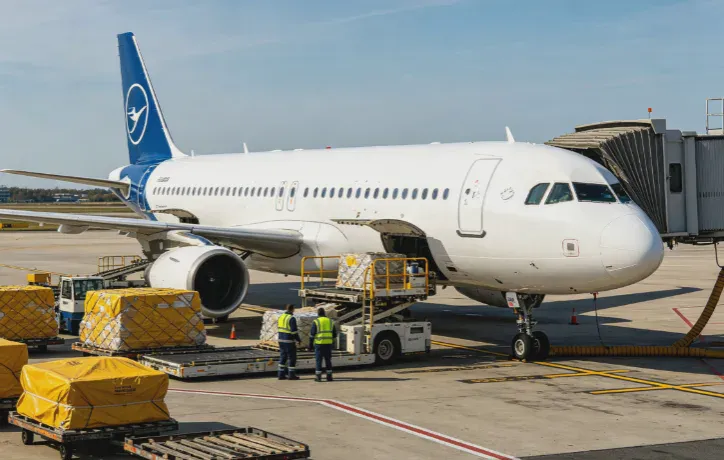
Your cargo is loaded onto the aircraft. Because there are no direct passenger flights from mainland China to Costa Rica, air freight typically routes through one of the major Latin American transit hubs:
- Miami (MIA): The most common connection point, served by multiple daily flights from PVG, HKG, and CAN
- Mexico City (MEX): A strong alternative, particularly for shipments originating from Shanghai and Shenzhen
- Bogotá (BOG) or Panama City (PTY): Common for flights departing Beijing and Guangzhou. Panama also serves as a major regional logistics hub — learn more in our guide to air shipping from China to Panama
Cargo moves either in the belly hold of passenger aircraft or on dedicated freighter planes operated by carriers like LATAM Cargo, DHL Aviation, and Emirates SkyCargo. Throughout transit, your AWB number enables real-time tracking.
Phase 4 — Arrival & Import Clearance at SJO (Day 5–7)
The aircraft lands at Juan Santamaría International Airport (SJO) in San José. Your forwarder's customs broker (or your own, if shipping airport-to-airport) files the DUA (Documento Único Aduanero) through Costa Rica's TICA digital customs platform. Duties and taxes are assessed and paid. Standard customs processing takes 1 to 2 days; expedited clearance is available in 6 to 12 hours for urgent or perishable cargo.
Phase 5 — Last-Mile Delivery (Day 7–8)
Once customs releases the cargo, it is loaded onto a truck for final delivery. If your destination is within the Greater San José Metropolitan Area (GAM), delivery is typically same-day. For destinations further afield — Liberia, Limón, Puntarenas — add 1 to 2 days. Important: Costa Rica's rainy season (May through November) can cause significant delays on Route 27 (San José–Caldera) and Route 32 (San José–Limón). We always recommend building in a 1–2 day buffer during these months.
How Long Does Air Freight Take from China to Costa Rica?
Not all routes are created equal. The airport your cargo departs from has a meaningful impact on both transit time and cost per kilogram.
| Departure Airport (China) | Typical Transit (Airport-to-Airport) | Common Transit Hub | Notes |
|---|---|---|---|
| Hong Kong (HKG) | 3–5 days | MIA or direct freighter | Most frequent connections; best for DG/battery cargo |
| Shanghai Pudong (PVG) | 4–6 days | MIA or MEX | Strong for East China manufacturing regions |
| Guangzhou Baiyun (CAN) | 5–7 days | MIA or BOG | Primary hub for Pearl River Delta |
| Shenzhen Bao'an (SZX) | 5–7 days | MIA or MEX | Electronics manufacturing cluster |
| Beijing Capital (PEK) | 6–8 days | BOG or PTY | North China cargo; slightly longer due to routing |
Service Level Comparison
| Service Level | Transit Time (Door-to-Door) | Best For |
|---|---|---|
| Express Courier (DHL/FedEx/UPS) | 3–5 days | Documents, samples, shipments under 30 kg |
| Standard Air Freight | 5–8 days | Airport-to-airport B2B cargo, 45–500+ kg |
| Consolidated Air Freight | 7–10 days | Cost-saving option, 20–30% cheaper than standard |
| DDP Door-to-Door Air | 6–10 days | Full-service, all-inclusive door delivery |
Factors That Affect Your Actual Transit Time
- Connecting flight schedules: A 6-hour layover in Miami versus a 24-hour layover makes a real difference
- Customs inspection triggers: First-time importers and certain product categories (electronics, food items) face higher inspection rates
- Holiday impacts: Chinese New Year (January/February) slows China-side operations; Semana Santa (Holy Week, March/April) reduces Costa Rican customs staffing
- Rainy season road delays: Landslides on Route 27 and Route 32 during heavy rains (May–November) can delay last-mile delivery by 1–3 days
How Much Does Air Freight from China to Costa Rica Cost?
Air freight pricing is more nuanced than a simple per-kg number. Three variables determine what you actually pay: your shipment's chargeable weight, the weight bracket it falls into, and the surcharges applied.
Chargeable Weight: The Golden Rule of Air Freight
Airlines charge based on chargeable weight — the greater of your actual gross weight or your volumetric (dimensional) weight. The formula is:
Volumetric Weight (kg) = (Length cm × Width cm × Height cm) ÷ 6,000
Here is a real-world example: You ship a box measuring 120 × 80 × 60 cm that weighs 70 kg on the scale. The volumetric weight is (120 × 80 × 60) ÷ 6,000 = 96 kg. Since 96 kg exceeds the actual 70 kg, the airline charges you for 96 kg — a 37% increase over what you might have budgeted.
Expert Tip: For bulky, lightweight goods like apparel or plush toys, optimizing your packaging to reduce empty space is the single most effective way to lower your air freight bill. Even reducing box height by 5 cm can save hundreds of dollars per pallet.
Air Freight Rate Table — China → Costa Rica (2026 Reference)
Rates vary by departure airport, season, and airline capacity. The figures below represent current market ranges for standard airport-to-airport service and all-inclusive DDP door-to-door service.
| Weight Bracket | Airport-to-Airport Rate (USD/kg) | Door-to-Door DDP Rate (USD/kg) |
|---|---|---|
| 45–100 kg | $4.50–$6.50 | $6.50–$8.50 |
| 100–300 kg | $3.80–$5.50 | $5.50–$7.50 |
| 300–500 kg | $3.20–$4.80 | $4.80–$6.80 |
| 500+ kg | Custom quotation | Custom quotation |
Note: DDP rates include export clearance in China, international air freight, import customs clearance in Costa Rica, payment of all import duties and taxes, and final door delivery. All rates are indicative market references as of June 2026 — air freight pricing is dynamic and fluctuates weekly based on fuel costs, seasonal capacity, and airline yield management. Request a spot quote from your forwarder for binding rates on your specific shipment.
Surcharge Breakdown: What Is (and Isn't) in Your Quote
Your base freight rate is never the full picture. Here are the surcharges to budget for:
| Surcharge | Typical Range | Notes |
|---|---|---|
| Fuel Surcharge (FSC) | 15–25% of base rate | Floats with global jet fuel prices; adjusted monthly |
| Security Surcharge (SSC) | $0.15–$0.25/kg | Mandatory for all air cargo |
| Terminal Handling | $40–$80 per shipment | Charged by origin and destination airports |
| Customs Broker Fee | $75–$250 per clearance | Costa Rica-side broker fee for DUA filing |
| Destination Delivery | Varies by distance from SJO | Typically $0.50–$1.50/km for trucking |
Four Ways to Reduce Your Air Freight Costs
- Consolidate shipments to hit higher weight brackets — the rate for 300 kg is meaningfully lower per-kg than for 45 kg.
- Book off-peak: Avoid Chinese New Year (January/February) and the Q4 holiday rush (October–December) when rates can spike 20–40%.
- Consider consolidated air freight: If you can tolerate 7–10 days instead of 5–7, consolidated service saves 20–30%.
- Optimize packaging: Reduce volumetric weight by using right-sized boxes and vacuum-sealing bulky items where possible.
Costa Rica Customs Clearance for Air Cargo from China: Import Duties, Documents & Taxes
Costa Rica has one of the most digitized and efficient customs systems in Central America — but it is also unforgiving of paperwork errors. According to the Costa Rican Dirección General de Aduanas (DGA), the TICA platform processed over 2 million import declarations last year, with an average electronic release time under 4 hours for compliant shipments. Getting your documentation right before the cargo leaves China is the difference between same-day release and a week of storage fees — a lesson we have learned the hard way on behalf of our clients.
Required Documentation Checklist
- Air Waybill (AWB) — Issued by the carrier or forwarder; your primary tracking and identification document
- Commercial Invoice — Strongly recommended in Spanish; must separately list FOB value, freight cost, and insurance cost
- Packing List — Itemized with quantities, weights, dimensions, and HS codes for each line item
- Certificate of Origin — Required to claim preferential tariff rates under CAFTA-DR (Dominican Republic-Central America Free Trade Agreement)
- DUA (Documento Único Aduanero) — The import declaration filed electronically via the TICA system by your customs broker
- Special Permits (as applicable): RTN (Registro Técnico Nacional) for electronics, SENASA phytosanitary certificate for agricultural goods, Ministry of Health registration for medical devices
Costa Rica Import Duty & Tax Calculation (Worked Example)
Here is how your total landed cost is calculated at Costa Rican customs. The key principle: IVA (13% VAT) is applied to the CIF value PLUS the import duty — not just the CIF value alone.
| Cost Component | Amount | Calculation |
|---|---|---|
| CIF Value (goods + freight + insurance) | $10,000 | Supplier invoice + freight + insurance |
| Import Duty (example: 8% for textiles) | $800 | 8% × $10,000 |
| Subtotal before VAT | $10,800 | CIF + Duty |
| IVA (13% VAT) | $1,404 | 13% × $10,800 |
| Customs Broker Fee | ~$150 | Service fee for DUA filing |
| Total Landed Cost | $12,354 | — |
CAFTA-DR Note: Goods manufactured in China generally do not qualify for CAFTA-DR preferential rates, as China is not a signatory. However, if you are re-exporting goods that underwent substantial transformation in a CAFTA-DR member country, reduced duties may apply. Consult your customs broker.
Key Compliance Requirements You Cannot Afford to Miss
RTN (Registro Técnico Nacional) — This is the most commonly overlooked requirement for electronics importers, and in our experience, the number one cause of customs holds for first-time shippers to Costa Rica. We have seen shipments sit at SJO for weeks simply because the importer did not know the RTN existed. Any electronic product entering Costa Rica — from LED screens to smartphone accessories — must be registered with the Ministry of Economy, Industry and Commerce (MEIC) and obtain an RTN certificate before import. The RTN registration process typically takes 2–4 weeks, so we strongly advise initiating it before your goods are even manufactured. Your supplier or forwarder should verify RTN eligibility during the pre-shipment phase.
Spanish Labeling — Product labels, instruction manuals, and packaging must be in Spanish. Customs officers at SJO routinely flag shipments with English-only labeling for secondary inspection. We once had a client's shipment of LED lighting fixtures held for five extra days at SJO because the wattage specifications on the outer carton were printed in English and Chinese but not Spanish — a $0.50 label cost them $350 in storage and demurrage fees. Today, our pre-shipment checklist includes a Spanish labeling audit before any cargo leaves China.
HS Code Accuracy — Costa Rica's TICA system cross-references declared HS codes against global trade databases. Misclassification — even unintentional — can trigger an automatic audit, penalties, and weeks of delay.
Undervaluation Risks — Never under-declare your cargo value to save on duties. TICA compares declared values against international benchmarks for similar goods and flags discrepancies automatically. The fines for undervaluation can exceed the duties you attempted to avoid.
Customs Processing Timeline
- Standard clearance: 1–2 days
- Expedited clearance: 6–12 hours (available for urgent, perishable, or medical cargo)
- Physical inspection (Red Channel): Adds 2–5 days
Prohibited & Restricted Items
Costa Rica prohibits or restricts the import of: firearms and ammunition, ********s and precursor chemicals, used tires, unregistered wireless/radio devices, and certain agricultural products without SENASA clearance. Always verify your product category with your forwarder before shipping.
Door-to-Door Air Shipping from China to Costa Rica: DDP vs. Airport-to-Airport
One of the most consequential decisions you will make is whether to ship DDP door-to-door or airport-to-airport. The right choice depends entirely on your operational setup in Costa Rica.
What Is DDP Air Shipping?
Under Incoterms 2020, DDP (Delivered Duty Paid) means the seller or freight forwarder assumes all costs, risks, and responsibilities — from pickup at the Chinese factory through export clearance, international air transport, Costa Rican import clearance, duty and tax payment, and final delivery to your specified address. You receive one invoice and deal with one point of contact for the entire journey. For a broader comparison of shipping terms, see our guide on DDP vs FOB and how each option affects your total landed cost.
Airport-to-Airport (Standard Air Freight)
With airport-to-airport service, your forwarder handles the China side (pickup, export clearance, and the international flight to SJO). You — or your locally appointed customs broker in Costa Rica — handle import clearance, duty/tax payment, and last-mile delivery. This gives you more control but requires you to have a Costa Rican tax ID (cédula jurídica for companies) and a relationship with a local broker.
Side-by-Side Comparison
| Factor | DDP Air (Door-to-Door) | Airport-to-Airport |
|---|---|---|
| All-in cost | Higher per-kg rate | Lower freight rate + your broker costs |
| Convenience | One contact, one invoice | Coordinate two sides independently |
| Tax ID required? | No — forwarder acts as Importer of Record | Yes — cédula jurídica or personal ID needed |
| Pricing transparency | All-inclusive upfront quote | Separate freight + customs + delivery bills |
| Best for | First-time importers, SMEs, e-commerce sellers | Experienced importers with an established local broker |
| Customs risk | Borne by forwarder | Borne by you as importer of record |
Important: Even under DDP, you as the importer remain legally responsible for product compliance. If your electronics lack RTN certification or your medical devices lack Ministry of Health registration, the fact that a forwarder handled the logistics does not shield you from liability.
How to Decide: A Simple Decision Framework
- You have a Costa Rican tax ID, an established customs broker, and experience with TICA procedures → Airport-to-airport gives you more cost control.
- You are a first-time importer, an SME without a logistics team, or an e-commerce seller who wants a hands-off experience → DDP door-to-door is the right call.
The DDP premium (typically $1.50–$2.50/kg above airport-to-airport rates) buys you: import customs brokerage, advance payment of duties and taxes, last-mile delivery coordination, and — most importantly — the peace of mind that a single accountable party owns the entire shipment lifecycle. This same DDP framework applies across the region — see our guide to door to door shipping from China to Panama for a comparable Central American destination.
What Can You Ship by Air from China to Costa Rica?
Different product categories face different regulatory hurdles, packaging requirements, and cost structures when shipping by air from China to Costa Rica. Here is what you need to know for the most common import categories.
Electronics & Batteries
Electronics are the single most common air freight category on the China–Costa Rica route — and the most heavily regulated.
- Lithium batteries: Governed by the IATA Dangerous Goods Regulations (DGR) — specifically Section 4.2 (Dangerous Goods List) and Packing Instruction 965–970 depending on battery type and configuration. UN3480 covers lithium-ion batteries shipped alone; UN3481 covers batteries packed with equipment. Both require DG-certified packaging, Class 9 hazard labeling, and a completed Shipper's Declaration for Dangerous Goods signed by a DG-certified person. The International Civil Aviation Organization (ICAO) Technical Instructions also apply, mandating a state of charge limit of 30% for standalone lithium-ion batteries effective January 2026.
- RTN certification: Every electronic product entering Costa Rica must hold a valid RTN (Registro Técnico Nacional) issued by MEIC. Obtain this before your shipment departs China.
- Packaging: Anti-static wrapping for sensitive components; UN-specification outer packaging for standalone batteries. Expect a DG handling surcharge of $0.50–$1.00/kg.
- Duty rate: Typically 1–13% depending on the specific electronic item; some IT equipment qualifies for reduced rates.
Textiles & Apparel
Textiles and apparel are Costa Rica's largest consumer import category from China.
- Volumetric weight challenge: Clothing is bulky relative to its weight — volumetric weight often exceeds actual weight. Vacuum-sealing and compact folding can meaningfully reduce your chargeable weight.
- Duty rate: 8–14% depending on fabric composition; knitwear and synthetic fibers tend toward the higher end.
- Labeling requirement: All garments must carry Spanish-language composition labels and care instruction tags. Shipments without them are flagged for re-labeling at the importer's expense.
Machinery Parts & Industrial Equipment
- Weight advantage: Dense and heavy — actual weight typically exceeds volumetric weight, making air freight pricing more favorable per kg of actual product.
- Wooden pallets/crating: Must comply with ISPM 15 (International Standards for Phytosanitary Measures) — wood packaging must be heat-treated and stamped with the IPPC mark. Non-compliant crating will be rejected at SJO.
- Duty rate: Often 1–6% under Costa Rica's industrial development incentives; CAFTA-DR may apply if goods originate from a member country.
Medical Devices & Pharmaceuticals
- Cold chain: Temperature-controlled air freight using active (powered) or passive (insulated with coolant packs) cold chain packaging. Inform your forwarder of temperature requirements during booking.
- Registration: Medical devices require registration with the Costa Rican Ministry of Health. Pharmaceuticals face even stricter import licensing.
- Customs priority: Request expedited clearance (6–12 hours) to minimize time outside temperature-controlled environments.
E-Commerce & Small Parcels
For shipments under 30 kg, express courier services (DHL, FedEx, UPS) are often more cost-effective and faster than traditional air freight. For shipments between 30–100 kg, an air freight consolidator typically offers better per-kg rates. Costa Rica applies a de minimis threshold for low-value shipments — consult your forwarder for current limits, as they are subject to periodic revision by the DGA.
How to Choose the Best Air Freight Forwarder from China to Costa Rica
Selecting the right freight forwarder is the single most impactful logistics decision you will make. A competent forwarder saves you money, prevents customs problems, and gives you visibility into your supply chain. The wrong one leaves you with delayed cargo, surprise fees, and nobody answering the phone when things go wrong.
7-Point Forwarder Evaluation Checklist
- IATA & FIATA Certification: For air freight, IATA (International Air Transport Association) accreditation is non-negotiable — it verifies that the forwarder is licensed to issue AWBs and handle air cargo under IATA Cargo Agency rules. The FIATA (International Federation of Freight Forwarders Associations) certification adds a broader credibility layer, confirming the forwarder adheres to FIATA's Model Rules for Freight Forwarding Services, recognized in over 150 countries. Always verify a forwarder's IATA numeric code and FIATA membership on the respective organizations' public registries.
- China–Latin America Trade Lane Experience: Not every forwarder understands Costa Rican customs. Ask specifically about their experience with the SJO route, TICA system, and Spanish-language documentation.
- Direct Airline Contracts: Forwarders with direct carrier agreements secure better rates and guaranteed space — critical during peak season when capacity tightens. Ask whether they contract directly with airlines serving the Latin America corridor.
- DDP Capability: Can the forwarder handle Costa Rica import clearance and duty payment on your behalf? This capability is essential if you do not have a local tax ID or broker relationship in Costa Rica.
- Real-Time Tracking: Your forwarder should provide AWB-based online tracking that lets you monitor your shipment from pickup in China through to delivery in Costa Rica — not just during the flight segment.
- Client References: Request Costa Rica-specific references or case studies. A forwarder who has successfully cleared the same types of goods you import is worth their weight in gold.
- Communication & Language: The Costa Rica side of the operation requires Spanish-language coordination with customs officials, trucking companies, and warehouse operators. Confirm that your forwarder's team includes Spanish-speaking staff.
Red Flags to Avoid
- Quotes significantly below market rates — this often signals planned undervaluation or hidden destination fees
- No physical office or warehouse in China
- Cannot provide a sample AWB or customs clearance record for a Costa Rica shipment
- Vague about surcharges — if they cannot itemize fuel, security, and handling fees, expect surprise charges
Why Experience Matters on This Route
At DTFU Logistics, we have been handling air freight from China to destinations across the Americas since 2014 — from air shipping from China to Peru on the Pacific coast to Central American markets like Costa Rica and Panama. As an IATA and FIATA dual-certified forwarder, we operate from all major Chinese airports — Shenzhen (our headquarters), Shanghai Pudong, Guangzhou Baiyun, Hong Kong, and Beijing Capital — giving you the flexibility to ship from the airport closest to your supplier. Every client is assigned a dedicated account manager who coordinates your shipment end-to-end, and our 24/7 online tracking platform gives you real-time visibility from pickup to delivery. Our direct contracts with carriers serving the Latin America corridor ensure competitive rates and guaranteed space, even during the Q4 peak season. We provide fully itemized quotes with every surcharge broken out — no hidden fees, no last-minute surprises.
Get a free, itemized air freight quote for your China → Costa Rica shipment within 24 hours. Contact our team today and let us build a shipping plan tailored to your cargo type, volume, and timeline.
FAQs
How long does air freight take from China to Costa Rica?
Standard air freight takes 5 to 8 days airport-to-airport, and 6 to 10 days door-to-door (DDP). The fastest routes — Hong Kong (HKG) to San José (SJO) — can deliver in as little as 3 to 5 days. Actual transit time depends on the departure airport, connecting flight schedules, and customs clearance speed at SJO.
How much does air shipping from China to Costa Rica cost per kg?
For shipments over 100 kg, expect $3.80 to $5.50 per kg for airport-to-airport service. All-inclusive DDP door-to-door rates range from $5.50 to $8.50 per kg. Smaller shipments (45–100 kg) pay higher per-kg rates ($4.50–$6.50 airport-to-airport). Rates fluctuate with season, fuel prices, and airline capacity.
What documents are needed for air freight from China to Costa Rica?
The essential documents are: Air Waybill (AWB) issued by the carrier, Commercial Invoice (preferably in Spanish, showing FOB value, freight, and insurance separately), Packing List with HS codes, and Certificate of Origin if claiming trade agreement benefits. Depending on your product, you may also need an RTN certificate (electronics), SENASA permit (agricultural goods), or Ministry of Health registration (medical devices).
Do I need a Costa Rican tax ID to import by air freight?
For airport-to-airport shipments, yes — you need a cédula jurídica (corporate tax ID) or personal identification number to act as the Importer of Record. For DDP door-to-door service, no — your freight forwarder acts as the Importer of Record and handles all customs formalities on your behalf.
What is chargeable weight and how is it calculated?
Chargeable weight is the greater of your shipment's actual gross weight or its volumetric (dimensional) weight, calculated as (Length × Width × Height in cm) ÷ 6,000. For example, a box measuring 120 × 80 × 60 cm has a volumetric weight of 96 kg — even if it only weighs 70 kg on the scale, the airline charges for 96 kg.
Which Chinese airports offer air freight service to Costa Rica?
All major Chinese international airports serve San José (SJO) via connecting hubs: Hong Kong (HKG) offers the fastest connections (3–5 days), followed by Shanghai Pudong (PVG) at 4–6 days, Guangzhou Baiyun (CAN) and Shenzhen Bao'an (SZX) at 5–7 days, and Beijing Capital (PEK) at 6–8 days. All routes transit through hubs like Miami (MIA), Mexico City (MEX), Bogotá (BOG), or Panama City (PTY).
Can I ship electronics with lithium batteries by air from China to Costa Rica?
Yes, but the shipment must comply with IATA Dangerous Goods Regulations (DGR). Lithium-ion batteries are classified as UN3480 (batteries alone) or UN3481 (batteries packed with equipment). Your forwarder must hold DG certification to prepare the Shipper's Declaration and ensure compliant packaging and labeling. Electronics also require RTN certification for Costa Rican import clearance.