Curious about air shipping from China to Belgium—including which airports handle the most cargo, how long your shipment will take, the cost per kilogram, or the tariffs you’ll encounter? If these questions leave you feeling uncertain—worried about delays, unexpected costs, or Customs Clearance hurdles—you’re in the right place.
This guide breaks down everything you need to know about air shipping from China to Belgium: from the key airports in China and Belgium that power this trade route, to clear timelines for different air freight services, detailed cost estimates per kilogram, and even tariff rates for common imports. Whether you’re shipping electronics, new energy vehicles (NEVs), or machinery, we’ve got the insights to help you navigate the process smoothly. Let’s turn your logistics uncertainty into confidence.
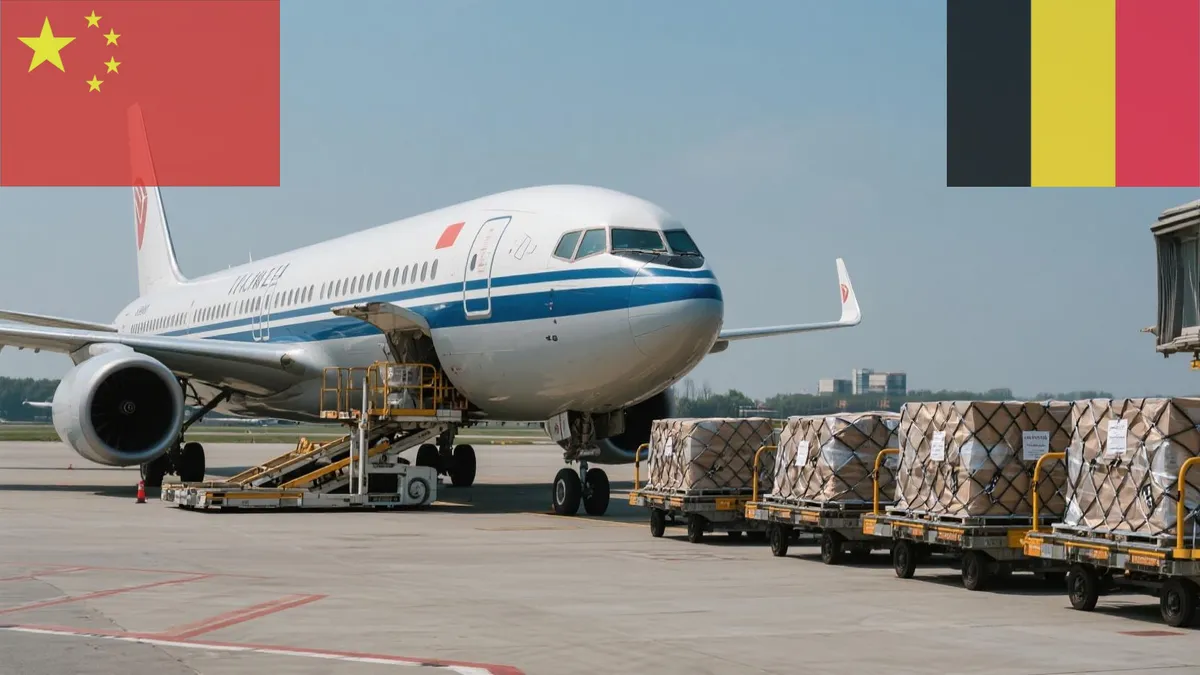
Main Airports in China and Belgium
Main Airports in China
Shanghai Pudong International Airport (PVG)
- Location: Shanghai
- Overview: China’s largest air cargo hub and a critical gateway for trade with Europe.
- Cargo Capacity: Approximately 3 million tons annually.
- Airlines: Primary hub for China Eastern Airlines, with partnerships with global carriers such as Air France-KLM and Lufthansa Cargo.
- Belgium Route Focus: Operates daily flights to Brussels (BRU) and Liège (LGG), primarily transporting electronics (e.g., smartphones, semiconductors), textiles, and machinery components. The direct flight distance to Brussels is about 9,200 kilometers, with a flight time of 11–12 hours. In 2024, this route handled over 180,000 tons of cargo between China and Belgium, accounting for 35% of bilateral air freight volume.
Zhengzhou Xinzheng International Airport (CGO)
- Location: Zhengzhou, Henan Province
- Overview: A fast-growing air cargo hub in central China, specializing in cross-border e-commerce and high-tech goods.
- Cargo Capacity: Over 700,000 tons annually.
- Airlines: Major operations by Cargolux (a leading global cargo airline), Saudi Cargo Airlines, and China Southern Cargo.
- Belgium Route Focus: Offers 15+ weekly flights to Liège Airport (LGG), making it one of the most frequent China-Belgium cargo routes. Key cargo includes cross-border e-commerce parcels (e.g., consumer electronics, home goods) and NEV parts. In May 2025, the “Riyadh-Zhengzhou-Liège” multi-stop route was launched, increasing weekly capacity by 20% and reducing transit times for goods routed through the Middle East.
Hefei Xinqiao International Airport (HFE)
- Location: Hefei, Anhui Province
- Overview: An emerging European-focused cargo hub, leveraging its proximity to China’s manufacturing centers for auto parts and electronics.
- Cargo Capacity: Growing rapidly, with 2024 cargo volume exceeding 320,000 tons (up 45% year-on-year).
- Airlines: Operated by China Cargo Airlines using Boeing 777 freighters (capacity: 100+ tons per flight).
- Belgium Route Focus: Launched 3 weekly flights to Liège Airport in May 2025, with each flight carrying approximately 83 tons of cargo. Around 65% of shipments are cross-border e-commerce goods, while the remaining 35% includes auto parts and high-end manufacturing components (e.g., precision instruments). The direct flight time is 11 hours, and the route is expected to handle 13,000+ tons of cargo in its first year.
Ningbo Lishe International Airport (NGB)
- Location: Ningbo, Zhejiang Province
- Overview: A specialized hub for high-value and NEV-related cargo, serving the Yangtze River Delta’s automotive and electronics industries.
- Cargo Capacity: Over 500,000 tons annually.
- Airlines: Partnered with ASL Airlines (Belgium-based cargo carrier) and China Eastern Cargo.
- Belgium Route Focus: Made industry history in May 2025 by launching the first direct air route for NEV transport from China to Belgium (Ningbo-Liège). Each flight can carry up to 40 NEVs (packaged in specialized containers) and completes the 9,500-kilometer journey in 12 hours. This route addresses Europe’s growing demand for Chinese NEVs—Belgium imported 242,300 Chinese NEVs in 2024, making it the EU’s top NEV import market.
Chengdu Shuangliu International Airport (CTU)
- Location: Chengdu, Sichuan Province
- Overview: Western China’s primary air cargo hub, connecting inland manufacturing bases (e.g., Chongqing’s electronics sector) to Europe.
- Cargo Capacity: Approximately 700,000 tons annually.
- Airlines: Operates dedicated charter flights (KF Charter) to Brussels three times weekly (Mondays, Wednesdays, Fridays).
- Belgium Route Focus: Direct 13–16 hour flights to Brussels Airport, primarily transporting electronics (e.g., laptop components from Chengdu’s hi-tech parks) and machinery. In 2024, this route carried over 45,000 tons of cargo, a 30% increase from 2023, driven by Western China’s export growth.
Main Airports in Belgium
Liège Airport (LGG)
- Location: Liège
- Overview: Belgium’s largest cargo airport and a core hub in Europe’s “Golden Logistics Triangle” (serving Germany, France, and the Netherlands).
- Cargo Capacity: Over 1.2 million tons annually (2024 data), making it the 7th busiest cargo airport in Europe.
- Airlines: Home base for Cargolux (one of the world’s top 5 cargo airlines) and ASL Airlines Belgium. It also partners with China Cargo Airlines and China Eastern Cargo.
- China Route Focus: Handles 60% of all air cargo between China and Belgium, with 40+ weekly flights from Chinese hubs (Shanghai, Zhengzhou, Hefei, Ningbo). It is the primary gateway for Chinese NEVs, cross-border e-commerce goods, and electronics entering Europe. Its proximity to major European markets (e.g., 1.5-hour truck ride to Cologne, Germany; 2-hour ride to Paris, France) enables fast distribution after Customs Clearance.
Brussels Airport (BRU)
- Location: Brussels (near the EU headquarters)
- Overview: Belgium’s main passenger airport with significant cargo operations, specializing in high-value and time-sensitive goods.
- Cargo Capacity: Approximately 700,000 tons annually (2024 data).
- Airlines: Served by global carriers including Lufthansa Cargo, Air France-KLM Cargo, and China Southern Airlines.
- China Route Focus: Operates daily flights to Shanghai, Beijing, and Guangzhou, primarily transporting pharmaceuticals, high-end fashion (e.g., luxury goods from China’s manufacturing hubs), and electronics. As the EU’s political and regulatory center, Brussels Airport benefits from streamlined customs coordination for EU-wide distribution. In 2024, it handled 30% of China-Belgium air cargo, with pharmaceuticals accounting for 25% of its China-bound shipments.
These airports form a robust network that drives China-Belgium trade—Liège Airport leads in volume (especially for NEVs and e-commerce), while Brussels Airport excels in high-value and regulated goods.
How long does air shipping take from China to Belgium?
Air freight from China to Belgium is ideal for urgent or high-value cargo (e.g., NEVs, electronics, pharmaceuticals). Total transit time depends on service type, airport pairs, and Customs Clearance efficiency. Generally, door-to-door shipping takes 2–10 days, including Customs Clearance and final delivery.
Below is a breakdown of typical transit times:
| Service Type | Airport-to-Airport (Days) | Door-to-Door (Days) | Best For |
|---|---|---|---|
| Express Air Freight | 1–2 | 3–5 | Urgent parcels, documents, small high-value goods |
| Standard Air Cargo | 2–4 | 5–7 | General cargo (electronics, textiles, auto parts) |
| Economy Air Cargo | 5–7 | 8–10 | Larger, less urgent shipments (e.g., bulk machinery parts) |
Route-Specific Examples (2025 Data)
- Ningbo-Liège (NEV transport): 12 hours (airport-to-airport); 5 days (door-to-door, including NEV-specific customs checks).
- Shanghai-Brussels (express): 24 hours (airport-to-airport); 3 days (door-to-door, leveraging Brussels’ fast customs for high-value goods).
- Chengdu-Brussels (charter): 13–16 hours (airport-to-airport); 6 days (door-to-door, accounting for inland transport from Chengdu).
- Hefei-Liège (e-commerce): 11 hours (airport-to-airport); 4–5 days (door-to-door, with dedicated e-commerce customs lanes at Liège).
Belgium’s efficient customs processes—especially at Liège Airport, which has a dedicated China-EU cargo Customs Clearance team—reduce delays compared to other European hubs.
How much is air freight from China to Belgium per kg?
The cost of air freight from China to Belgium per kilogram varies based on market demand, fuel prices, cargo type, and service speed. Below are key influencing factors and 2025 estimated rates:
Key Factors Influencing Cost
- Weight & Volume: Rates are based on either actual weight or volumetric weight (whichever is higher). Dense cargo (e.g., machinery parts) costs less per kg than light, bulky goods (e.g., furniture).
- Service Speed: Express services (e.g., DHL, FedEx charters) cost 2–3x more than economy options due to priority handling and faster flights.
- Airport Pair: Flights from major Chinese hubs (Shanghai, Zhengzhou) to Liège/Brussels have lower rates (more competition, higher frequency) than smaller airports (e.g., Hefei’s new route has slightly higher initial rates but is dropping as volume grows).
- Market Conditions: Fuel prices (Jet Fuel Price Index rose 8% in Q2 2025) and seasonal peaks (e.g., pre-Christmas e-commerce surges in Q4) increase rates. NEV transport also incurs a 15–20% premium for specialized packaging and safety compliance.
- Additional Services: Customs Clearance, cargo insurance, and door-to-door shipping add 10–15% to total costs but simplify logistics.
2025 Estimated Air Freight Costs Per KG
| Service Type | Price Range Per KG (USD) | Minimum Charge (USD) | Recommended Cargo Weight |
|---|---|---|---|
| Express Air Freight | 8.00–13.00+ | 50–150 | Up to 100 kg (e.g., urgent documents, small electronics) |
| Standard Air Cargo | 4.50–8.00 | 100–250 | 100–500 kg (e.g., auto parts, textiles) |
| Economy Air Cargo | 2.80–4.50 | 200–400 | 500 kg+ (e.g., bulk machinery, non-urgent goods) |
Route-Specific 2025 Rates
- Shanghai-Brussels (standard): $5.00–$6.50 per kg.
- Chengdu-Brussels (charter): $6.00–$7.50 per kg (45kg+).
- Ningbo-Liège (NEV transport): Custom pricing ($1,200–$1,800 per vehicle, equivalent to $30–$45 per kg for a 40kg NEV component).
- Hefei-Liège (e-commerce): $4.80–$6.00 per kg (bulk e-commerce parcels).
Note: Rates are current as of Q3 2025 and subject to change. For exact pricing, request a quote from a logistics provider with China-Belgium expertise.
What is the tariff rate for imports from China to Belgium?
Belgium, as an EU member, applies the EU Common Customs Tariff (CCT) to imports from China. Tariffs are determined by the product’s Harmonized System (HS) Code, and all imports are subject to Belgium’s Value Added Tax (VAT). Below is a breakdown of key rates and rules (2025 updates):
Key Tariff & VAT Basics
- VAT: Standard rate is 21% (applied to the total value: cost of goods + shipping + duty). Reduced rates (6% or 12%) apply to specific goods (e.g., food, medical devices), but most industrial/consumer goods use 21%.
- Tariff Calculation: Based on the product’s HS Code (6–10 digits). Use the EU Tariff Database to verify exact rates.
- Duty Deferral: Belgium offers “duty suspension” for goods in transit or stored in free zones (e.g., Liège Airport Free Zone), allowing importers to delay duty payments until goods are sold in the EU.
2025 Tariff Rates for Common Chinese Imports
| Product Category | HS Code (Example) | EU Tariff Rate (Approx.) | Belgium VAT Rate | Notes (2025 Updates) |
|---|---|---|---|---|
| Electronics (Smartphones) | 8517.12 | 0%–2.7% | 21% | Most consumer electronics benefit from low tariffs under EU-China tech trade agreements. |
| Textiles & Apparel | 6205.20 (Women’s dresses) | 9.6% | 21% | No changes in 2025; finished textiles face higher rates than raw materials. |
| Footwear (Leather Shoes) | 6402.19 | 10%–16% | 21% | Rates vary by material (synthetic footwear: 10%; leather: 16%). |
| New Energy Vehicles (NEVs) | 8703.80 | 0% (temporarily extended) | 21% | EU extended the 0% NEV tariff until 2026 to support clean energy goals—critical for Chinese NEV exporters. |
| Machinery (Industrial Parts) | 8483.60 | 0%–1.7% | 21% | Low tariffs to support EU manufacturing (e.g., 0% for precision engineering parts). |
| Toys (Plastic Dolls) | 9501.10 | 0% | 21% | Most toys enter duty-free under EU safety standards (must comply with CE marking). |
Important 2025 Rules
- Free Zones: Liège Airport and Antwerp Port operate free zones where goods can be stored, processed, or re-exported without paying duties. This is ideal for Chinese exporters using Belgium as a European distribution hub.
- Prohibited/Restricted Goods: Certain items require permits (e.g., lithium-ion batteries in NEVs, which need UN38.3 certification) or are banned (e.g., counterfeit goods, non-CE-certified electronics).
- Rules of Origin: To qualify for preferential tariffs, goods must meet “origin criteria” (e.g., 50%+ Chinese content for some tech products). Use a Certificate of Origin to claim benefits.
Belgium’s status as the EU’s top NEV import market (242,300 Chinese NEVs in 2024) is partly driven by the 0% tariff—this advantage is expected to continue until 2026.
Dantful Logistics – Your Expert in China-Belgium Air Freight
At Dantful Logistics, we offer one-stop, professional air freight solutions tailored to China-Belgium trade. Our expertise in EU customs, specialized cargo (e.g., NEVs), and route optimization ensures safe, cost-effective, and on-time deliveries.
Why Choose DTFU Logistics?
- Route Expertise: Deep knowledge of key China-Belgium routes (e.g., Ningbo-Liège NEV transport, Hefei-Liège e-commerce) and access to preferential rates from carriers like Cargolux and China Cargo Airlines.
- Specialized Handling: Experience in NEV transport (compliance with EU battery regulations), pharmaceutical shipping (temperature-controlled logistics), and high-value electronics (secure tracking).
- Customs Simplification: In-house EU Customs Clearance team to navigate HS codes, duty deferral, and free zone logistics—reducing delays by 30% vs. average Customs Clearance times.
- Transparent Pricing: No hidden fees; we provide detailed quotes including fuel surcharges, Insurance Services, and door to door shipping from China to Belgium costs.
- Real-Time Tracking: Through the digital platform, 24-hour cargo monitoring services are provided, with real-time updates on transportation status, allowing you to keep track of the dynamics of your goods at any time.
If you need worry-free and efficient air freight services between China and Belgium, please feel free to contact Dantful Logistics immediately!