Customer Background
The customer is a sanitaryware and washroom equipment distributor headquartered in Jeddah, Saudi Arabia. Their product range covers commercial washroom fittings for hotels, restaurants, hospitals, and office buildings across the kingdom, supplied to project contractors and retail chains.
This order was a mixed purchase of manual soap dispensers — wall-mounted and countertop models in several sizes — sourced from a group of factories in the Foshan and Guangzhou area. The customer ordered enough volume to exceed a single 40HQ container, which presented the question of how to split the cargo across container sizes without overpaying for unused space.
Cargo Information
| Item | Detail |
|---|---|
| Commodity | Manual soap dispensers (wall-mounted and countertop models, mixed sizes) |
| Container type | 1 × 40HQ + 1 × 20GP (Full Container Load) |
| Origin | Nansha, China |
| Destination | Jeddah, Saudi Arabia |
| Incoterm | FOB Nansha |
| Gross weight | 40HQ: approx. 12,400 kg | 20GP: approx. 5,600 kg |
| Volume | 40HQ: approx. 52 CBM | 20GP: approx. 24 CBM |
The cargo consisted of roughly 2,800 pieces of soap dispensers in total, packed in export cartons. Wall-mounted units are relatively bulky but light; countertop units are denser. The packaging was consistent across suppliers — single-wall export cartons with internal foam dividers for the dispenser nozzles.
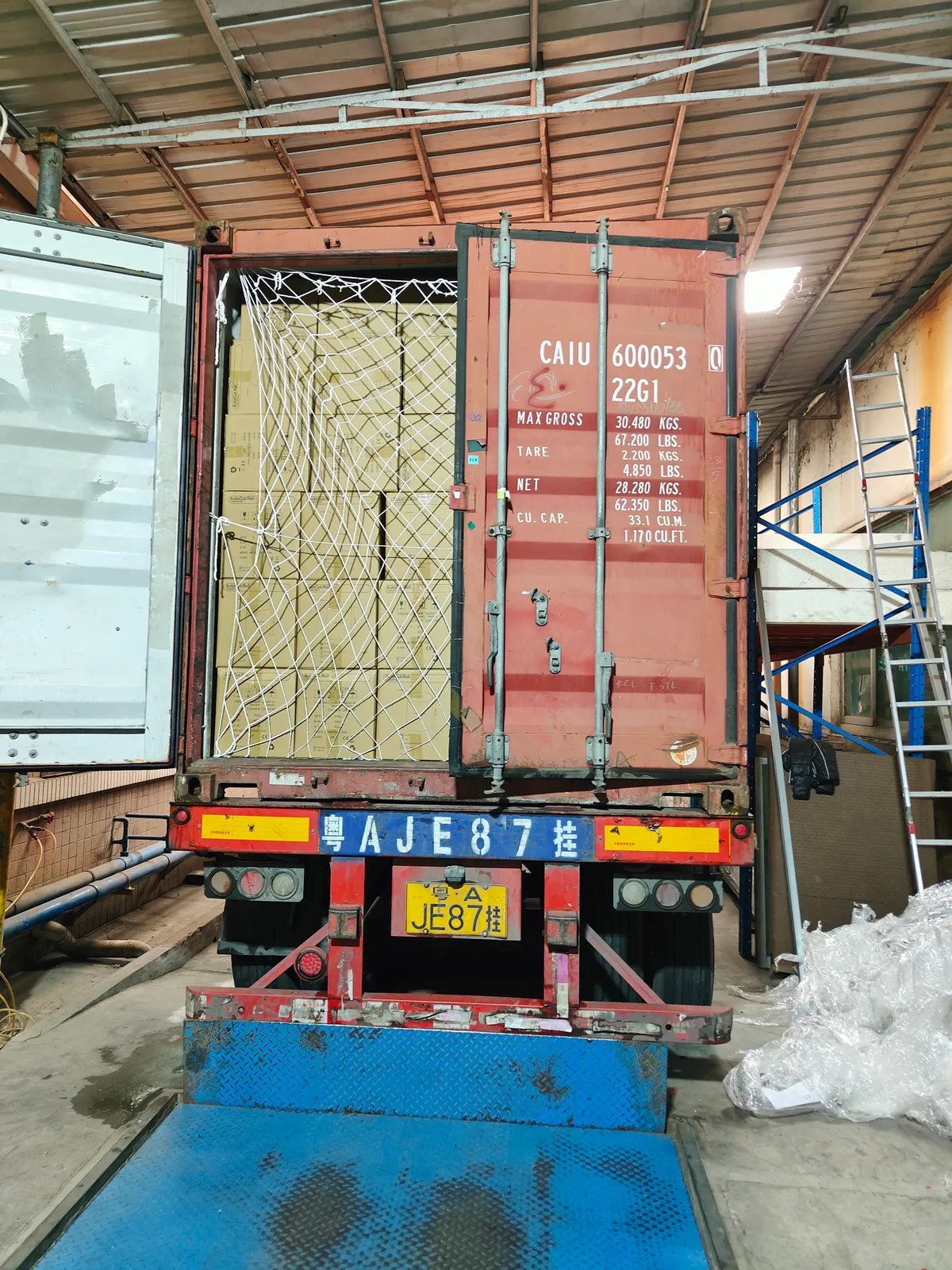
Why This Shipping Method
The total volume of the order was approximately 76 CBM, which exceeds the usable capacity of a single 40HQ container (roughly 58–60 CBM in practice). The customer had three options:
| Option | Container cost (approx.) | Usable volume | Fit |
|---|---|---|---|
| 2 × 40HQ | ~$4,200 | ~120 CBM | Overkill — paid for 44 CBM of empty space |
| 1 × 40HQ + 1 × 20GP | ~$3,400 | ~85 CBM | Fits the 76 CBM with margin |
| 1 × 40HQ + LCL remainder | ~$3,150 | ~58 + LCL | Cheaper but split the cargo into two streams |
The 40HQ + 20GP combination was selected as the most economical fit. A second 40HQ would have carried roughly 44 CBM of empty space that the customer still paid for. Shipping the remainder as LCL would have introduced a second consignment with its own consolidation delays and transshipment risk, which was not worth the roughly $250 saving for a customer who values predictable project delivery.
Sea freight was the appropriate mode: soap dispensers are non-urgent, high-volume consumer goods, and there was no commercial case for air freight at roughly 6–8 times the sea rate.
Shipping Process
Step 1 — Supplier consolidation
The dispensers came from several factories in the Foshan and Guangzhou area. All goods were delivered to a consolidation warehouse in the Nansha district, where they were inspected, counted against the packing list, and staged for loading. Each carton was marked with its destination SKU to keep the two containers' contents distinct.
Step 2 — Cargo allocation between the two containers
The key operational decision was how to split the cargo. The 40HQ was allocated the bulk of the bulky, lightweight wall-mounted models, while the 20GP took the denser countertop models and the heavier cartons. This balanced the weight and volume across both containers and kept each within its usable envelope — the 40HQ at ~52 CBM and the 20GP at ~24 CBM.
Step 3 — Container loading
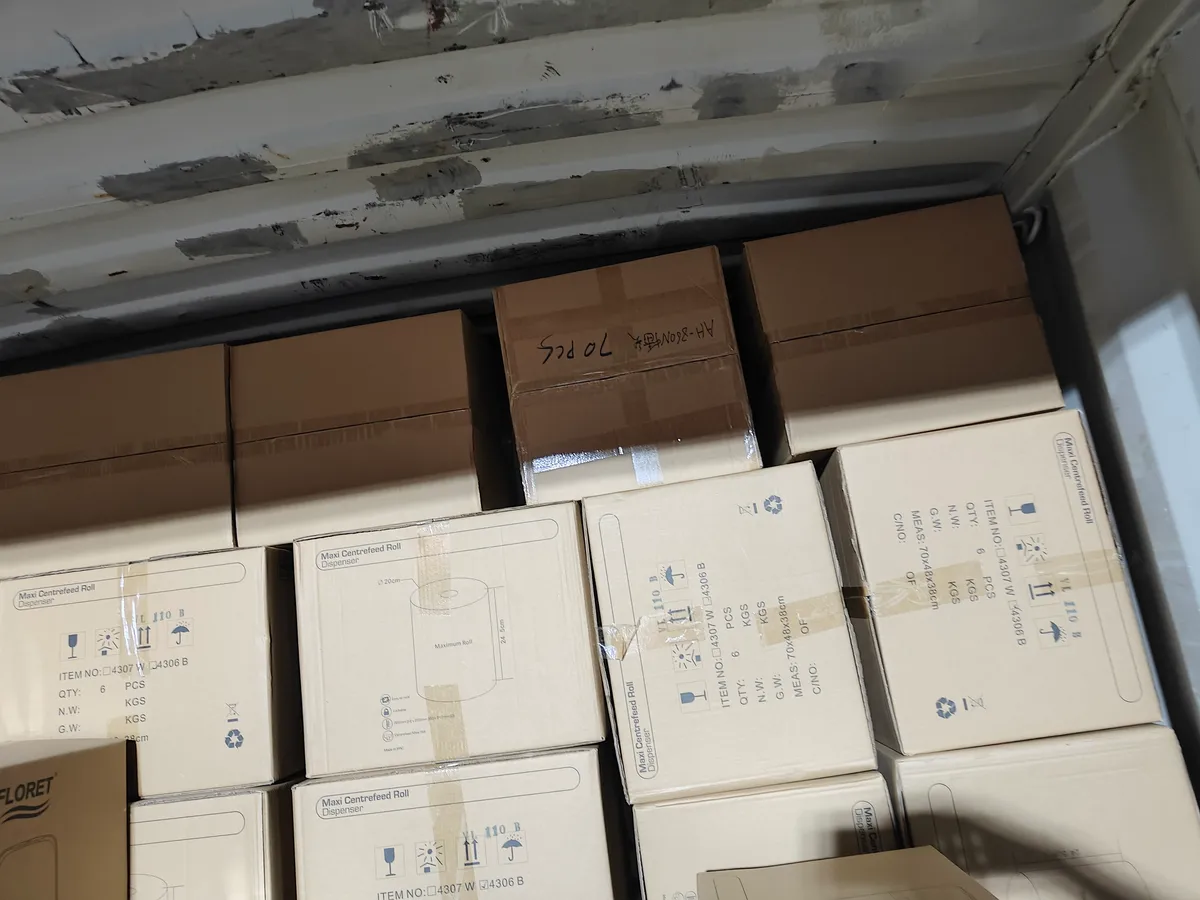
Loading took a full day for the two containers. The wall-mounted dispensers were stacked floor-to-roof in the 40HQ with cartons interlocked to prevent shifting. The 20GP was loaded with the countertop units packed tightly, with the heaviest cartons at the front. Both containers were sealed after a final count against the packing list.
Step 4 — Export customs clearance and vessel loading
Export customs clearance was handled in Nansha. Soap dispensers are not restricted goods for export from China; the process was routine and clearance was granted within one working day. Both containers were trucked to Nansha Port and loaded onto the same vessel.
Step 5 — Ocean freight and destination delivery
The vessel sailed from Nansha to Jeddah Islamic Port. Total transit time was approximately 16 days from departure to arrival. Upon arrival, the containers underwent Saudi customs inspection, the customer's broker handled the import declaration, and the goods were transferred to the customer's warehouse in Jeddah.
Challenges Encountered
1. Container size economics
The order exceeded a single 40HQ but did not justify two 40HQs. The challenge was to find the container combination that fit the cargo without paying for excessive empty space, while keeping the whole shipment on one vessel to avoid splitting delivery.
2. Weight and volume balance between containers
A 40HQ and a 20GP have very different envelopes — the 40HQ's strength is volume, the 20GP's is weight tolerance. Splitting the cargo incorrectly could have resulted in one container over-capacity and the other under-utilized, or in a 20GP overloaded against its weight limit.
3. Mixed model consolidation
With multiple SKUs from multiple suppliers, there was a risk of cartons being loaded into the wrong container or the wrong carton count being recorded, which would cause discrepancies at destination customs and delays in delivery.
How We Solved Them
For the container economics:
The cargo was profiled into volume and weight totals before any container was booked. With the order at ~76 CBM, the 40HQ + 20GP combination was confirmed as the lowest-cost option that kept the full shipment together on a single vessel. The $250 saving from shipping part as LCL was judged not worth splitting the consignment.
For the weight and volume balance:
The cartons were sorted by size and weight during consolidation. The bulky, low-density wall-mounted models were assigned to the 40HQ, which has the volume to absorb them; the denser countertop models and heaviest cartons were assigned to the 20GP. This kept the 40HQ at ~52 CBM / ~12,400 kg and the 20GP at ~24 CBM / ~5,600 kg — both within usable limits, neither over- or under-loaded by more than a few percent.
For mixed model consolidation:
Every carton was SKU-marked at the consolidation warehouse, and a container-by-container packing list was prepared before loading. The two containers were counted and sealed separately, so the destination broker received an accurate manifest for each. This kept the customs declaration clean and avoided any ambiguity at Jeddah.
Final Timeline
| Milestone | Date |
|---|---|
| Goods arrived at Nansha consolidation warehouse | March 3 |
| Inspection and container allocation | March 4 |
| Container loading (both containers) | March 5 |
| Export customs clearance | March 6 |
| Both containers loaded onto vessel, Nansha | March 8 |
| Arrival Jeddah Islamic Port | March 24 |
| Saudi customs clearance completed | March 26 |
| Delivery to customer warehouse, Jeddah | March 27 |
Total door-to-door transit time: 24 days
Final Cost
The total cost for this shipment was approximately $3,420, broken down as follows:
- Inland trucking and consolidation handling (Nansha): ~$310
- Ocean freight: 1×40HQ ~$1,580 + 1×20GP ~$820 = ~$2,400
- Container loading fees: ~$180
- Export customs clearance: ~$150
- Destination customs clearance and broker fees (Jeddah): ~$520
- Terminal handling charges (Jeddah): ~$180
- Delivery to warehouse in Jeddah: ~$180
The customer paid the ocean freight, inland trucking, and export-side charges to DTFU Logistics; destination-side charges were settled through their local broker.
Ocean freight rates on the Nansha–Jeddah route fluctuate with season and vessel utilization. The figures above reflect the rate at the time of booking (March 2026).
Customer Review
"The container split worked out well. The whole order arrived together, which matters for our project deliveries. We knew exactly which container held which models, and the count at our warehouse matched the packing list. The combination saved us the cost of a second 40HQ we didn't need."
— The customer's procurement manager, Jeddah
Lessons Learned
-
A 40HQ + 20GP combination is a common answer for mid-size orders. When volume sits between 55 and 85 CBM, this pairing usually beats two 40HQs and beats an FCL-plus-LCL split on reliability. Profiling the cargo by volume and weight before booking is the key first step.
-
Assign cargo to containers by density, not convenience. Bulky and light cargo belongs in the 40HQ, dense and heavy cargo in the 20GP. This balances both containers' envelopes and avoids the classic error of a volume-heavy 20GP or a weight-underused 40HQ.
-
Keep the two containers' contents distinct from the start. SKU marking and container-specific packing lists mean destination customs sees an accurate manifest for each box. This avoids queries and keeps delivery on schedule.
-
For project-sensitive customers, keeping the shipment on one vessel is worth paying for. The ~$250 saved by LCL-splitting was small relative to the delivery reliability the customer values.