Customer: Confidential (Spanish EV Infrastructure Company, Barcelona)
Route: Shanghai, China → Barcelona, Spain
Mode: Sea Freight — 1×20GP + 1×40HQ FCL (Two Full Container Loads)
Customer Background
Our customer is a Barcelona-based electric vehicle infrastructure company that supplies, installs, and maintains EV charging stations across Spain and southern Europe. They work with municipalities, commercial property developers, and retail chains to deploy public and semi-public charging networks.
As Spain's EV adoption accelerated — the country saw a 38% increase in EV registrations in 2025 — the customer needed to scale up their inventory of charging units quickly. They identified several Chinese manufacturers offering competitive pricing on both AC wallbox chargers (typically 7–22 kW) and DC fast chargers (60–180 kW). They had previous experience importing electronics from Asia but needed a reliable logistics partner for a larger consolidated order.
They contacted DTFU Logistics through our website and after an initial consultation, we proposed a full FCL solution to handle their volume.
Cargo Information
| Item | Details |
|---|---|
| Cargo | EV Charging Stations (AC wallbox units + DC fast chargers) |
| Containers | 1 × 20GP (General Purpose) + 1 × 40HQ (High Cube) |
| Total Units | ~480 units (420 AC wallboxes in 20GP; 60 DC fast chargers in 40HQ) |
| Total Weight | ~14,500 kg (20GP: ~4,200 kg / 40HQ: ~10,300 kg) |
| Total Volume | ~68 CBM combined |
| Origin | Shanghai, China (supplier factory in Jiading district) |
| Destination | Barcelona, Spain (customer warehouse in Zona Franca) |
| Incoterm | FOB Shanghai |
The AC wallbox chargers were compact units (roughly the size of a small briefcase) packed in individual cardboard boxes with foam inserts. The DC fast chargers were significantly larger — freestanding units approximately 1.8 m tall, 0.6 m wide, and 0.7 m deep, each weighing around 170 kg. These required special handling and crating.
Why This Shipping Method
The decision to use two separate containers (1×20GP + 1×40HQ) rather than a single 40HQ or LCL consolidation was driven by the cargo characteristics:
- Weight distribution: The DC fast chargers are heavy. Loading all 60 units (over 10 tons) plus the AC wallboxes into one 40HQ would have created an overweight container for road transport within Spain.
- Cargo segregation: The AC wallboxes are palletized cardboard boxes that can be stacked efficiently in a 20GP. The DC fast chargers needed individual wooden crating and extra headroom for forklift loading/unloading — the 40HQ's extra height was beneficial.
- Cost optimization: Using one 20GP + one 40HQ gave us the exact cubic capacity needed without paying for unused space in a single larger container.
- Better packing density: The two-container approach allowed us to optimize packing configurations separately for each cargo type.
We chose Shanghai as the port of loading because the manufacturer's factory is located in the Jiading district, less than 40 km from Shanghai's Yangshan Deep-Water Port, minimizing inland trucking costs.
Shipping Process
Step 1: Pre-Shipment Inspection & Documentation
Before loading, we arranged a third-party inspection at the factory to verify product specifications, quantities, and packaging quality. We also collected all required compliance documentation — critical for EU customs clearance of electronic goods.
Step 2: Packing & Container Loading
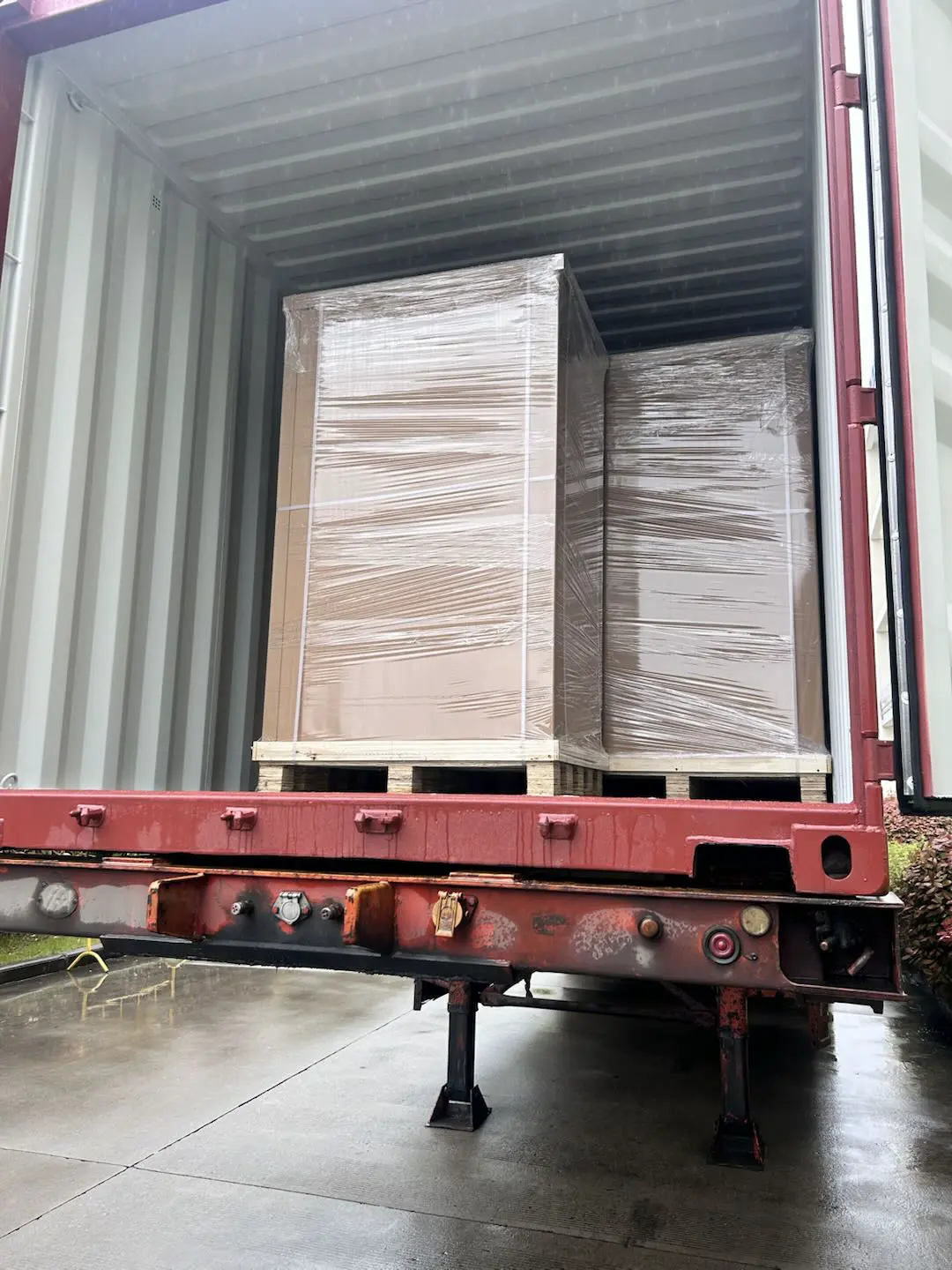
The AC wallbox chargers arrived at our nominated warehouse already palletized from the factory. Each pallet held 42 units, stacked 6 layers high with cardboard separators. Ten pallets were loaded into the 20GP container, achieving over 90% space utilization.
The DC fast chargers required individual wooden crates — each unit was bolted to a plywood base, wrapped in waterproof film, and enclosed with timber framing. These were loaded into the 40HQ container using a forklift, with 15 crates per row and 4 rows total. Airbags were placed between rows to prevent shifting during transit.
Step 3: Export Customs Clearance (China)
China export customs clearance was straightforward. We submitted the commercial invoice, packing list, bill of lading instructions, and certificate of origin. The EV chargers were classified under HS code 8504.40 (static converters), which required no special export permits.
Step 4: Main Carriage (Sea Freight)
Both containers were trucked to Shanghai Yangshan Port and loaded onto a direct vessel bound for Barcelona. The sea route crossed the South China Sea, transited the Strait of Malacca, crossed the Indian Ocean, and entered the Mediterranean via the Suez Canal.
Step 5: Import Customs Clearance (Spain)
Upon arrival at the Port of Barcelona, our local customs broker handled the import clearance. All EU compliance documentation was submitted through the Spanish customs electronic system (DUA).
Step 6: Final Delivery
After customs clearance, both containers were de-stuffed at the port terminal. The cargo was transferred to trucks for final delivery to the customer's warehouse in the Zona Franca district of Barcelona, less than 5 km from the port.
Challenges Encountered
1. CE Certification & EU Compliance Documentation
EV charging stations are regulated electronic products under the EU's Low Voltage Directive (2014/35/EU) and EMC Directive (2014/30/EU). Spanish customs required proof of CE conformity — including the EU Declaration of Conformity (DoC) and test reports from a notified body. The manufacturer initially provided incomplete documentation.
2. DC Fast Charger Crating & Weight
Each DC fast charger weighs ~170 kg. Standard wooden crates needed reinforced bases to support the weight during lifting and stacking. One crate shifted during loading and had to be rebuilt on-site.
3. Container Space Optimization
The 20GP container for AC wallboxes was relatively straightforward, but fitting 60 large DC fast charger crates into a 40HQ while maintaining safe weight distribution required careful planning. The crates varied slightly in dimensions between different charger models.
How We Solved Them
CE Documentation Solution
Our compliance team reviewed the manufacturer's documentation immediately after the order was confirmed — not at the last minute. We identified that the EU Declaration of Conformity was missing the reference standards and the test report was from a non-recognized lab. We worked with the manufacturer to obtain a corrected DoC referencing EN 61851-1 (the applicable standard for conductive charging systems) and arranged for the product to be tested at a TÜV Rheinland-accredited laboratory in Shanghai. The updated documents were ready before the vessel arrived in Barcelona, and our customs broker submitted them proactively.
Crating Solution
After the shifting incident during loading, we reinforced the remaining crates with cross-bracing on all four sides and added metal corner brackets. We also applied "Heavy Equipment — Lift with Forklift Only" labels on all crates. For the one damaged crate, the warehouse team opened it, inspected the charger (no damage found thanks to the internal foam padding), repacked it with additional bracing, and reloaded it.
Loading Solution
We created a detailed stowage plan with the warehouse team. The 40HQ was loaded in two sections: the first two rows contained the larger DC fast charger models (180 kW), and the next two rows held the smaller models (60 kW). This progressive weight distribution kept the container balanced. All crates were secured with lashing belts and airbags between rows. The final stowage achieved approximately 88% volume utilization.
Final Timeline
| Phase | Date | Duration |
|---|---|---|
| Pre-shipment inspection at factory | Day 1 | 1 day |
| AC wallbox palletizing & 20GP loading | Day 2 | 1 day |
| DC fast charger crating & 40HQ loading | Day 3 | 1 day |
| Export customs clearance (China) | Day 4 | 1 day |
| Trucking to Shanghai Yangshan Port | Day 5 | 1 day |
| Vessel departure from Shanghai | Day 6 | — |
| Sea freight (Shanghai → Barcelona, via Suez) | Day 6–31 | ~25 days |
| Vessel arrival at Port of Barcelona | Day 31 | — |
| Import customs clearance (Spain) | Day 31–34 | 3 days |
| De-stuffing & final delivery to Zona Franca warehouse | Day 34 | 1 day |
| Total | Day 1 → Day 34 | 34 days |
Final Cost
| Cost Item | Amount (USD) |
|---|---|
| Pre-shipment inspection (third-party) | $450 |
| Wooden crating for 60 DC fast chargers | $1,800 |
| Warehouse handling & container loading (both containers) | $600 |
| Trucking (factory Jiading → Shanghai port) | $350 |
| Export customs clearance (China) | $150 |
| Ocean freight — 1×20GP (Shanghai → Barcelona) | $1,250 |
| Ocean freight — 1×40HQ (Shanghai → Barcelona) | $1,850 |
| B/L documentation & handling fee | $120 |
| TÜV Rheinland testing & CE documentation support | $950 |
| Import customs clearance (Spain) | $500 |
| Port handling charges (Barcelona) | $680 |
| Customs inspection & compliance review fee | $300 |
| Inland delivery (Barcelona port → Zona Franca, 5 km) | $220 |
| Total | ~$9,220 |
Note: Costs are approximate and based on prevailing market rates at the time of shipment. EU import duties (tariffs under HS 8504.40) and Spanish VAT (21%) are excluded as they vary based on product classification and the customer's tax status.
Customer Review
"This was our largest single import order, and we needed it to go smoothly — our installation team had multiple project deadlines lined up. DTFU handled the complexity of two different container types, the heavy DC chargers, and the EU compliance paperwork without a hitch. The CE documentation issue was caught early, not at customs, which saved us weeks of delay. The entire shipment arrived in perfect condition, and our warehouse team was impressed by how well the crates were packed. We're already planning our next order through them."
— Operations Manager, Barcelona EV Infrastructure Company
Lessons Learned
-
CE compliance documentation for EV chargers must be reviewed early. EU customs regulations for electronic charging equipment are specific. Starting the compliance review immediately after the order is confirmed — rather than during transit — gives time to correct any gaps before the cargo arrives.
-
Heavy electronic equipment needs heavy-duty crating. For items over 150 kg per unit, standard timber crates are insufficient. Reinforced bases and cross-bracing are necessary, and the crating cost should be budgeted upfront.
-
Two smaller containers can be better than one large one. When cargo has mixed weight density (light palletized goods + heavy machinery), splitting into a 20GP and a 40HQ can optimize both weight distribution and loading efficiency.
-
Pre-shipment inspection is worth the cost. Catching packaging issues, quantity discrepancies, or labeling errors at the factory stage is far cheaper than dealing with them after the cargo has left China.
-
Spanish customs appreciate proactive compliance. Having a local broker submit all documentation in advance — including the CE DoC and test reports — significantly reduced clearance time at Barcelona port.
Ready to ship EV chargers or other electronics from China to Spain? Contact DTFU Logistics for a tailored shipping solution.