FOB
Term Summary
FOB (Free On Board) is a widely used Incoterms® 2020 trade term, applicable only to sea and inland waterway transport. Under FOB, the seller is responsible for loading the goods onto the vessel nominated by the buyer, after which all risks and costs transfer to the buyer. This article provides a comprehensive explanation of the FOB definition, details the specific responsibilities of both buyer and seller, clarifies their obligations in a comparison table, and outlines key considerations when using FOB. It aims to assist both buyers and sellers in correctly selecting and applying the FOB term in international trade.
What is FOB (Free On Board) in Incoterms®?
FOB (Free On Board) is one of the most widely used shipping terms outlined in the Incoterms® rules published by the International Chamber of Commerce (ICC). Under FOB, the seller fulfills their delivery obligation when the goods are loaded onto the vessel nominated by the buyer at the agreed port of shipment. From that point, all risks, costs, and responsibilities transfer to the buyer.
FOB is intended for use only with sea or inland waterway transport.
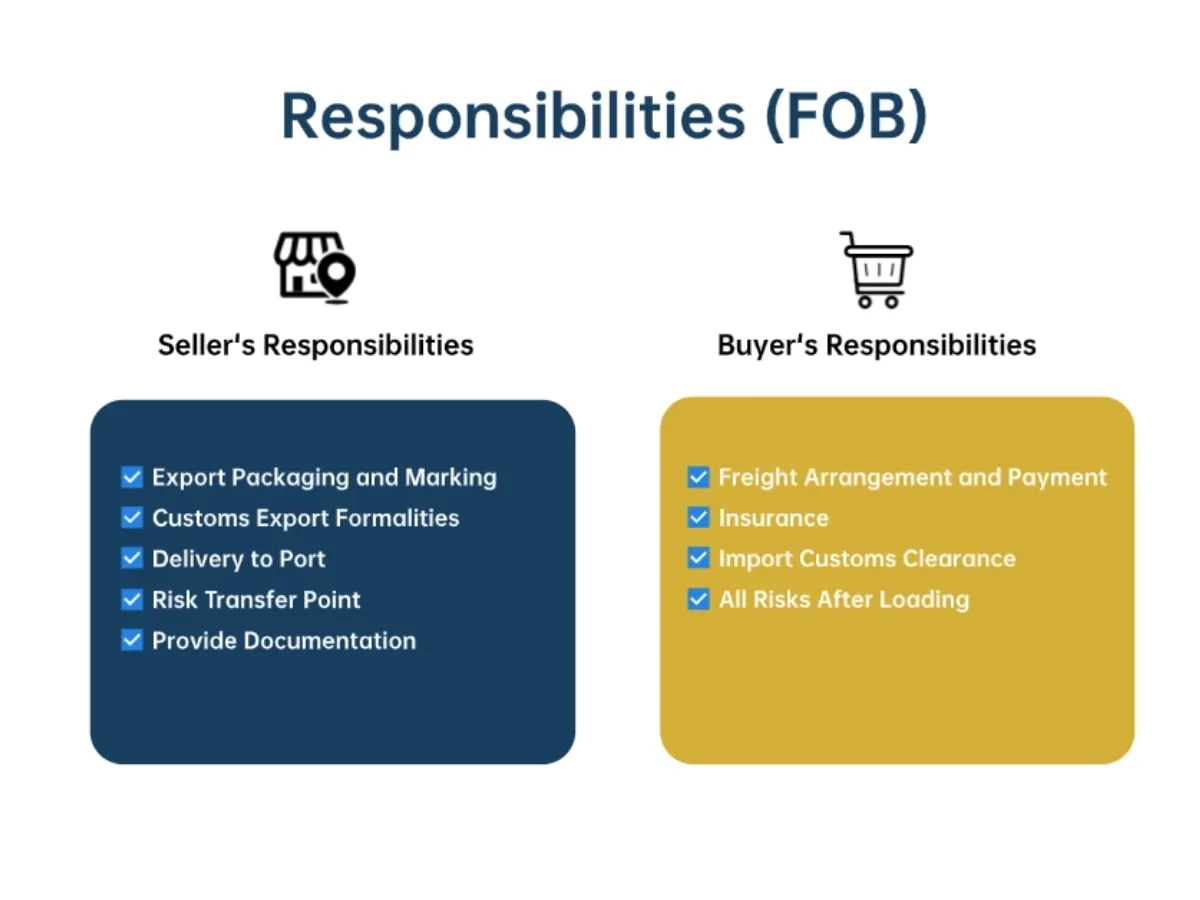
Seller’s Responsibilities (FOB)
- Export Packaging and Marking: Ensure the goods are packed and marked according to the contract and suitable for carriage.
- Customs Export Formalities: Obtain and pay for export licenses, permits, and complete all export customs clearance formalities.
- Delivery to Port: Deliver the goods to the agreed port of shipment and load them onto the vessel nominated by the buyer.
- Risk Transfer Point: Responsibility for the goods ceases once they are loaded on board the vessel.
- Provide Documentation: Issue commercial invoice and necessary transport or export documents to the buyer.
Buyer’s Responsibilities (FOB)
- Freight Arrangement and Payment: Select and contract the vessel, pay the main carriage (ocean freight), and any subsequent transportation.
- Insurance: Arrange cargo insurance from the point goods are loaded on board the vessel (optional, but recommended).
- Import Customs Clearance: Handle all import customs formalities, pay duties, taxes, and other clearance charges.
- All Risks After Loading: Assume all risks of loss or damage to the goods from the moment they are on board the vessel.
FOB Responsibilities Table
| Task / Costs | Seller | Buyer |
|---|---|---|
| Export packing & marking | ✔ | |
| Export customs clearance | ✔ | |
| Delivery to loading port | ✔ | |
| Loading on board vessel | ✔ | |
| Main carriage (ocean freight) | ✔ | |
| Cargo insurance | ✔ | |
| Import clearance & duties | ✔ | |
| Risk after vessel loading | ✔ |
Key Considerations When Using FOB
- Mode of Transport: FOB can only be used for sea freight or inland waterway transport. It is not suitable for air freight, rail, or road shipments. For non-sea/inland waterway scenarios, use FCA (Free Carrier) instead.
- Proof of On-board Delivery: The phrase "loaded on board the vessel" must be evidenced by the carrier's issued on-board bill of lading. Do not accept a “received for shipment” bill of lading, as this does not guarantee the goods have actually been loaded, which could lead to risk disputes.
- Communication Obligations: The buyer must inform the seller of the vessel, shipping schedule, and any relevant details in a timely manner. Conversely, the seller must promptly notify the buyer when goods are loaded. Any losses due to delayed notifications fall on the responsible party.
- Cost Allocation for Additional Services: If the seller is to cover additional costs after the goods are on board (such as stowage or trimming fees), these must be clearly stipulated in the sales contract—e.g., “FOB stowed and trimmed”.
Incoterms 2020: Core Points Comparison Table
| Term | Applicable Mode of Transport | Point of Risk Transfer | Seller's Responsibility | Buyer's Responsibility |
|---|---|---|---|---|
| EXW | Any mode | Upon delivery at seller’s premises | Only makes goods available; not responsible for transportation, clearance, or insurance | Responsible for all transportation, clearance, insurance costs, and risks |
| FCA | Any mode | Upon delivery to the carrier | Handles export clearance, delivers goods to carrier | Arranges transportation, pays all subsequent charges, assumes risk |
| CPT | Any mode | Upon delivery to the first carrier | Pays carriage to named destination, handles export clearance | Responsible for unloading at destination, import clearance, insurance costs, and risks |
| CIP | Any mode | Upon delivery to the first carrier | Pays carriage and insurance to named destination, handles export clearance | Responsible for unloading at destination, import clearance, assumes remaining risks |
| DAP | Any mode | Upon delivery at destination (not unloaded) | Bears costs and risks to the named destination, not responsible for unloading | Responsible for unloading, import clearance, and all related costs and risks |
| DPU | Any mode | After unloading at destination | Bears costs and risks for transportation and unloading at destination | Responsible for import clearance costs and risks |
| DDP | Any mode | Upon delivery at destination (duty paid) | Bears all costs (including import duties and taxes) and risks | Only needs to receive the goods |
| FOB | Sea / Inland waterway | When goods are loaded on board the vessel | Handles export clearance, pays loading charges | Arranges main carriage, pays freight and insurance, assumes risk post-loading |
| CFR | Sea / Inland waterway | When goods are loaded on board the vessel | Pays carriage to port of destination, handles export clearance | Handles insurance, import clearance, assumes risk after loading |
| CIF | Sea / Inland waterway | When goods are loaded on board the vessel | Pays carriage and insurance to destination port, handles export clearance | Responsible for import clearance, assumes risk after loading |
References
Ready to Ship?
Get your goods moving with our reliable freight forwarding services
Professional handling • Competitive rates • Global coverage