EXW
Term Summary
EXW (Ex Works) is a trade term under Incoterms® 2020, which means the seller only needs to make the goods available at their own premises. The buyer is responsible for all transportation, insurance, customs clearance, and risks after picking up the goods. This article mainly explains the definition of EXW, the specific responsibilities of both the buyer and seller, and which buyers EXW is suitable for, helping buyers choose the appropriate trade term.
What Is EXW (Ex Works) in Incoterms® 2020?
EXW (Ex Works) is one of the basic terms under the Incoterms® 2020 rules, published by the International Chamber of Commerce (ICC). EXW places the minimum obligation on the seller and the maximum responsibility on the buyer. It specifies that the seller fulfills their duty by making the goods available at their premises (factory, warehouse, etc.), while the buyer is responsible for all subsequent costs and risks.
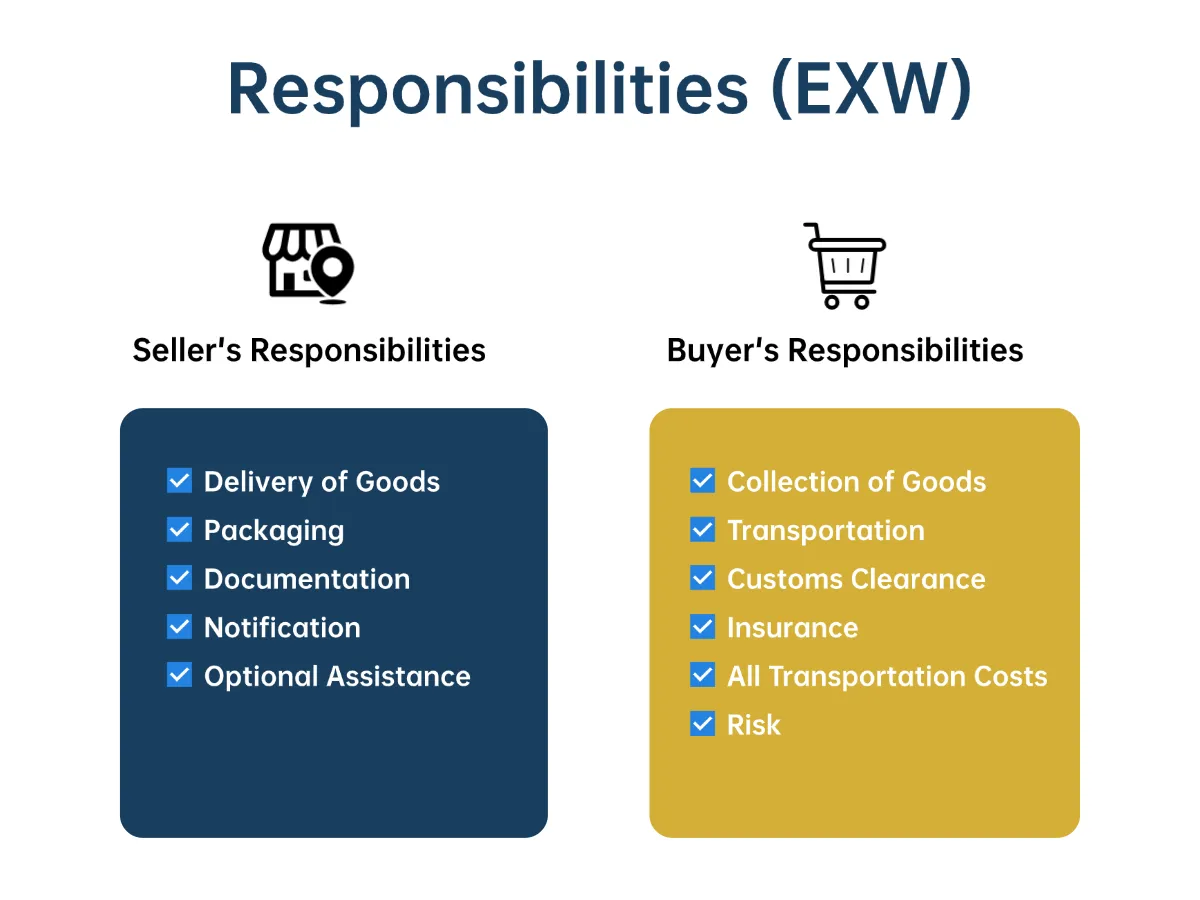
Seller’s Responsibilities
- Delivery of Goods: Provide goods at the agreed time and designated location, ensuring that they meet the contract’s specifications (such as quality and quantity).
- Packaging: Ensure the goods are packaged suitably for transport, taking into account the known mode of transport, destination, and other relevant requirements.
- Documentation: Issue the commercial invoice and any other necessary compliance documents (e.g., certificate of conformity).
- Notification: Inform the buyer of the specific time and place where the goods are ready for pick-up.
- Optional Assistance: Upon the buyer’s request, and at the buyer’s risk and expense, assist in obtaining export-related documents (such as licenses or permits).
Buyer’s Responsibilities
- Collection of Goods: Collect and take possession of the goods at the seller’s business premises or another specified location within the agreed timeframe.
- Transportation: Arrange and pay for all logistics costs from the collection point to the final destination (including road, sea, or air freight).
- Customs Clearance: Handle both export and import customs procedures, including the payment of applicable duties, taxes, and handling fees.
- Insurance: Arrange cargo insurance to cover transport risks.
- All Transportation Costs: Bear all expenses incurred after delivery, including loading charges, international freight, warehousing fees, inspection costs, etc.
- Risk: Assume all risks of loss or damage to the goods as soon as they are ready and placed at the buyer’s disposal by the seller.
EXW Responsibilities Table
| Task / Costs | Seller | Buyer |
|---|---|---|
| Prepare goods | ✔ | |
| Notify goods ready | ✔ | |
| Loading at seller’s premises | ✔ | |
| Export clearance | ✔ | |
| Main carriage (transport) | ✔ | |
| Import clearance and duties | ✔ | |
| Insurance | ✔ | |
| All risks after availability |
Key Notes
- Best for experienced buyers: EXW is ideal when buyers can handle all international logistics, documentation, and customs in the seller’s country.
- Risks for inexperienced buyers: If the buyer cannot efficiently manage export procedures, other Incoterms like FCA may be more suitable.
Incoterms 2020: Core Points Comparison Table
| Term | Applicable Mode of Transport | Point of Risk Transfer | Seller's Responsibility | Buyer's Responsibility |
|---|---|---|---|---|
| EXW | Any mode | Upon delivery at seller’s premises | Only makes goods available; not responsible for transportation, clearance, or insurance | Responsible for all transportation, clearance, insurance costs, and risks |
| FCA | Any mode | Upon delivery to the carrier | Handles export clearance, delivers goods to carrier | Arranges transportation, pays all subsequent charges, assumes risk |
| CPT | Any mode | Upon delivery to the first carrier | Pays carriage to named destination, handles export clearance | Responsible for unloading at destination, import clearance, insurance costs, and risks |
| CIP | Any mode | Upon delivery to the first carrier | Pays carriage and insurance to named destination, handles export clearance | Responsible for unloading at destination, import clearance, assumes remaining risks |
| DAP | Any mode | Upon delivery at destination (not unloaded) | Bears costs and risks to the named destination, not responsible for unloading | Responsible for unloading, import clearance, and all related costs and risks |
| DPU | Any mode | After unloading at destination | Bears costs and risks for transportation and unloading at destination | Responsible for import clearance costs and risks |
| DDP | Any mode | Upon delivery at destination (duty paid) | Bears all costs (including import duties and taxes) and risks | Only needs to receive the goods |
| FOB | Sea / Inland waterway | When goods are loaded on board the vessel | Handles export clearance, pays loading charges | Arranges main carriage, pays freight and insurance, assumes risk post-loading |
| CFR | Sea / Inland waterway | When goods are loaded on board the vessel | Pays carriage to port of destination, handles export clearance | Handles insurance, import clearance, assumes risk after loading |
| CIF | Sea / Inland waterway | When goods are loaded on board the vessel | Pays carriage and insurance to destination port, handles export clearance | Responsible for import clearance, assumes risk after loading |
Source: ICC Incoterms® 2020 – EXW Rule
Ready to Ship?
Get your goods moving with our reliable freight forwarding services
Professional handling • Competitive rates • Global coverage