FCA
Term Summary
FCA (Free Carrier) is an Incoterms® 2020 rule used in international trade for any mode of transport. Under FCA, the seller delivers export-cleared goods to the buyer's carrier at a specified location, transferring risk at that point. This article summarizes how FCA works, the responsibilities of each party, and how it affects the allocation of costs and risks in global trade.
FCA (Free Carrier) – Incoterms® 2020 Explained
FCA (Free Carrier) is one of the most flexible and commonly used Incoterms® 2020 rules established by the International Chamber of Commerce (ICC) for global trade. Under FCA, the seller fulfills their delivery obligation when the goods, cleared for export, are handed over to the carrier or another party nominated by the buyer at a named place—either the seller’s premises (e.g., factory or warehouse) or another agreed location (such as a port, terminal, or freight forwarder’s facility).
Key Features of FCA:
- Applicable to all modes of transport—sea, air, rail, road, multimodal, or a combination thereof.
- Clearly defines the delivery point, which determines the transfer of risk from seller to buyer.
Seller’s Responsibilities under FCA
- Export Packaging & Marking: Properly pack and mark the goods as per the contract.
- Customs Export Clearance: Obtain export licenses, complete export customs formalities, and pay any related charges.
- Delivery to Carrier/Nominated Party: Hand over the goods at the agreed place on the agreed date/time, either at the seller’s premises or another specified location.
- Provide Documents: Issue commercial invoice and any transport or export documents as agreed in the contract.
- Risk Transfer: The risk shifts to the buyer once the goods are delivered to the carrier or nominated party.
Buyer’s Responsibilities under FCA
- Carrier Selection & Contract: Appoint and contract the main carrier for further transportation.
- Freight Payment: Pay for main carriage, insurance (optional), and all subsequent transport costs after the handover point.
- Import Customs Clearance: Handle all import customs formalities, duties, taxes, and fees at the destination.
- All Risks After Delivery: Bear all risks of loss or damage after the seller delivers the goods to the carrier/nominated party.
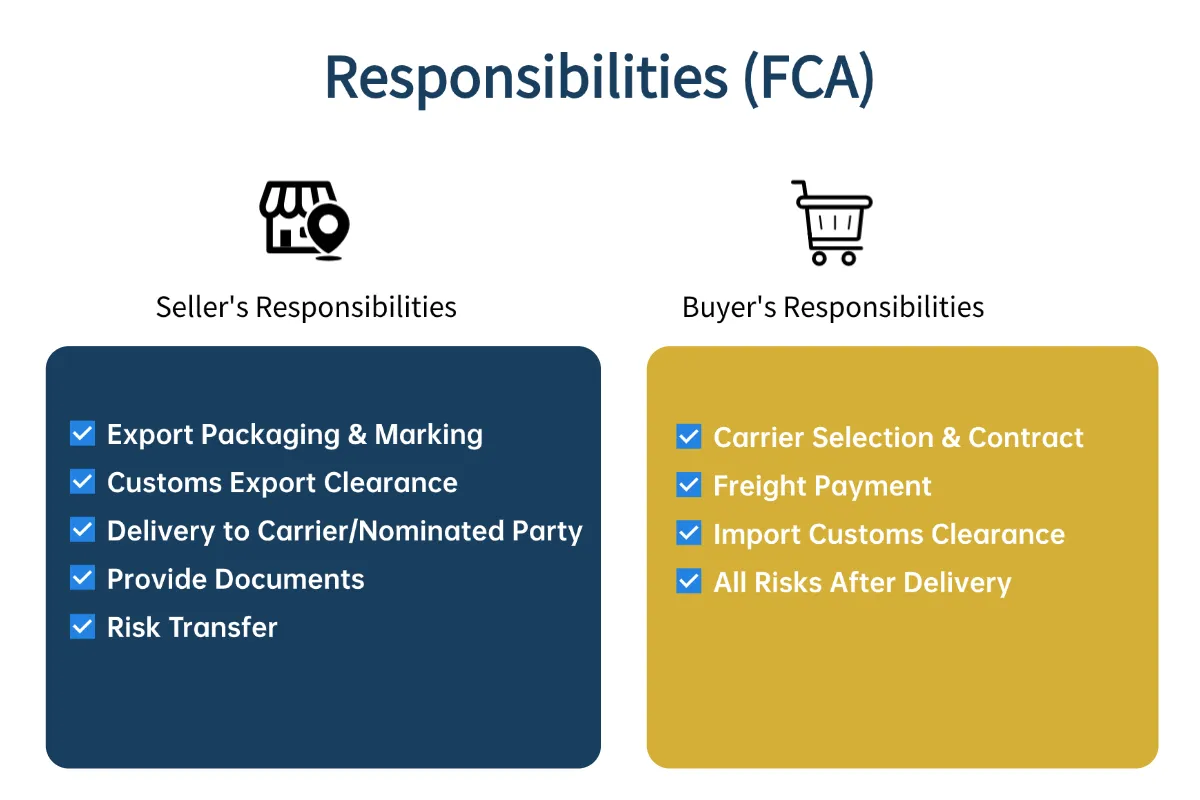
FCA Responsibilities Table
| Task / Costs | Seller | Buyer |
|---|---|---|
| Export packing & marking | ✔ | |
| Export customs clearance | ✔ | |
| Delivery to carrier/location | ✔ | |
| Main carriage/freight | ✔ | |
| Cargo insurance (optional) | ✔ | |
| Import customs & duties | ✔ | |
| Risk after carrier handover | ✔ |
FCA is particularly suitable for containerized cargo, multimodal shipments, or where the buyer wishes to control the main transport contract. It offers transparency in risk transfer and cost allocation, making it one of the most preferred Incoterms® for international traders.
Incoterms 2020: Core Points Comparison Table
| Term | Applicable Mode of Transport | Point of Risk Transfer | Seller's Responsibility | Buyer's Responsibility |
|---|---|---|---|---|
| EXW | Any mode | Upon delivery at seller’s premises | Only makes goods available; not responsible for transportation, clearance, or insurance | Responsible for all transportation, clearance, insurance costs, and risks |
| FCA | Any mode | Upon delivery to the carrier | Handles export clearance, delivers goods to carrier | Arranges transportation, pays all subsequent charges, assumes risk |
| CPT | Any mode | Upon delivery to the first carrier | Pays carriage to named destination, handles export clearance | Responsible for unloading at destination, import clearance, insurance costs, and risks |
| CIP | Any mode | Upon delivery to the first carrier | Pays carriage and insurance to named destination, handles export clearance | Responsible for unloading at destination, import clearance, assumes remaining risks |
| DAP | Any mode | Upon delivery at destination (not unloaded) | Bears costs and risks to the named destination, not responsible for unloading | Responsible for unloading, import clearance, and all related costs and risks |
| DPU | Any mode | After unloading at destination | Bears costs and risks for transportation and unloading at destination | Responsible for import clearance costs and risks |
| DDP | Any mode | Upon delivery at destination (duty paid) | Bears all costs (including import duties and taxes) and risks | Only needs to receive the goods |
| FOB | Sea / Inland waterway | When goods are loaded on board the vessel | Handles export clearance, pays loading charges | Arranges main carriage, pays freight and insurance, assumes risk post-loading |
| CFR | Sea / Inland waterway | When goods are loaded on board the vessel | Pays carriage to port of destination, handles export clearance | Handles insurance, import clearance, assumes risk after loading |
| CIF | Sea / Inland waterway | When goods are loaded on board the vessel | Pays carriage and insurance to destination port, handles export clearance | Responsible for import clearance, assumes risk after loading |
References:
Ready to Ship?
Get your goods moving with our reliable freight forwarding services
Professional handling • Competitive rates • Global coverage