CPT
Term Summary
CPT (Carriage Paid To) is an Incoterms® 2020 rule applicable to all modes of transport. Under CPT, the seller is responsible for arranging and paying the main freight to a named destination, while the risk transfers to the buyer once the goods are handed over to the first carrier. This article outlines the definition of CPT, its key features, and clearly explains the respective responsibilities of both seller and buyer throughout the shipping process.
CPT means the seller fulfills delivery when the goods are handed over to the first carrier (such as a freight forwarder, shipping line, or airline) at the agreed location. The seller must arrange and pay for the main carriage to the named place of destination under a contract of carriage. However, risk transfers to the buyer once goods are delivered to the first carrier, and any subsequent costs (such as destination unloading, import-related fees) are borne by the buyer.
Key Features
- No limitation on transport mode: Applies to any form of transport, including multimodal and cross-border combinations—unlike sea-exclusive terms.
- Separation of risk and cost: Risk passes to the buyer “when goods are handed to the first carrier,” but the seller pays the main carriage to the destination (the seller’s cost responsibility extends beyond the risk transfer point).
- Specificity of “destination”: Contracts must specify the exact destination (e.g., “CPT Paris Warehouse” or “CPT New York Port”), which is the endpoint for the seller’s freight payment.
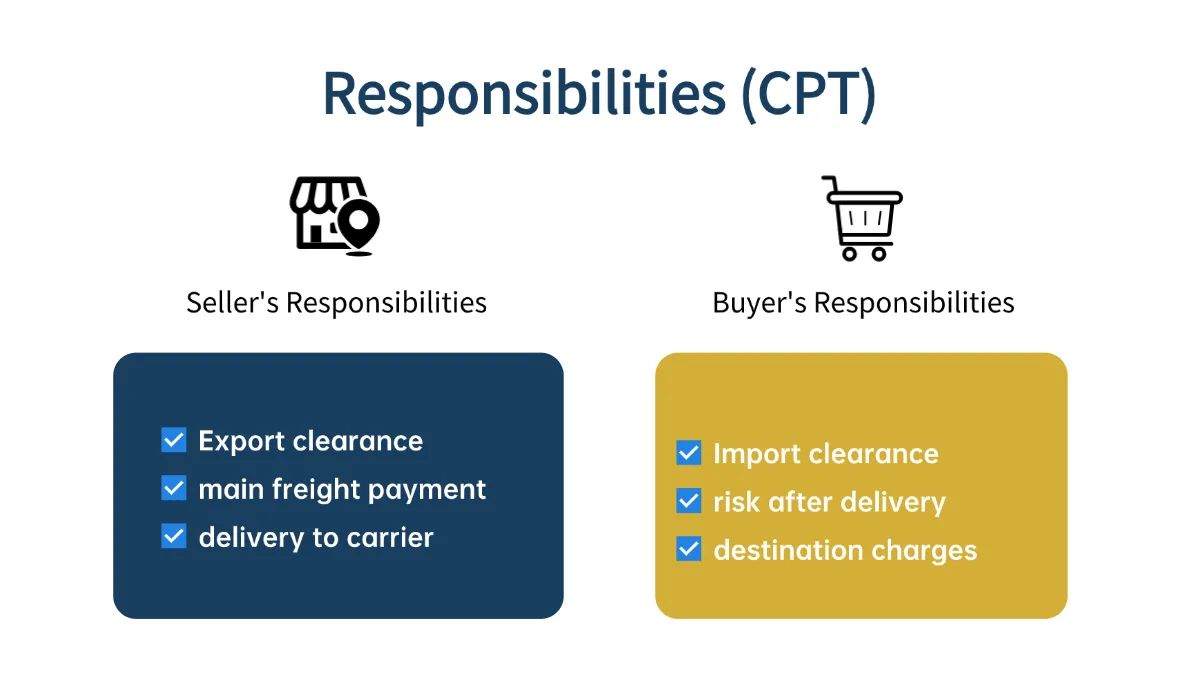
Seller’s Responsibilities (CPT)
- Delivery and Risk Transfer: Deliver goods compliant with the contract to the first carrier (or its agent) at the agreed time and place; risk transfers to the buyer upon handover.
- Arrange and Pay Freight: Enter into a contract of carriage and pay the regular freight (including basic fee and standard surcharges) to move the goods from the delivery point to the agreed destination.
- Export Formalities: Handle export customs clearance, pay export duties, taxes, and related fees (such as customs clearance fees, inspection fees), and obtain required export documents (e.g., export declaration, Certificate of Origin).
- Packaging and Marking: Ensure the goods are packed for the chosen transport mode and marked appropriately (marks, labels, destination).
- Notification and Documentation: Notify the buyer that the goods have been delivered to the carrier, and provide essential documents such as the commercial invoice and transport document (bill of lading, airway bill).
- No Insurance Obligation: Unless expressly agreed in the contract, the seller is not required to obtain cargo insurance (key difference from CIP).
Buyer’s Responsibilities (CPT)
Receipt of Goods and Documents: Receive the goods at the destination and accept the transport documents issued by the seller; pay the contract price of the goods.
Assume Subsequent Risks: From the moment goods are delivered to the first carrier, bear the risk of loss, damage, or delay (including in-transit accidents).
Pay Additional Costs: Bear all costs not included in the seller’s freight, such as:
- Storage fees, demurrage, or additional transportation surcharges after handover;
- Destination unloading charges, import customs duties, and other taxes/fees.
Import Compliance: Handle import customs formalities and obtain necessary import licenses or documents.
Arrange Own Insurance: Since the seller has no obligation to insure, the buyer should purchase their own cargo insurance if protection is required.
Key Points to Note
- Main Difference from CIP: Under CPT, the seller is not required to insure the cargo, while under CIP, the seller must purchase insurance of "minimum cover" for the buyer; choose CIP if buyer wishes for insurance to be included.
- Scope of Freight: The seller pays only the “regular freight to the named destination.” Any extraordinary costs (e.g., demurrage due to buyer’s delay) should be explicitly clarified in the contract.
- Multimodal Suitability: Since the “first carrier” may involve various stages of carriage, CPT is well-suited for multimodal transport, especially for arrangements outside “port-to-port” or “door-to-door” basics.
The key value of CPT lies in: “The seller arranges main transport and pays for it, while the buyer assumes subsequent risk and import responsibilities.” This structure is widely used in cross-border e-commerce and industrial shipments that require complex, multi-leg transport.
Incoterms 2020: Core Points Comparison Table
| Term | Applicable Mode of Transport | Point of Risk Transfer | Seller's Responsibility | Buyer's Responsibility |
|---|---|---|---|---|
| EXW | Any mode | Upon delivery at seller’s premises | Only makes goods available; not responsible for transportation, clearance, or insurance | Responsible for all transportation, clearance, insurance costs, and risks |
| FCA | Any mode | Upon delivery to the carrier | Handles export clearance, delivers goods to carrier | Arranges transportation, pays all subsequent charges, assumes risk |
| CPT | Any mode | Upon delivery to the first carrier | Pays carriage to named destination, handles export clearance | Responsible for unloading at destination, import clearance, insurance costs, and risks |
| CIP | Any mode | Upon delivery to the first carrier | Pays carriage and insurance to named destination, handles export clearance | Responsible for unloading at destination, import clearance, assumes remaining risks |
| DAP | Any mode | Upon delivery at destination (not unloaded) | Bears costs and risks to the named destination, not responsible for unloading | Responsible for unloading, import clearance, and all related costs and risks |
| DPU | Any mode | After unloading at destination | Bears costs and risks for transportation and unloading at destination | Responsible for import clearance costs and risks |
| DDP | Any mode | Upon delivery at destination (duty paid) | Bears all costs (including import duties and taxes) and risks | Only needs to receive the goods |
| FOB | Sea / Inland waterway | When goods are loaded on board the vessel | Handles export clearance, pays loading charges | Arranges main carriage, pays freight and insurance, assumes risk post-loading |
| CFR | Sea / Inland waterway | When goods are loaded on board the vessel | Pays carriage to port of destination, handles export clearance | Handles insurance, import clearance, assumes risk after loading |
| CIF | Sea / Inland waterway | When goods are loaded on board the vessel | Pays carriage and insurance to destination port, handles export clearance | Responsible for import clearance, assumes risk after loading |
Reference:
Ready to Ship?
Get your goods moving with our reliable freight forwarding services
Professional handling • Competitive rates • Global coverage